
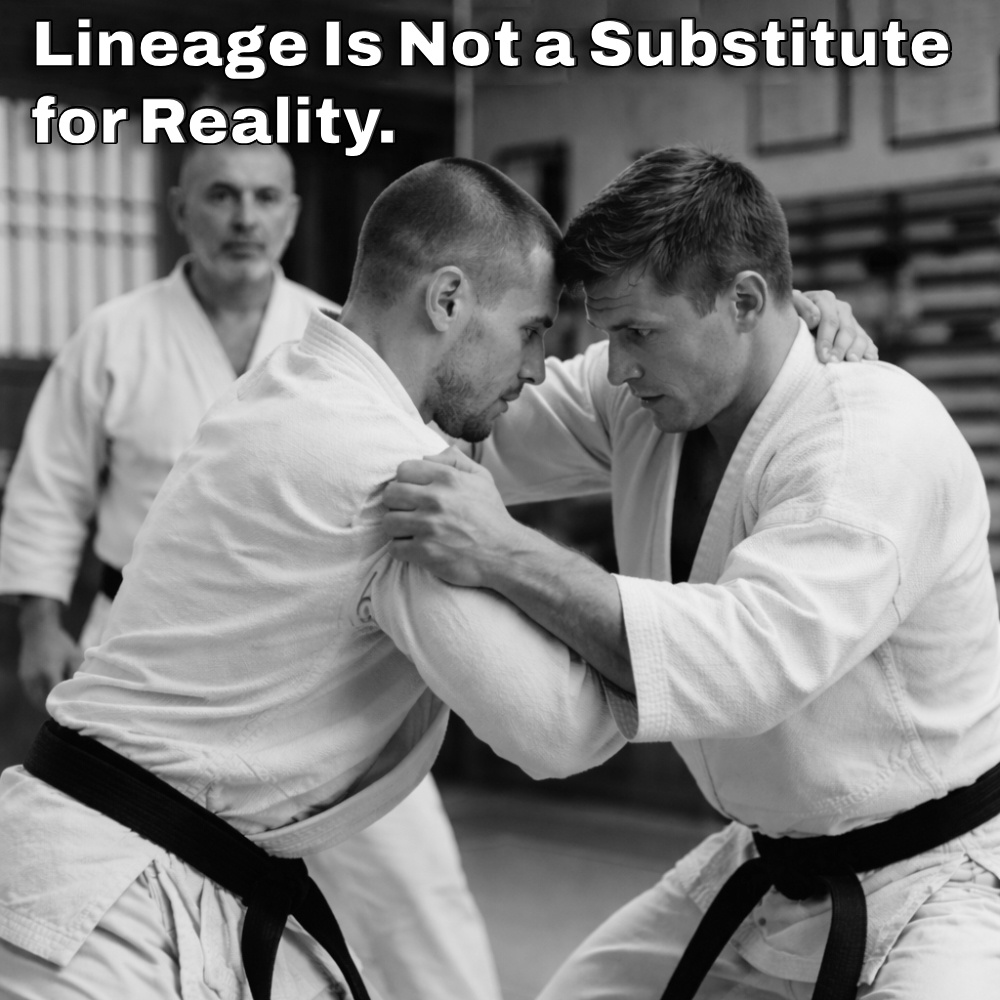
I’ve seen a series of so-called self-defense demonstrations doing the rounds on social media recently. They’re being promoted under the banner of a well-known karate lineage.
So what? You might say.
Well, it matters.
Because when a respected name is attached to something, people assume credibility. They assume it must be solid.
But that is exactly where we need to think for ourselves.
In the martial arts, authority is often inherited by association. If someone is connected to a well-known master, the public tends to transfer that credibility automatically. No questions asked.
The problem is this: lineage preserves tradition. It doesn’t automatically prove understanding of violence.
Those are two very different things.
When something is presented as self-defense, that’s not just a label. It’s a claim. And claims carry responsibility.
If you say what you’re teaching is self-defense, then it should have been tested against resistance. Against unpredictability. Against someone who doesn’t cooperate. Against fear. Against confusion. Against the fact that real assaults don’t happen at a polite distance.
One of the principles I return to often is simple:
Training value depends on whether it matches the realities a person is actually likely to face.
In other words context.
If what is shown does not resemble chaos, hesitation, resistance, emotional escalation, then we are not looking at preparation. We are looking at performance.
When I see demonstrations where attackers move one at a time, freeze the moment a technique lands, or fall to the ground in line with the script, that isn’t chaos. It’s choreography.
And choreography is agreement. Agreement is not assault.
Someone watching that clip may honestly believe they are seeing something that will protect them. They may assume that because a respected name stands behind it, the methods must be reliable.
They may never question it. They may never pressure test it.
Until one day pressure arrives anyway.
When I was younger, I was technically capable. Competitive. Confident. I had sharp skills. I had composure in controlled fights. And yes – a creditable lineage behind me.
And then I found out, the hard way, that chaos in the real world does not behave like competition.
That lesson did me good. It stripped away illusion. It forced humility. It made me ask better questions.
Respect for tradition is important. I have it. I value it. But respect should never become insulation from scrutiny.
If we use the term “self-defense”, then reality has to be the standard. A high standard. Not heritage. Not reputation. Not banner names.
Lineage is inherited.
But inheritance is not understanding.
When someone stands close to the source of a system – when they carry a respected name, and perhaps one day may carry the responsibility of leading it – what has been passed down to them deserves more than preservation.
It deserves to be understood at depth. Especially if it’s presented as self-defense. Because self-defense is not a symbolic inheritance. It’s not a tribute to history.
It’s a claim about what will function when someone is frightened, resisting, unpredictable, and not cooperating.
If inherited material is going to be shown as protection, then it must withstand scrutiny. It must survive pressure. It must be examined honestly against the realities it claims to address.
Not to diminish what was passed down, but to honor it properly.
Lineage carries history.
And in self-defense, responsibility means testing what you have inherited against the realities it claims to address.