
Karate doesn’t fail people – unclear goals do.
My page is predominantly about practical, pragmatic karate. It says so right at the top. So naturally, everything I write comes from that context.
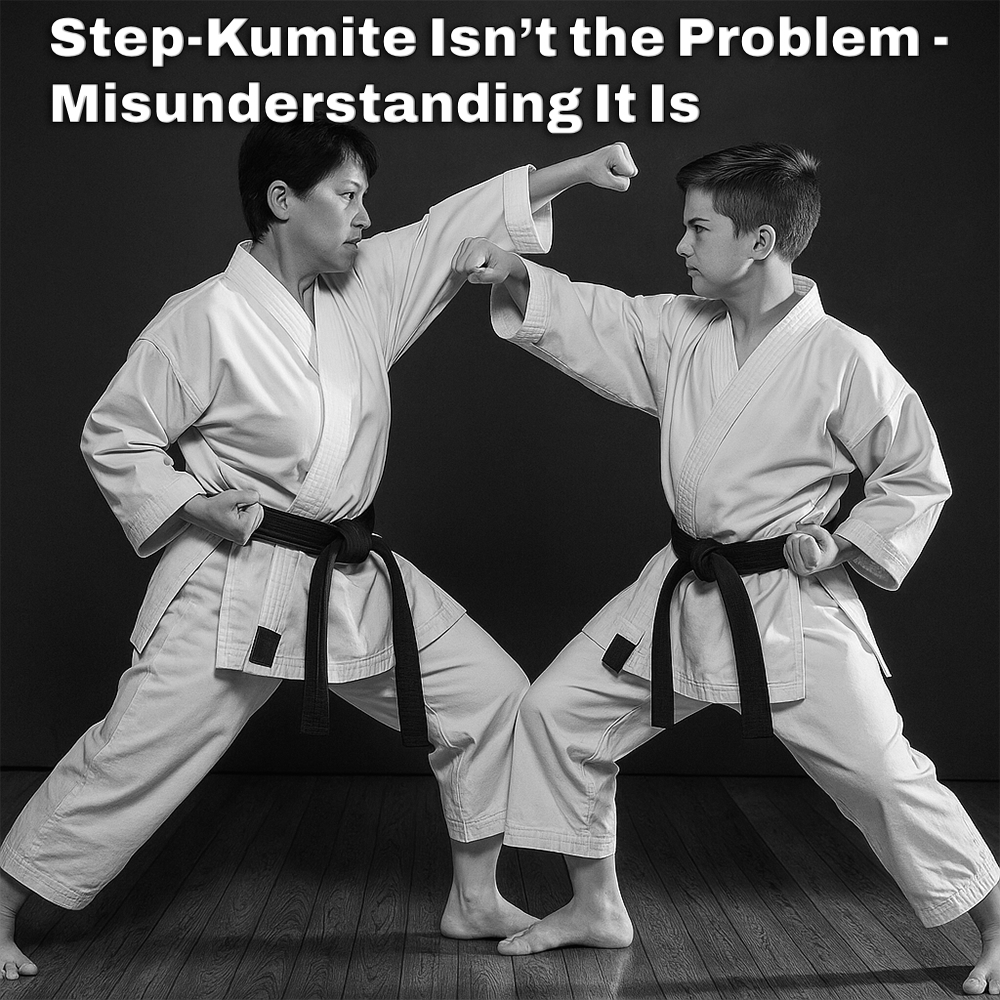
And from that perspective, something all of us have had to practice and learn at one time in our karate journey – step-kumite – has never really made sense to me.
Let’s look at one of the recurring points that often comes up – that step-kumite is fine for lower-level students and helps with progression.
The majority of karate taught today emphasizes defensive tactics first. You’re trained to block and then follow up with a counter. This method is everywhere – in kihon, in step-kumite drills, and in how kata is often interpreted.
From your very first class, you’re shown how to hard block and counter. And in step-kumite, this becomes the habit you’re building – a consensual exchange.
I don’t like it in the context I teach and train in. It’s ineffective for my goals. And it has very little relevance to the real world.
A reaction, by nature, comes after an action. That means delay – and more importantly, it means mental processing, where your mind is busy catching up.
In my view, the traditional block-and-counter approach is less practical when dealing with real threats.
You have to take the initiative – respond before the attack fully develops and take control. It’s faster to act than it is to react.
Someone recently mentioned teaching step-kumite at different levels to assist with progression.
So the question is still the same – why?
In my opinion, this approach is fundamentally flawed.
Let me explain why I think like this.
The distancing is wrong. The timing is wrong. Attacks don’t start from six feet away. Blocking is slower than preemption. No one steps back repeatedly while blocking and eventually counters. Violence happens at close range. Hands are inactive. There will be ferocity and rage. Any attack will likely be a distraction. I could go on.
This kind of training is poor progressive training – because it doesn’t actually progress. The timing and distancing only exist within that drill. You never see that kind of exchange in sparring or in real self-defense.
It’s also poor compliant training. It only works if your partner does exactly what they’re told. It’s reliant on cooperation – and has no real value in a broader training context. There’s nothing about it that survives once compliance is removed.
We can, and should, use pre-arranged drills that reflect real fighting and self-defense – drills that teach proper distancing, realistic timing, and sound tactics – and that can be scaled up to semi-live and live work without having to reinvent the wheel.
So why do we still practice step-kumite? I’ve seen very senior practitioners and teachers practice this over and over.
If the goal is structure, or if the goal is tradition, then say that. But if the goal is self-protection, then it needs to be questioned.
If you choose to practice it for fun or for tradition, that’s your decision. But as always – train with the right context in mind.
For me, and for the objectives of my training – it’s a waste of time at any level.