
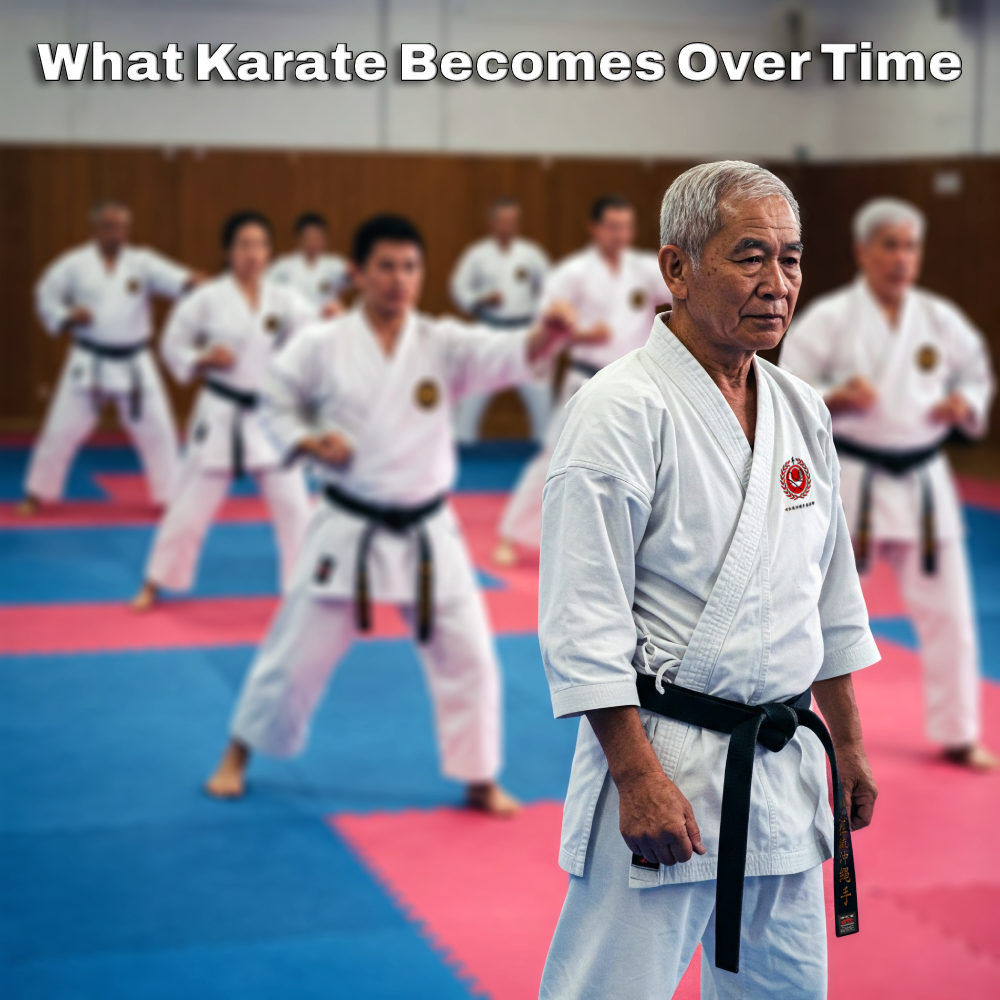
People often associate practical karate with fighting, self-defense, and physical confrontation. That is understandable. Much of my own writing over the years has focused on practical application, violence, realism, and the realities surrounding self-protection.
Those things matter.
But after more than fifty years of training, I have come to realize that karate eventually becomes something more than preparation for conflict.
If a person stays long enough, trains sincerely long enough, and continues through all the different stages of life, karate slowly changes its role. What may begin as self-defense, physical challenge, or even youthful competition, gradually becomes part of how a person maintains themselves physically, mentally, and emotionally.
Without even noticing it happening, the training becomes woven into life itself.
When I was younger, much of karate was naturally about proving myself physically. Like many young men, I was drawn to competition, conditioning, toughness, then to application, pressure, and realism. Those things still matter to me today because I believe karate should be honest about violence and honest about its purpose.
But time changes perspective.
As the decades pass, you begin to notice something else quietly happening beneath the surface. The training keeps you moving. It maintains coordination, mobility, balance, and discipline. It gives structure to difficult periods of life and continuity during uncertain times. Motivation fades, but routine remains.
Karate becomes less about occasional moments of conflict and more about maintaining yourself through life.
For many people outside the arts, health is reduced to exercise alone. But long-term training affects more than muscles and cardiovascular fitness. It affects focus, emotional control, patience, resilience, and how a person handles adversity. Training can calm the mind just as much as strengthen the body.
That does not mean karate is magical, nor does practice automatically make someone wise, balanced, or healthy. I have trained long enough to know that the martial arts can sometimes inflate the ego just as easily as refine the person.
Long-term karate training does not guarantee a good character.
Over the years, I have known practitioners who embodied humility, integrity, and quiet discipline. People who trained sincerely, helped others, and never needed constant recognition or validation. Their karate became part of who they were, not something performed for attention.
I have also seen the opposite.
I have seen people consumed by titles, status, ego, and ambition. I have seen recognition pursued faster than understanding. I have seen dojos built over decades damaged by dishonesty, greed, or self-interest. In some cases, the very values that once held a dojo together slowly disappear once ego becomes more important than responsibility.
That is one of the difficult truths long-term training eventually reveals.
Karate does not create a good character automatically. It simply magnifies what’s already there if a person is unwilling to confront themselves honestly.
Perhaps that is why many people expect more from martial artists. Not perfection, because nobody is perfect, but at least some degree of maturity, humility, honesty, and self-control. Especially from senior practitioners. Skill without character eventually becomes hollow.
For me personally, karate has become less about proving anything and more about continuing the journey itself. The older I get, the more I appreciate simply being able to train, move, teach, learn, and remain part of something that has accompanied me for over half a century.
The benefits are no longer measured only in fighting ability.
They are measured in longevity, discipline, clarity, routine, resilience, and the ability to keep going through life without completely losing yourself to bitterness, ego, or stagnation.
Practical self-defense may bring many people into karate.
But for those who remain long enough, karate often becomes something quieter and far deeper than that.
It simply becomes part of how we continue living.