
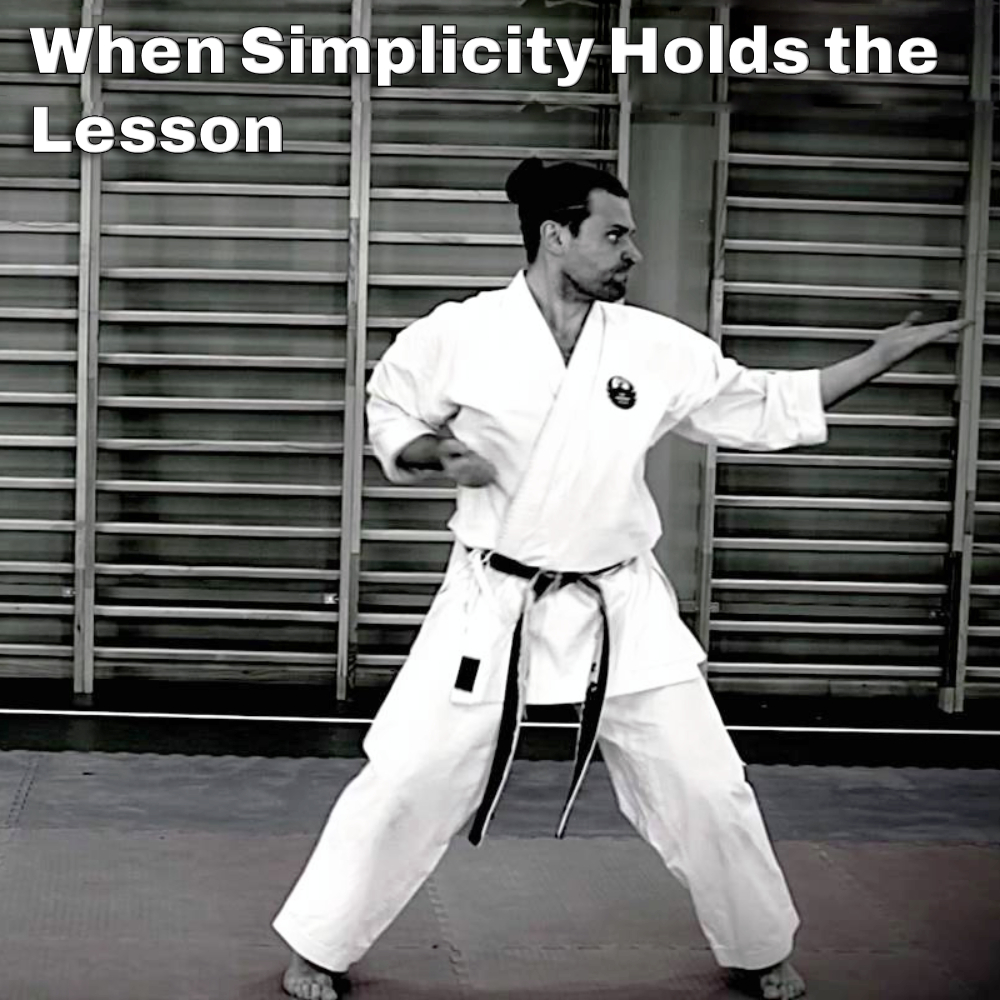
I’m sure many of you have a favorite kata. I know I do. Several, actually.
There are certain kata we keep going back to, sometimes because they feel good to perform, sometimes because they keep revealing something new, and sometimes because they simply stay with us.
For me, Naihanchi is one of those kata.
Simple in appearance, but deep in application.
One of the reasons I like it so much is that it feels very different from many other kata. It moves sideways, from left to right, and its methods bring you close to the opponent.
Very close.
Its name is often interpreted as “sideways fighting,” usually because of the kata’s distinctive embusen, or line of movement. Personally, I think that interpretation can be a little too simple. The sideways movement is obvious, but the value of the kata is not found in moving left and right. It is found in what the movements teach at close range.
In Shotokan, Gichin Funakoshi later renamed the kata Tekki, often translated as “Iron Horse” or “Iron Horseman.” In many Okinawan and non-Shotokan lines, the kata remains Naihanchi and is commonly practiced in naihanchi-dachi rather than the deeper kiba-dachi associated with Shotokan.
Some traditions connect the form to Sokon Matsumura and to older Chinese influence, although the details are difficult to verify. It is possible that Naihanchi, or an earlier form related to it, came through those connections. It is also possible that the kata was shaped and revised over time on Okinawa.
That uncertainty matters.
Karate history is rarely as clean as we would like it to be.
What we can say is that it held an important place in earlier karate practice. In some lines, it was taught early, not because it was simple, but because it contained principles considered essential for combative training.
This was long before the development of kata such as the Fukyugata or Pinan, which were designed with a different teaching purpose in mind.
Otsuka Hironori, the founder of Wado-ryu, is often quoted as saying:
“I personally favor Naihanchi. It is not interesting to the eye, but it is extremely difficult to use. Naihanchi increases in difficulty with more time spent practicing it. However, there is something deep about it.”
That, to me, says a great deal.
This kata does not try to impress the viewer. It is not large, dramatic, or visually complex.
Its value is found in the study.
There are three kata in the series. Some believe that Shodan, Nidan, and Sandan were once a single longer form, later divided into sections. Others believe that Nidan and Sandan were created by Anko Itosu. The fact that only Shodan has a formal opening is often used to support the first possibility.
Whatever the case, this form clearly occupied an important place in the training of several major Okinawan teachers.
Kentsu Yabu, a student of Itosu, is often associated with the saying:
“Karate begins and ends with Naihanchi.”
Whether taken literally or not, the sentiment is clear.
This was not viewed as a minor kata.
Despite its understated appearance, it is rich with highly effective concepts. It contains close-range striking, body shifting, limb control, gripping, unbalancing, and methods that make far more sense when studied at close quarters rather than at long distance.
You will rarely see it emphasized in competition. Many modern students may overlook it because it does not look exciting. But for those interested in practical karate, that simplicity is part of its value.
Choki Motobu, one of Okinawa’s most formidable fighters, placed great emphasis on this kata in his own study and teaching. Motobu was a pragmatist, known for his real-world fighting experience, and he clearly saw it as something more than a formal exercise.
The movements are direct and close. They belong in the space where civilian violence often happens, not at the long, polite distance of formalized karate practice.
That is why this kata remains so important to me.
For anyone seeking to improve their close-range understanding, it offers a great deal to study. It is certainly one of my favorites, and one I often used when teaching seminars and courses.
Its methods may appear simple, but they deserve deep and consistent practice.
And although some styles do not practice it, I believe it is well worth reviewing, because it holds many of the core principles found in classical practical karate.
Photo Credit: Sensei Jerzy Chrzanowski