
There is a difference between surviving something and having a good method.
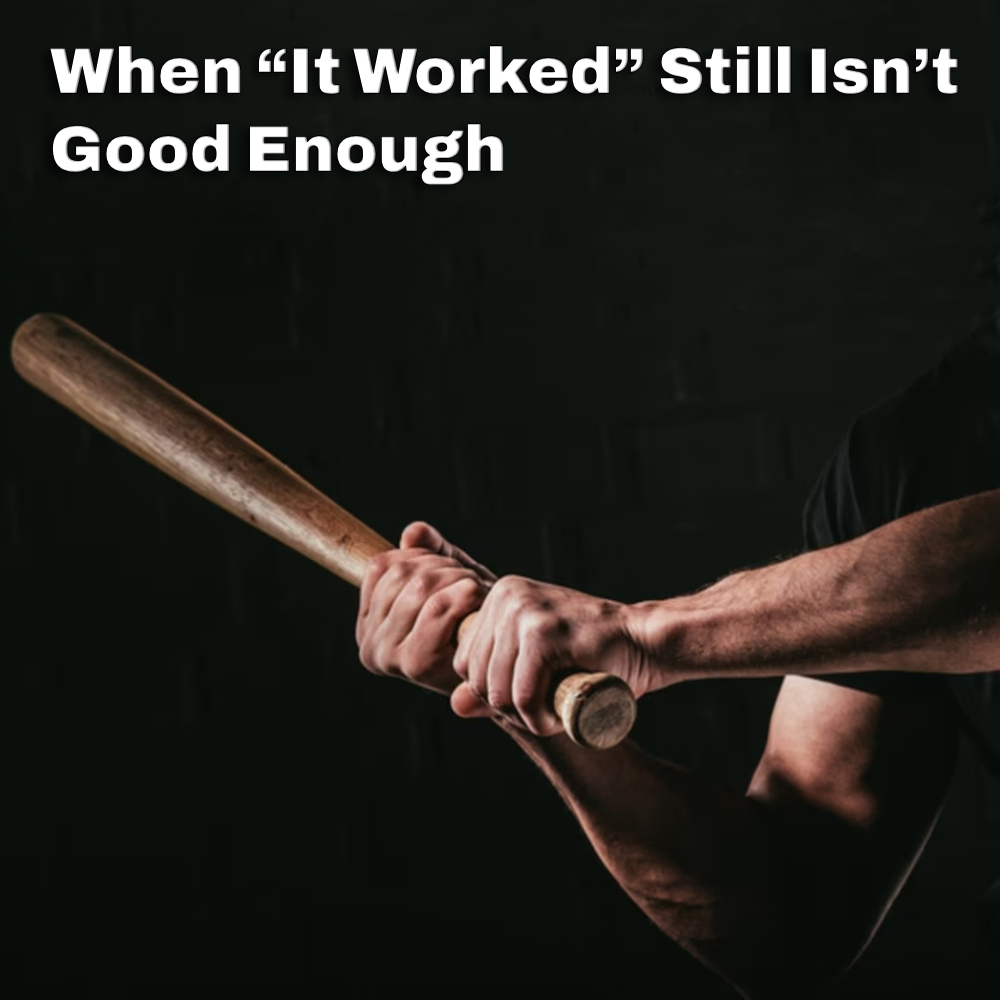
A while ago, I wrote about the use of jodan age-uke against a downward strike from a bo. The same idea is often shown against a baseball bat. The arm rises, the weapon comes down, and the defender is shown stopping the attack with the forearm.
My point was simple. Used that way, against that kind of force, there is a very good chance the defender gets injured.
Someone disagreed and told me that he had once blocked a baseball bat aimed at his head. The bat did not hit his head, so in his view the method had worked.
But he also said the impact broke his arm.
And that is the problem.
Of course, a broken arm may be better than a fractured skull. In that narrow sense, I understand the argument. If the choice is between the weapon landing cleanly on the head or the arm taking the impact, most of us would rather the arm take the impact than the head.
But that is not the same as saying this is a good method.
It is not the same as saying this is what we should teach as the standard.
“It worked” is not always the same as “it worked well.”
If a method leaves you with a broken limb, unable to use that arm, still standing in front of an armed attacker, then what has really been solved? The first strike may have been interrupted, but the situation is not over. The attacker still has the weapon. You are now injured, and the ability to protect yourself and others has been reduced. Your ability to escape may also be reduced.
That matters.
Self-protection should not be built around the idea of trading one injury for another. It should not teach students to sacrifice part of the body as though that is an acceptable outcome. Sometimes, in a desperate moment, injury may be unavoidable. But unavoidable is not the same as desirable. It is not the same as sound training.
Against a weapon, especially something with the weight and momentum of a bo or baseball bat, trying to stop the force dead with the forearm is a dangerous assumption. The weapon has leverage, mass, and speed. The person holding it may strike again immediately. This is not a single frozen photograph where the defender blocks once and the encounter politely ends.
This is where the way karate is sometimes taught can get people into trouble.
Too much emphasis is placed on the shape of the block, and not enough on the reality of the force coming in. Students are shown a position and told, “This is the defense.” But a position is not a defense. A movement has to be understood in relation to distance, timing, angle, intention, and consequence.
If the incoming force is too great to receive directly, then the answer should not be to stand there and meet it bone against weapon. The answer has to involve movement. Avoid the line. Change the angle. Reduce the force. Enter only when it is possible to do so safely. Control the limb or the weapon-bearing arm if the opportunity is there. Escape when escape is available.
That does not mean there is always a clean answer. There often isn’t. Real violence does not give us ideal conditions. But that is exactly why we should be careful about what we present as reliable.
A desperate reaction is not the same as a trained method.
A lucky survival is not the same as a principle.
And a broken arm is not proof that the technique worked. It may be proof that the person survived despite the method.
This is why context matters so much in karate. Jodan age-uke, like many movements, should not be reduced to a simple rising block against anything coming down from above. When we teach it that way, we risk turning a useful movement into a dangerous habit. We encourage students to think in terms of stopping attacks rather than managing force, position, and opportunity.
Karate is not supposed to be a collection of poses held up against imaginary attacks. It is supposed to teach us how to move, receive, control, disrupt, and escape.
There is a responsibility in that.
If we teach students that a broken arm is an acceptable result because the head was saved, then we should at least be honest about what we are teaching.
We are not teaching a preferred method. We are teaching a last-ditch sacrifice.
And those are not the same thing.
The goal should always be to come out with as little damage as possible, still able to move, still able to think, still able to protect yourself, and if necessary, still able to protect someone else.
Sometimes we may have no perfect choice.
But we should not confuse surviving a bad option with having a good method.