
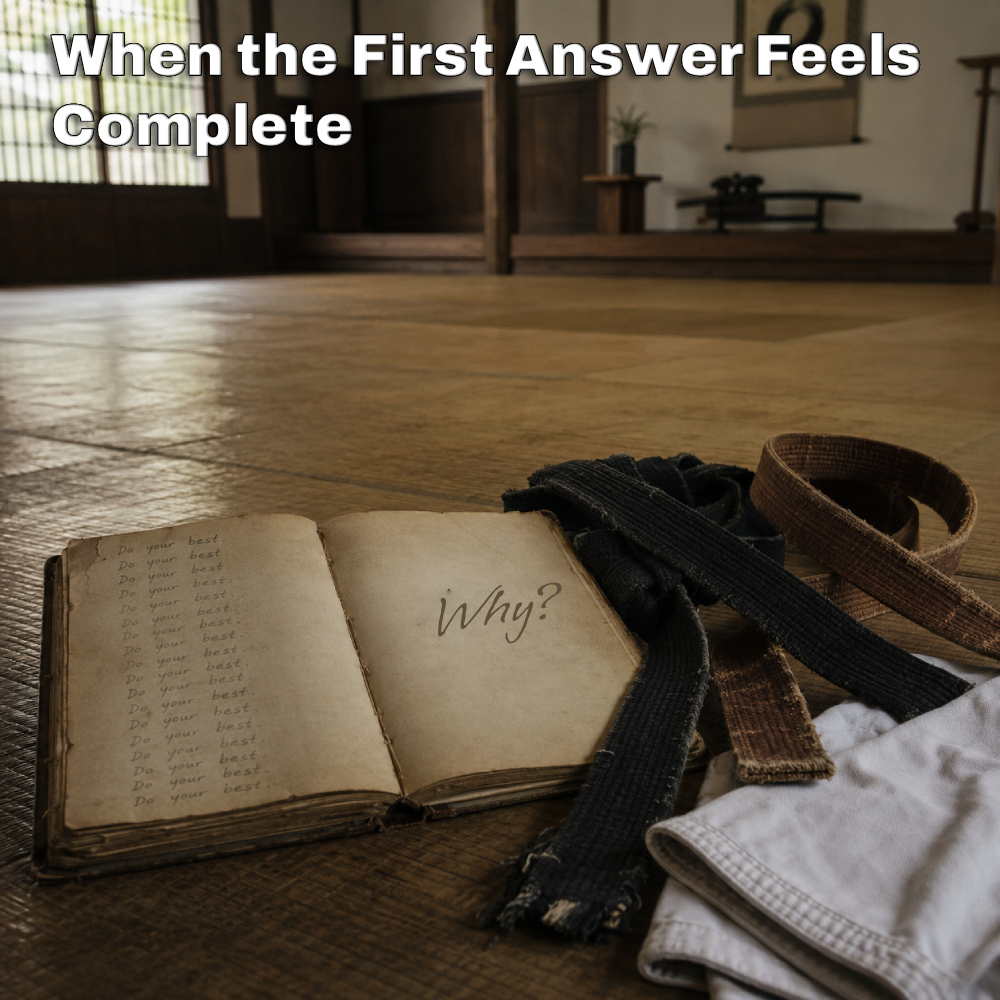
In karate, some explanations are not kept because they have been tested. They are kept because they have been repeated.
A teacher says it, a student accepts it. A group reinforces it, and a rank structure protects it. Years pass, and the explanation begins to feel less like an idea and more like a fact.
This is not always a matter of arrogance.
It is often a matter of comfort.
The answer was handed to someone early. It fitted the training they were doing at the time, and it was repeated by the people around them. It was rewarded through grades, certificates, titles, and belonging. Over time, the explanation stopped being something to examine and became something to defend.
That is where karate can become difficult.
Not physically difficult. Intellectually difficult.
Because once an answer becomes part of a person’s identity, questioning the answer can feel like questioning the person. A different interpretation is no longer heard as another possibility. It is heard as an attack. A question is no longer a question. It becomes disrespect. A challenge to the method becomes a challenge to the teacher, the group, the lineage, or the years already invested.
This is one reason people can repeat the same explanation for decades without ever really testing it.
They may genuinely believe what they are saying. They may have heard it so often that it simply feels true.
How often have you heard, repetition, repetition, repetition?
But repetition is not proof.
An explanation may be passed down sincerely and still be incomplete. It may come from a senior teacher but still need to be examined. It may be protected by tradition and still fail when placed under pressure in the real world.
The problem is not that a teacher speaks with confidence. Students need guidance, and a teacher cannot guide properly if everything is presented as a guess. But in practical karate, confidence has to be earned through testing, not borrowed from repetition, rank, or tradition.
In practical karate, this matters.
If we say a movement is for self-defense, we have to ask what that means. Against what kind of attack? At what range? Under what pressure? With what level of resistance? Does the explanation still work when the other person does not cooperate? Does it account for the chaos of real violence, or does it only make sense inside the safety of the drill?
These questions are not disrespectful.
They are necessary.
If an explanation cannot survive honest questioning, then perhaps it was never as strong as we thought. If a movement only works when the attacker gives us the correct arm, at the correct distance, with the correct pause, in the correct rhythm, then we may not be studying self-protection. We may simply be preserving choreography with a story attached to it.
Tradition should not be a hiding place for weak thinking. Respect should not prevent investigation. Loyalty to a teacher should not require the student to stop asking whether the method actually works.
A good teacher should not fear questions, and good traditions should not collapse because someone asks, “Why?”
The real problem is not that people inherit answers. We all do. Everyone begins by receiving something from someone else. None of us start from nowhere.
The problem begins when the inherited answer is never placed under pressure, never compared against reality, and never allowed to mature.
Then the answer becomes frozen.
It is repeated, protected, and performed.
Karate should not be a museum of untested explanations. It should be a living practice. That means we preserve what is useful, question what is unclear, and remain honest enough to admit when something doesn’t hold up.
Experience can deepen understanding, but it can also harden opinion. Rank can open doors, but it can also make people afraid to admit they were wrong. And yes, all those years in training can produce wisdom, but they can also produce attachment to the first answer we were given.
That is why humility matters.
Not the false humility of polite words and correct etiquette, but the real humility of being willing to test what we believe. The humility to say, “I was taught this, but I need to understand it.” The humility to say, “This may not be complete,” or, “Perhaps there is another way to look at this.”
In the dojo, many things can be made to work the way we want them to. That is comfortable.
But comfort is not the same as reality.
Sometimes the most important step in training is not learning a new technique, a new kata, or a new drill. Sometimes it is being willing to look again at the answer we have repeated for years and ask whether we truly understand it, or whether we have simply become confident in repeating it.