
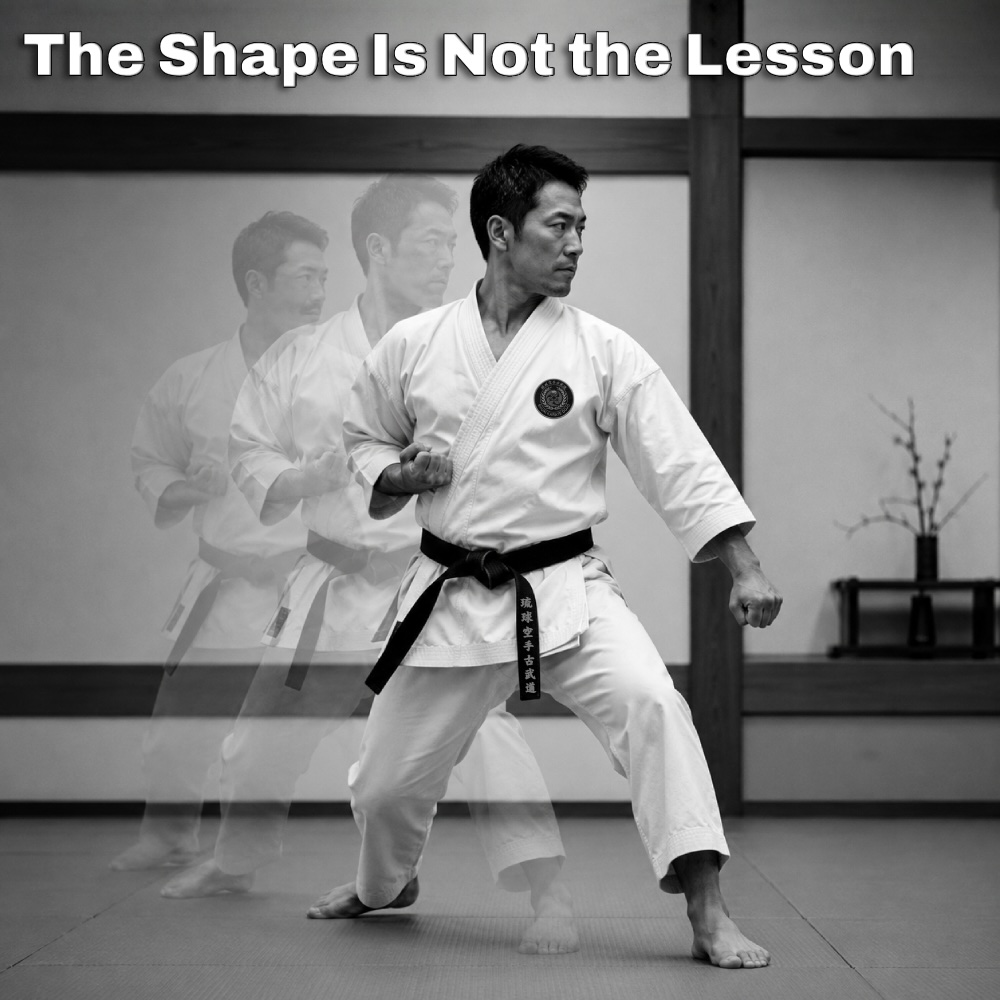
Everyone starts the same way in karate. We learn how to punch, kick, “block”, turn, and stand. Before we understand much else, we are shown where to place the feet, how to bend the knees, where the hips should face, and how the body should settle into a position.
That beginning has value. Stances give the student structure. They teach balance, alignment, posture, weight distribution, and body awareness. A beginner needs something visible to work from, and stances provide that. You can see whether the knee is collapsing inward, whether the body is leaning too far, or whether the student has no connection to the floor.
But somewhere along the way, many people begin to mistake the training shape for the final purpose.
In everyday English, the word “stance” often suggests something fixed. It can mean a position someone holds and does not easily change. That common meaning can influence how we think about karate stances too, as if they are meant to be exact, fixed, and the same for everyone.
But karate stances are not meant to be stationary.
They are better understood as snapshots in movement.
Nobody grew up waiting at the bus stop in shiko dachi or neko ashi dachi. These are dojo shapes. They are training tools. They can teach structure, connection, transition, pressure, rooting, shifting, and balance, but they are not meant to become cages.
This is where discussions about short stances and long stances can sometimes miss the point. Of course there are differences between them. A longer stance may teach driving through, lowering the body, or stability through a particular line. A shorter stance may allow quicker adjustment, easier movement, and better mobility. Both can have value, depending on what is being taught.
The problem begins when we start treating stance length as if it should be the same for everyone.
We are not all built the same. A tall person with long legs will not naturally occupy the same stance as a shorter person with different hips, knees, ankles, and proportions. Two students may be practicing the same kata and the same principle, but the external shape may not look identical. That does not automatically mean one is right and the other is wrong.
A stance should serve the body and the movement.
The body should not be forced to serve an arbitrary measurement.
How many students have had a foot moved an inch or two so the stance “looks” right? Sometimes that correction is necessary. Sometimes the student really is out of alignment. But sometimes we are only improving the appearance, not the function. That distinction matters.
It is sometimes said that deep stances are there to build strong legs. Strong legs are useful, of course, and they may develop as a consequence of training, but that is not the main lesson of stances. Their real value is in teaching structure, movement, transition, pressure, and balance.
Funakoshi wrote:
“Beginners must master low stances and posture; natural body positions are for advanced students.”
That does not mean stances are useless. It means they are part of the learning process. The beginner needs structure, but the more advanced student should not remain trapped inside the beginner’s shape.
If stances are only taught as fixed positions, students become good at holding positions. But karate is not only about holding positions. It’s about moving, entering, changing direction, taking balance, applying pressure, and adapting to what is happening in front of you.
A stance in kata may not be saying:
“Stand here”.
It may be saying:
“Move through here”.
That is a very different lesson.
Traditional karate is excellent at building discipline, and I am not arguing against that. I am not saying stances should be ignored or treated casually. Poor structure still matters. Weak posture still matters. Bad alignment still matters.
But we need clarity of purpose.
A long stance is not automatically better because it is longer. A short stance is not automatically better because it is more mobile. A deep stance is not automatically more traditional. A natural stance is not automatically more practical. The question should always be whether the stance serves the movement and the principle being taught.
Teach stances to build the base. Teach movement to make that base usable. Then teach both until the student understands that a stance is not a fixed destination.
It is a moment in motion.