
Kata is often misunderstood because many people view it through a modern lens.
Today we live in a world of instant access to information. There are videos, books, seminars, online courses, slow-motion breakdowns, and endless commentary available at the touch of a screen.
When kata was developed, none of that existed.
There was no social media, no instructional footage, hardly any photography, and very little written material available to ordinary practitioners. Teaching was usually private, often limited to only a few students, and sometimes passed to a single family member.
So this raises an important question.
How do you preserve and transmit fighting knowledge when no recording system exists?
Kata was one answer.
Many people see kata as a strange ritual – a person moving in different directions fighting imaginary opponents. But that interpretation misses what kata was actually for.
The foundation of kata was the two-person drill.
Long before kata existed as solo forms, there were partner exercises. These drills taught methods for dealing with grabs, strikes, clinches, off-balancing, and close-range civilian violence. The student would practice these methods repeatedly with a partner under the guidance of a teacher.
But eventually the student would go home alone.
How were they supposed to rehearse and remember what they had learned?
Kata became the method.
Rather than being the fight itself, kata acted as a way to preserve and rehearse information when training alone. It was a physical memory system. A method of organizing principles, combinations, and responses into something that could be repeated, refined, and passed on.
This is why the common criticism – “good luck fighting with your kata” – completely misses the point.
You are not supposed to fight by performing an entire kata from beginning to end any more than a boxer fights by shadowboxing exactly as practiced in training.
Training methods isolate and preserve attributes.
Kata preserved information.
What is interesting is that when you begin extracting movements from kata and comparing them to live combat, the similarities become obvious.
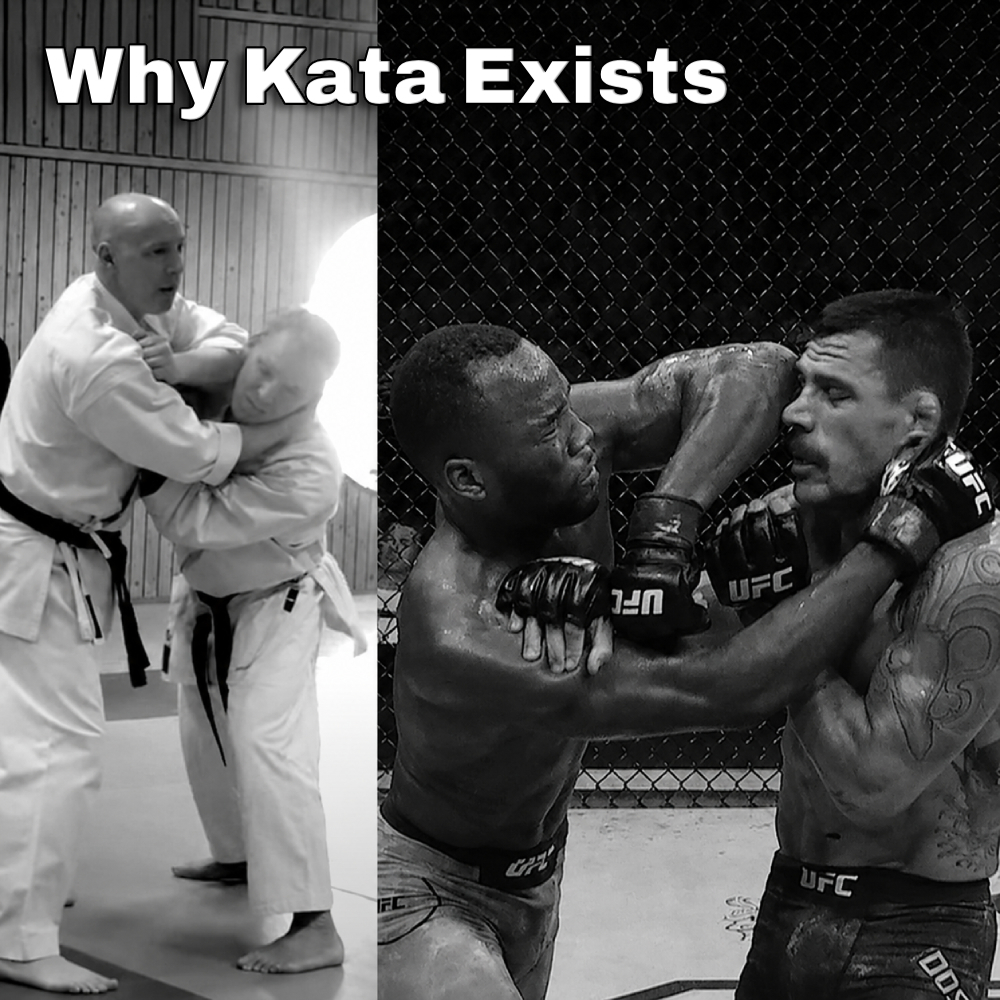
As an example, watching MMA, one fighter trapped his opponent against the cage, controlled the back of the head with an open palm, and delivered a tight round elbow strike.
In karate, that movement exists in many kata as mawashi empi uchi. You can find variations of it in kata such as Naihanchi.
The technique worked in exactly the same way it always has.
This is where many misunderstand kata. They imagine the form itself is the application, when in reality the form is the storage system for the application.
The pioneers of karate also did not practice the huge number of kata often seen today. Many focused deeply on only one or two forms. Those kata contained the methods, preferences, and lessons their teacher considered important.
Each kata had emphasis and purpose.
Seen this way, kata becomes far less mysterious.
It was not designed as performance art, and it was never intended to look realistic to spectators.
It was a practical solution from another time – a way of preserving and transmitting combative knowledge before modern recording systems existed.
Understanding that changes the question entirely.
The question is no longer, “Would you fight exactly like a kata?”
Of course you wouldn’t.
The better question is whether kata still contains useful information once you understand how to extract and apply it correctly.
For many practitioners, the answer to that is still yes.