
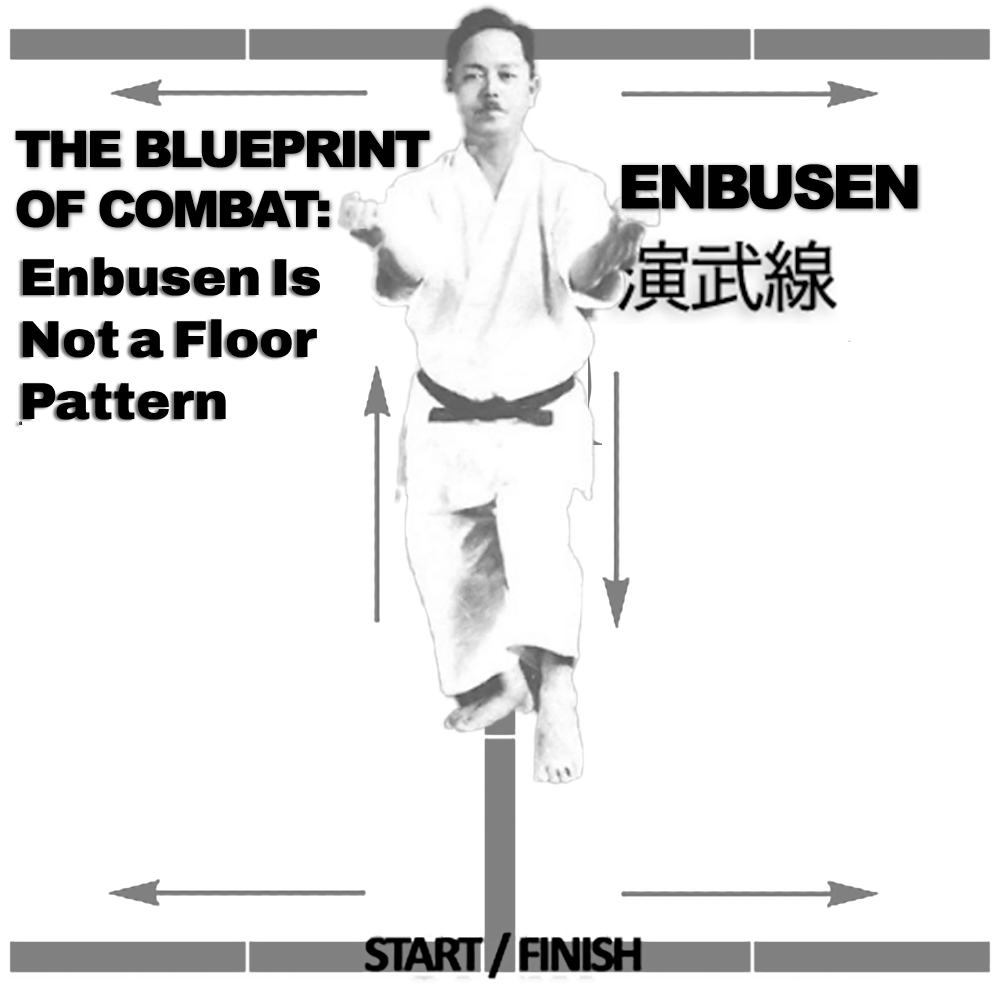
“Enbusen isn’t just about where you face when you perform kata. Enbusen is the opponent themselves. Enbusen represents the opponent’s attacks or movements, the practitioner must move accordingly to the movements of the opponent, and react to said attacks accordingly… Enbusen is the opponent.”
- Toshihiro Oshiro
One of the biggest mistakes people make with kata is believing the enbusen is simply the line you walk across the floor.
It isn’t.
Enbusen (演武線) is commonly described as the pattern or shape of a kata. In the modern karate world, it is often reduced to diagrams in books, competition lines, or instructions about where your feet should land during performance.
But that is only the surface level.
The enbusen exists because combat has angles.
If an attacker moves, you move. If an attack comes from a particular line, you adjust relative to that line. Kata had to record those angles somehow, and since the attacker is absent during solo practice, the movement pattern becomes the method of recording it.
The floor pattern is not the fight itself. It’s the shadow the fight leaves behind.
Getting off the opponent’s line of attack while keeping them on yours is a sound combative principle, and kata records this constantly. The turns, shifts, and directional changes are often telling you something about positioning rather than informing you that a new attacker has magically appeared behind you.
This is where many interpretations drift away from practicality.
Too often, karateka are taught that every turn in kata means “another opponent”. In reality, many of those turns are simply repositioning against the same person. The angle changes because the relationship between you and the opponent has changed – perhaps even to execute a throw.
That matters.
Because once you stop seeing enbusen as choreography and start seeing it as positional information, kata begins to make more sense.
Distance makes more sense.
Timing makes more sense.
Bunkai starts making more sense.
There are also those who insist that kata must always start and end on exactly the same point – the kiten (起点).
But from a practical perspective, that idea has little meaning.
The notion that returning to the exact same spot was somehow fundamental to kata construction is almost certainly a modern obsession, influenced heavily by standardization, demonstration, and competition culture. There are many traditional kata that do not naturally finish where they began.
Historically, the priority would have been function, not geometry.
In fact, it has even been said that some kata contain turns simply because the creator ran out of room and turned around to continue practicing.
Whether every such story is true or not is almost beside the point. The point is that older karate was not designed around the modern expectation of symmetrical performance lines and visual neatness.
It was designed around movement and application.
The enbusen primarily records the angle we assume relative to an attacker. It communicates movement, positioning, and combative relationship. It is not simply a decorative floor pattern, nor is it a map of multiple enemies attacking one at a time from polite directions.
In the end, the enbusen is not there to help you perform kata beautifully.
It’s there to help you understand where you need to be for the technique to work.
Reference: Toshihiro Oshiro interview in American Samurai, Vol. 7, July 2002.
Note: Both enbusen and embusen are used in karate circles. Enbusen matches the exact Japanese spelling, while embusen is just how it’s naturally pronounced.