
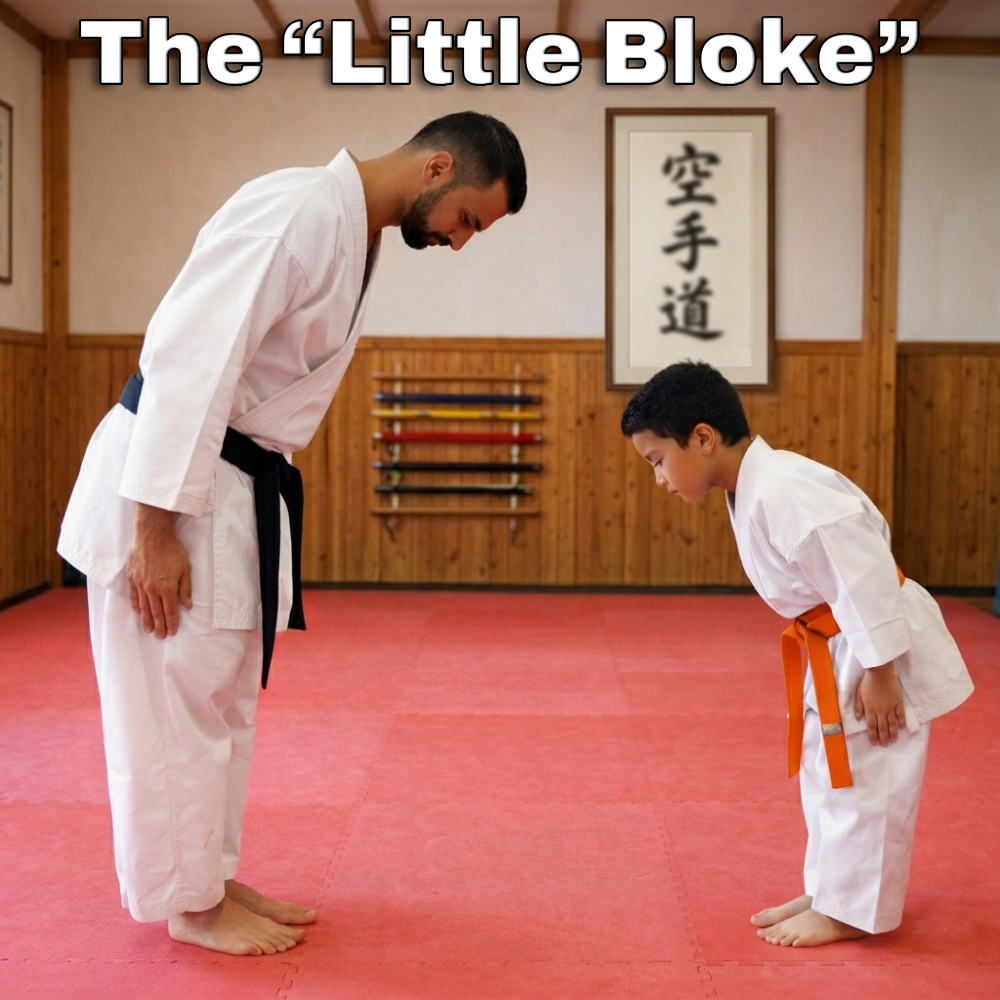
When I was a kid, I wanted to join the Army Cadets, but I was too young. So I lied about my age and got in anyway. I became known as the “little bloke”.
I threw myself into everything they offered – sometimes literally.
During one escape and evasion exercise, after being caught, a group of cadets introduced me to reality by throwing me into a patch of high gorse bushes. It was rough, chaotic, and memorable. At the time it just felt like part of the environment. Looking back now, I realize it was also my introduction to pressure, unpredictability, and human aggression.
Through the cadets I was introduced to amateur boxing and self-defense. Being the smallest bloke there, I was often the one chosen to perform the demonstrations. The reasoning was simple – if I could make something work against a bigger, rougher, more intimidating attacker, then anyone could.
Perhaps that shaped me more than I realized.
Recently, I came across the term “Alpha Athlete” – the naturally gifted individual who can often make almost anything work regardless of circumstance. That stood out to me because I was never that person. I knew a few of them, but I was the opposite. I was the small kid trying to understand how things actually worked against people larger, stronger, and more aggressive than myself.
Fast forward a few years and I found karate.
The contrast stayed with me.
Much of what I encountered felt heavily ritualized, compliant, and passive by comparison. Attacks were predetermined. Resistance was controlled. Timing was cooperative. Everyone understood the script. None of this made the training worthless, but it felt very different from the rough unpredictability I had already experienced elsewhere.
Over time, I began to understand something important.
Structured and compliant training has value. Beginners need it. Timing, coordination, distancing, posture, and basic movement rarely emerge from chaos alone. Ritual can help build foundations.
But foundations are not the same as function.
At some point training has to move beyond cooperation if the goal is functional application. Pressure changes things. Aggression changes things. Fear changes things. Unscripted movement changes things. The human element changes things.
This is where many discussions in martial arts become confused. People often argue in absolutes. One side dismisses ritual entirely. The other defends compliance as though it alone produces effectiveness. In reality, functional training usually exists along a spectrum.
Structure teaches us, resistance reveals, and pressure eventually refines.
The problem is not necessarily ritual practice itself. The problem begins when ritual becomes the destination instead of part of the pathway.
Looking back now, I think those early experiences as the “little bloke” stayed with me more deeply than I realized. They shaped how I viewed training, application, resistance, and ultimately karate itself.
Not because I rejected structure – but because I learned early that structure alone is not reality.