
Rank, in some environments, can become a trophy for time served, rather than a measure of functional ability.
We see this often in the modern martial arts landscape: the rise of the “instant master”. Some individuals move from junior grades to self-appointed high ranks in a matter of years. They trade on titles because they cannot trade on skill. They mistake bravado for “character” and certificates for competence.
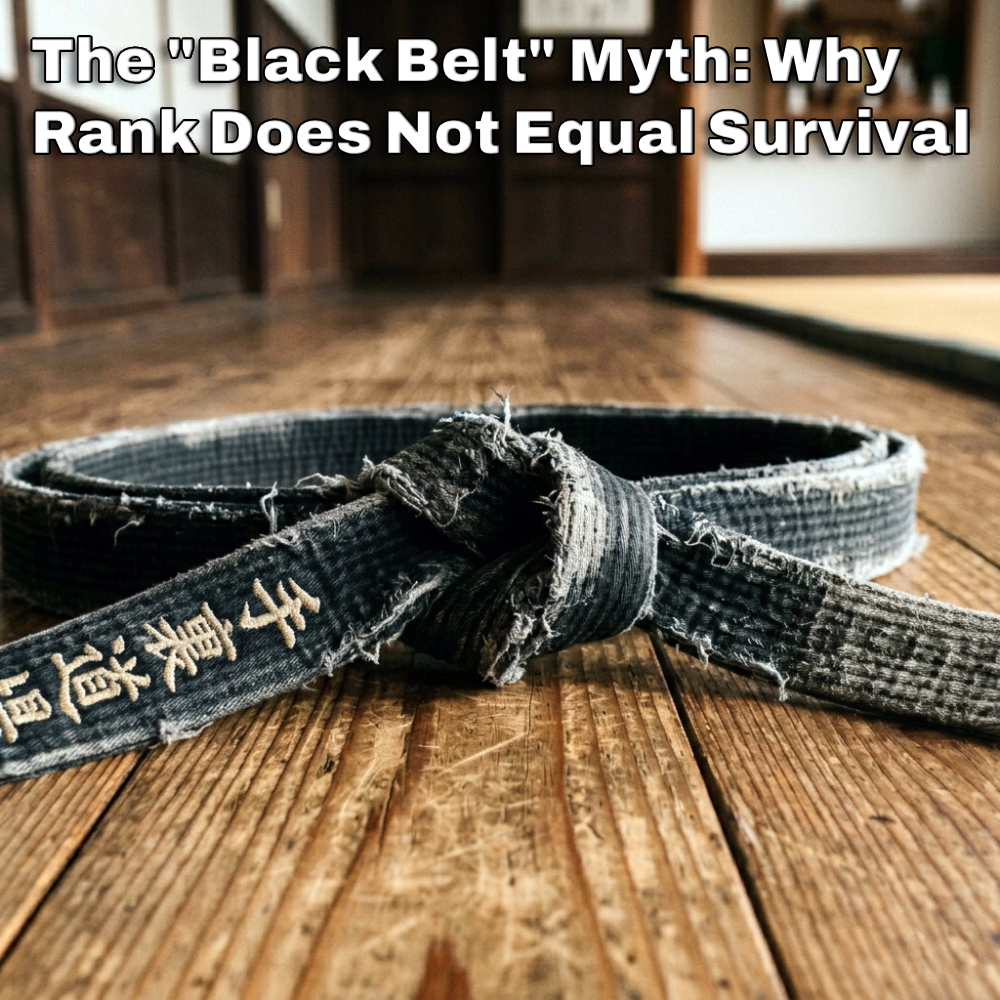
A black belt is a piece of cloth that holds your karate-gi together. It is not a magical charm that protects you from the physics of a violent encounter.
The danger of this “Black Belt Myth” is threefold.
First, it gives the practitioner a false sense of security. They believe that because they have a title and a black belt around their waist, they have the ability. This “rank-induced” confidence can lead someone to stay in a situation they should have fled, or to engage in a way that ignores the chaotic reality of violence.
Second, it poisons the student. When an instructor emphasizes the prestige of rank over the mastery of mechanics, they are teaching their students to value the destination over the journey. They are preparing them for a grading, not for the unpredictable nature of a real-world confrontation.
Finally, it creates a “Comfort Trap”. Some practitioners will openly admit they don’t want their training to prepare them for violence; they prefer the ritual, the social aspect, or the “idea” of the art over the messy reality of self-protection. While there is nothing wrong with training for hobby or health, it becomes dangerous when that comfort is dressed up as “combat readiness”. To wear a high rank in a martial art while avoiding the truth of what violence actually looks like is a profound contradiction.
Furthermore, we must ask: what happens when the violence isn’t directed at you, but at someone you have a moral obligation to protect? If you have spent years wearing a high rank but intentionally avoiding the “ugly” side of training, will you have the tools to intervene when someone else is at risk? To wear a rank that implies mastery while lacking the capability to protect others is a profound contradiction.
Gravity and physics do not care about your rank or your preference for comfort. In a high-pressure situation, a title won’t de-escalate a threat or stop a powerful, all-out strike.
True skill is about stripping away the unnecessary. It’s about awareness, presence, and the ability to move before the problem becomes a crisis.
If training is built on the ego of an instructor or the comfort-seeking of a student, it is merely a performance. In the dojo, a “bad” instructor or a misplaced priority just costs you time and money. In a real-world encounter, that same bad advice – confusing a “performance” for self-defense – can have far more permanent consequences.
We must return to the idea of deliberate practice. Rank should be a byproduct of years of being “corrected” on the dojo floor, not a title used to bypass the hard work of being a student.
I have been training for over 50 years, and I am still a student of the art. In the dojo, you can wear whatever rank you like. But in the real-world, you only have your habits. If those habits were bought with a title rather than earned with sweat, you have paid a very high price for a very dangerous illusion.
PS: Some say a belt should never touch the floor. I say that if you’ve truly trained, your belt has met the floor a thousand times over. Gravity is the first teacher.