
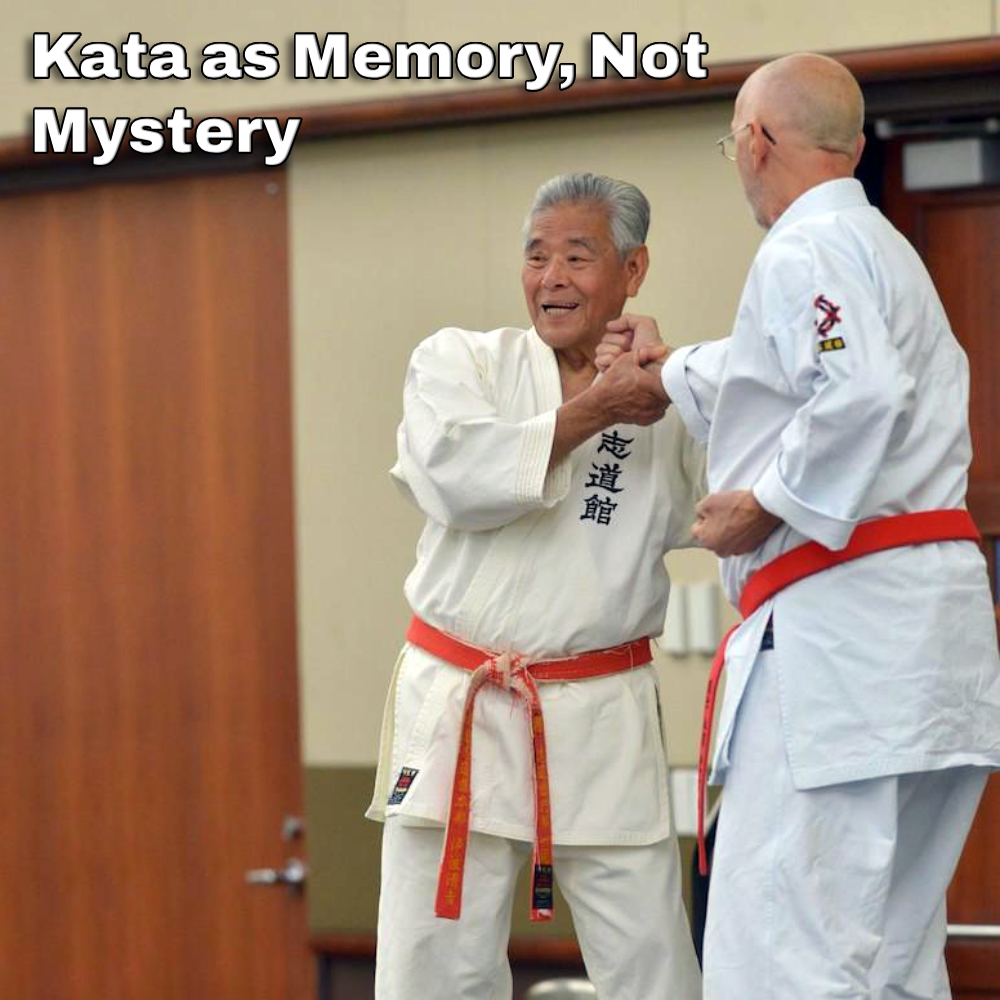
I came across a story told by Seikichi Iha (1931-2024) talking about the origins of kata. What stood out for me wasn’t the detail, it was the simplicity of the idea. He suggested that kata may have been formed by working backwards from what someone found useful in a fight – simply what worked for that individual at that time.
If you think about that, it strips away a lot of the mystique people like to attach to kata. It stops being a puzzle to solve and starts looking more like a record of experience.
Someone has a fight, certain actions prove effective, and afterwards those actions are repeated, shown to others, and eventually organized into something that can be remembered. Over time that process becomes more structured, and what began as a handful of functional movements becomes a sequence.
But if what you are looking at is someone else’s experience, shaped by their circumstances, then you have to be careful how you approach it. You don’t know what they were dealing with, you don’t know what they prioritized, and you don’t know what they discarded along the way. What survives is not the fight itself, but a version of it that has been shaped for memory and transmission.
There was also some speculation about purpose. The suggestion that certain types of training may have suited merchants, or bodyguards, or soldiers. That kind of explanation is common, and it is easy to see why people are drawn to it. But once you start assigning roles like that, you move away from what can be reasonably understood and into what simply sounds plausible.
That matters, because the story you tell yourself about kata directly affects how you train. If you convince yourself that something was designed for a very specific type of person or situation, you may end up forcing your training into that shape, whether it fits or not.
What seems far more likely is that kata became more elaborate over time. Not because real encounters are long and complex, but because memory tends to expand. People add things, refine things, and pass them on. Over generations, what may have started as a small number of effective actions becomes layered. So when you look at kata now, you are not looking at a single moment, but at accumulated decisions.
Some of those patterns may look like themes to us today, but that still doesn’t tell us how they were originally formed.
There was also a very direct comment about intent, that kata should feel like someone is trying to kill you and that you must deal with that quickly. Stripped of the language used, the point is valid.
Violence, when it happens, is not hesitant. It is sudden and it is committed. But this is where people often go wrong, because they take that idea and turn it into something exaggerated.
For most practitioners, the goal is not to fight like a soldier. It is to deal with a situation quickly enough to get out of it. That is a very different objective, and it should shape how training is approached.
Training value depends on whether it matches the realities a person is actually likely to face.
If the context is wrong, the training drifts, no matter how hard or how serious it looks.
So instead of asking what a kata “means”, a more useful line of thought is to ask what kind of situation would make a movement functional, and whether that situation is one you are realistically preparing for. That keeps the focus where it should be, on application rather than interpretation.
Kata does not need to be treated as something mysterious, and it does not need elaborate explanations attached to it. It can be approached in a far more grounded way, as a method of preserving and transmitting experience. Not perfectly, and not completely, but enough to give you something to work with if you are prepared to question it.
Seen that way, kata is not something to decode.
It is something to test.
Photo Credit: Seikichi Iha Hanshi, 10th Dan (1932-2024) – courtesy of Iha Dojo