
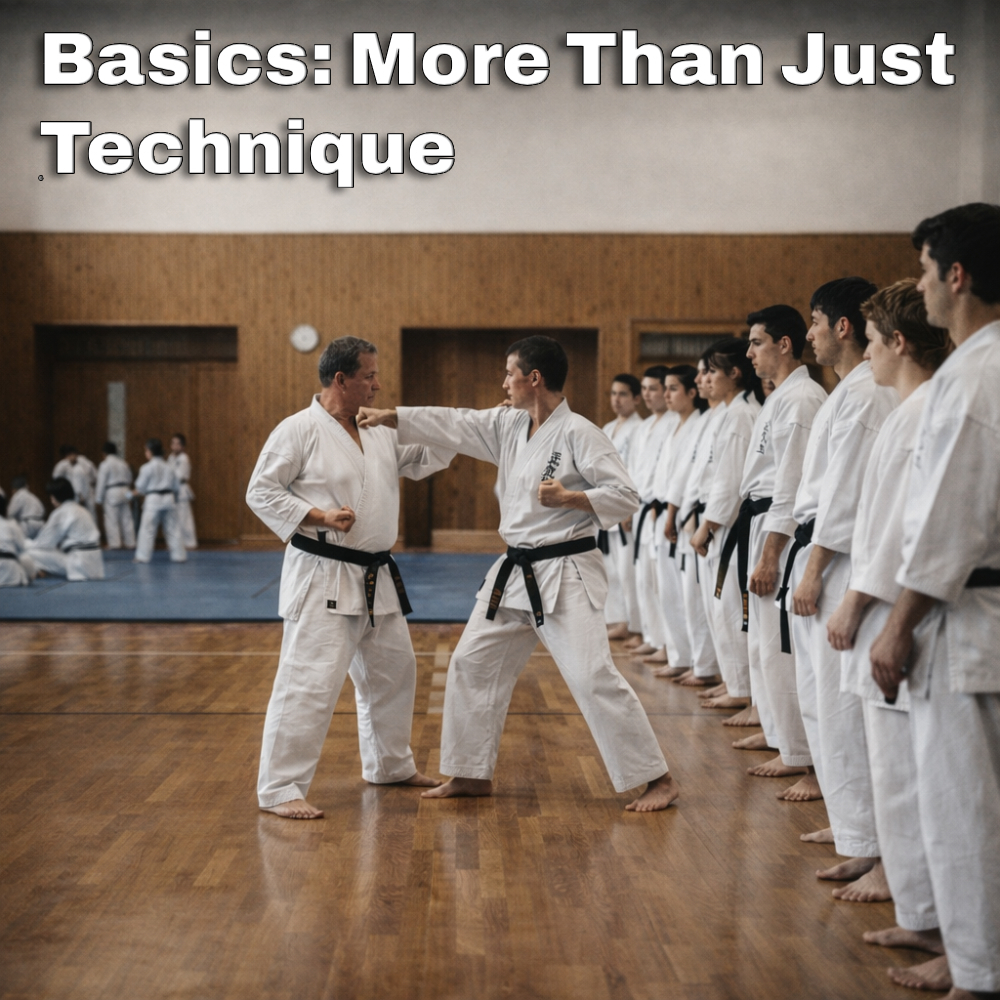
One of the biggest challenges for any instructor is keeping students focused on the basics.
Why is this important?
Because without a good solid foundation, everything built on top of it eventually starts to give way. It might not be obvious at first. In fact, it often looks quite the opposite. People get faster, sharper, more confident. But underneath that, if the foundation isn’t right, there is always a point where things stop working as they should.
So when I say focused on the basics, what do I mean? ‘Blocking’, punching, kicking?
That’s usually how it’s understood. A list of techniques. Things to repeat. Movements to get right.
Step forward, block. Step back, punch. Again. Again.
The issue is not that these things are practiced. It’s how they are being framed.
Because if those ‘basics’ are taught as fixed techniques, performed in isolation and without context, then what’s being built isn’t a foundation – it’s a pattern. And patterns, once ingrained, are difficult to change.
This is where the problem starts to show.
Many people spend years repeating these movements, only to later be told they need to “adapt” them for real situations. That the way they have been training isn’t quite how it would work under pressure in the real-world. So changes are made. The stance adjusts. The timing shifts. The distance closes. The intent becomes something else entirely.
And slowly, the original ‘basic’ begins to fall away.
So what was it building?
If a basic needs to be reworked later just to make it functional, then it wasn’t really a basic – it was a placeholder.
That doesn’t mean we don’t need basics. We absolutely do. But we need to be clear about what they are.
A basic should not just be a technique. It should be a principle.
I saw this clearly years ago when I was teaching advanced driving.
At the higher levels – what people often think of as ‘blues and twos’ – everything came back to what had already been taught at the very beginning.
Basic car control. Observation. Awareness. Positioning.
But now those same ideas were being applied with far more precision, under more pressure, at higher speeds, and with far greater consequence.
Now, to be clear – you cannot simply learn the basics and then step straight into a police car or ambulance and “do the job”. There is far more to it than that. Experience, judgement, decision-making, and exposure to real conditions all play a part.
But what was always telling during early assessments was this:
People were often stripped right back to those fundamentals.
Not to see how advanced they were – but to see whether they had truly understood what they had already been taught.
Because if the basics weren’t there, or weren’t embedded properly, everything else became far more difficult to build.
The difference was not in what was being used – it was in how well it had been understood and embedded from the start.
That’s what allowed it to scale.
Because those basics were never just “techniques”. They were principles. And they held up when it mattered.
And that’s no different here.
If we teach a ‘block’, it shouldn’t just be an arm moving from one place to another. It should carry with it an understanding of distance, timing, positioning, and intent. The same with a punch. The same with any movement.
Otherwise, we are not building a foundation. We are building something that will eventually need undoing.
And that is where a lot of training quietly starts to come undone.
Because instead of moving forward, people find themselves having to go back – not to improve, but to fix.
Keeping students focused on the basics is not just about repetition. It’s about making sure what they are repeating is actually worth keeping.
If the basics don’t hold up, nothing built on them ever will.