
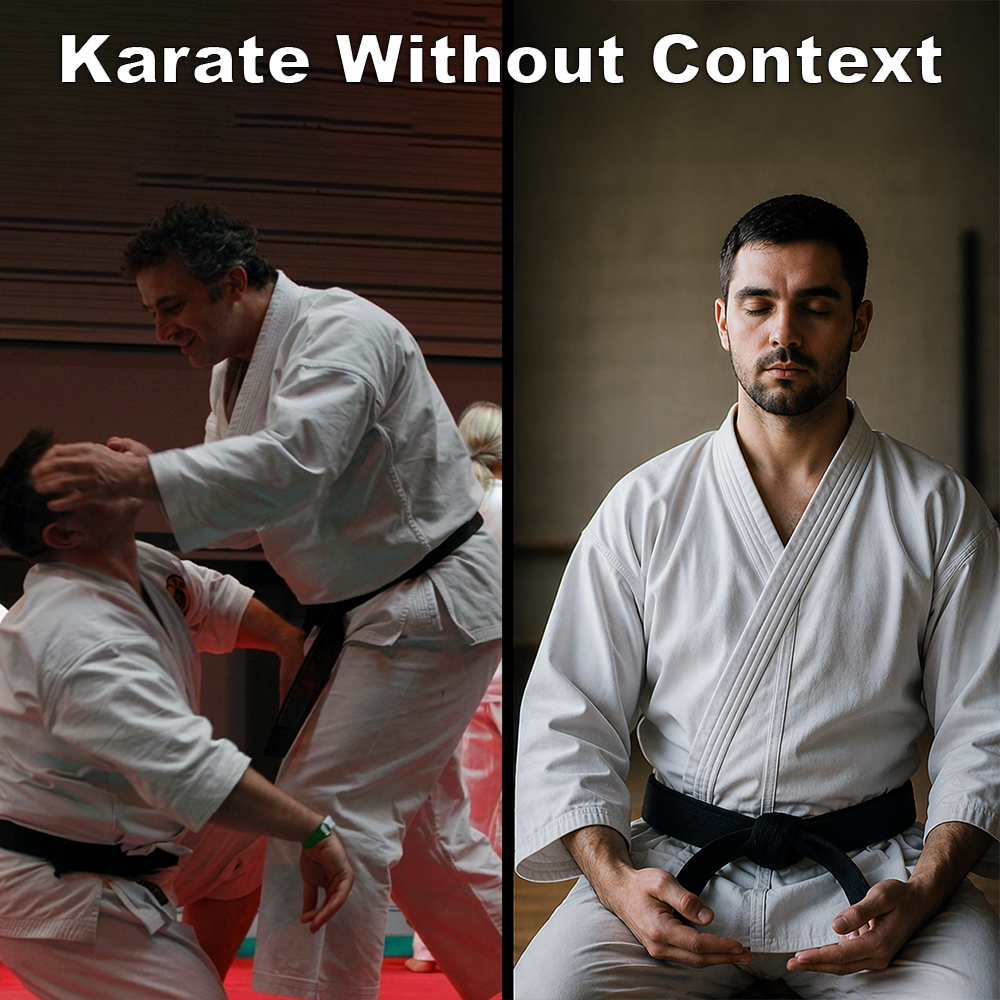
Someone made a comment recently that stuck with me. Not because it was unusual – but because it was honest.
The person had been training in Shotokan for nearly 30 years and said he was completely indifferent to self-defense. For him, karate was a kind of moving meditation. Something personal. Something calm. Something far removed from violence.
He doesn’t train in a dojo anymore. He doesn’t train with others. In his own words, he doesn’t care for the emphasis on violence.
That’s where things start to unravel.
Because whether people like it or not, karate is rooted in violence. Not in the sense of aggression or harm for its own sake – but in preparation. You don’t begin training by learning stillness or philosophy. You begin by learning how to strike, how to move, how to deal with physical confrontation.
That’s the foundation.
Everything else can grow from there – discipline, focus, control, even a kind of mindfulness – but those are outcomes, not the original purpose.
What struck me most was the contradiction in what he said next. Despite having no interest in self-defense, he admitted that part of him feels more prepared for it.
Even when someone rejects the idea of karate as self-defense, the training still carries that imprint. Because it was designed that way.
But here’s the problem.
If you remove the context that gave those movements meaning in the first place, what are you left with?
Karate doesn’t fail people – unclear goals do.
If the goal is meditation, then fine – but let’s be honest about what’s being practiced. Because once the link to application is gone, the movements can quickly drift into choreography. They may still feel meaningful, but the original function has been lost.
That doesn’t make it worthless – but it does make it something else.
And that distinction matters.
There’s also a deeper issue here, and it’s one that often gets overlooked.
The idea that self-defense is somehow an irrational motivation because “it may never happen. That argument doesn’t hold up.
We prepare for unlikely events all the time. We lock doors. We wear seatbelts. We carry insurance. Not because something will happen, but because if it does, the consequences matter.
Training value depends on whether it matches the realities a person is actually likely to face.
For most people, violence is rare. But it isn’t impossible. And when it does happen, it’s fast, chaotic, and unforgiving.
Ignoring that reality doesn’t make it go away.
Now, none of this means karate has to be trained as if you’re preparing for a war. That’s another extreme, and just as unhelpful.
Over time, most practitioners come to appreciate the wider benefits – the structure, the discipline, the clarity it brings. I certainly have. But those things sit on top of something more fundamental.
Karate is, at its core, a method of preparation.
Preparation for confrontation. For pressure. For the moments where things don’t go to plan.
Remove that, and you may still have movement. You may still have routine. You may even have something personally valuable. But you no longer have karate in its original sense.
And that’s fine – as long as it’s understood.
What doesn’t work is trying to redefine karate while ignoring what it was built for, or dismissing those who choose to train with that context intact.
For most practitioners, self-defense is rare, messy, and often hypothetical.
But hypothetical doesn’t mean irrelevant.
So train for whatever reason gets you on the dojo floor each day. That part is personal.
Just don’t be surprised when someone points out that without the context of violence, what you’re doing may look more like choreography than application.
That’s not an insult.
It’s a distinction.
Photo Credit: Image on the left courtesy of John Burke