
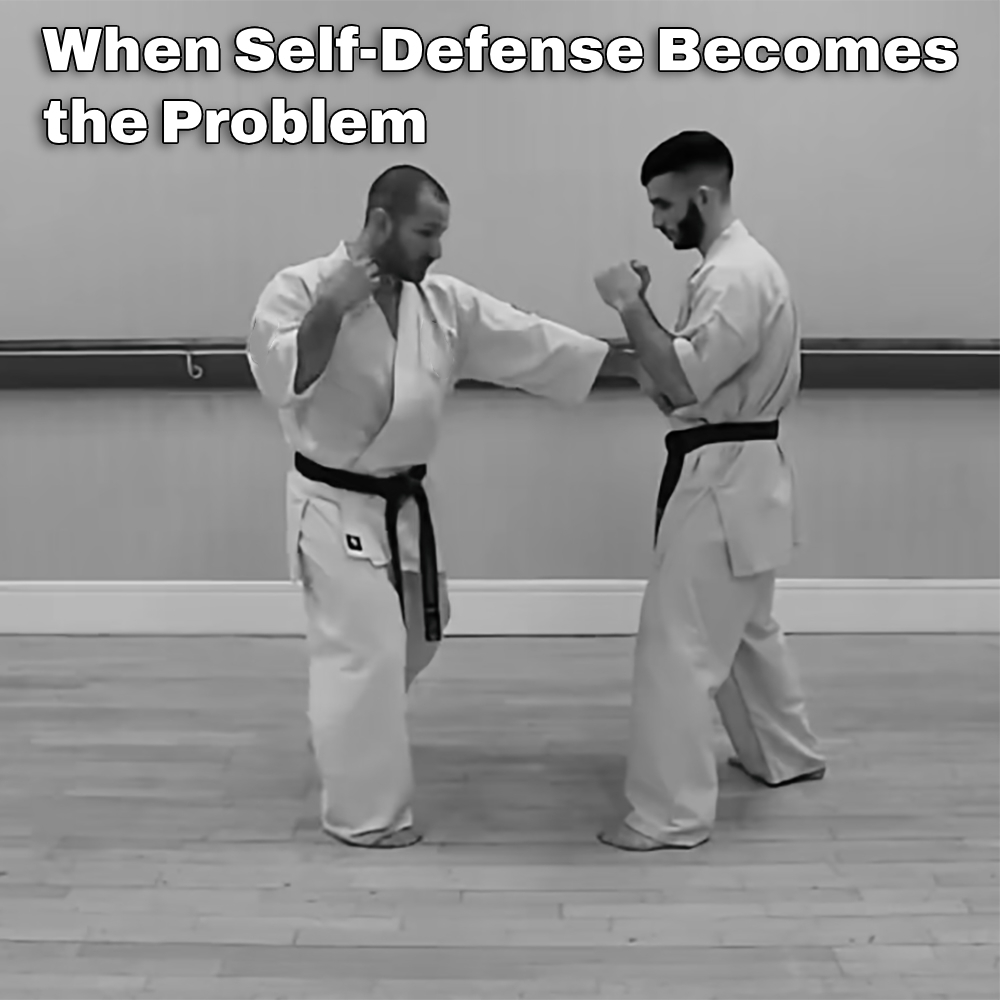
Drills, whether practical or not, are often shown through demonstration. If you want to explain a movement or an idea, you need a partner, and at some level that partner has to cooperate for the demonstration to take place. There’s nothing wrong with that in itself.
The problem starts when that cooperation isn’t recognized for what it is, and more importantly, when it isn’t reduced or challenged as training progresses. What begins as a way of showing something slowly becomes the model people believe they are working toward. Over time, the distinction between demonstration and application starts to blur, and that’s where the issues begin. What is being shown looks clean, structured, and like something that should work. But often, it only works within that structure.
This is why methods that rely on fixed distance and agreed exchange don’t translate well to self-defense. They exist within a set of conditions that make them work, but those conditions don’t exist outside of the drill.
The difficulty is that structure does have its place in training. We all use it. We use it to introduce movement, to understand positioning, and to begin exploring how something might work. At that level, cooperation isn’t just useful – it’s necessary. But it has to remain what it is, a starting point, not the end point. Because if the method only works when both people stay within that agreed structure, then what’s being learned is tied to that structure, and it doesn’t exist outside of it.
When you step outside of that structure, things change very quickly. The distance is no longer set, the timing is no longer predictable, and the attack doesn’t arrive in the way you expect or stop just because you’ve started to respond. There’s interruption, resistance, confusion, and that’s before you even consider intent.
This is the part that often gets missed. It’s not just that real violence is faster or closer, it’s that it doesn’t follow the same rules that the training is built around. If the method depends on a particular type of attack, delivered in a particular way, from a particular distance, then it’s already limited. Not because the idea behind it is completely wrong, but because it hasn’t been taken beyond the conditions it was first introduced in.
This is where it starts to become a problem. When something is presented as self-defense, people don’t see it as a drill or a starting point. They see it as something that will work for them if they ever need it, and they begin to build expectations around it. That there will be time to respond, that the attack will be clear, that the method will unfold the way it was shown. When that doesn’t happen, there’s a moment where those expectations don’t match reality, and that moment matters.
I was teaching a group of my students a drill – what we call a ‘known response’. Of course it is never truly ‘known’, but inferred as likely. When the attack changed slightly, he froze, turned to me with a blank expression and said, ‘I have forgotten what to do’. My reply was, ‘Try anything, see what happens’. He did, and successfully completed the task set. This is still an example of cooperation, but it shows what happens when expectations are disrupted, and this type of training needs to happen more often.
This isn’t about dismissing cooperative training, and it isn’t about criticizing individuals. It’s about being clear on what something is, and what it isn’t. If a drill is cooperative, then it should be understood as such. If it’s used to introduce ideas, then it should lead somewhere beyond itself. But if it never moves beyond that structure, and is still presented as preparation for real-world violence, then it needs to be questioned.
There’s often resistance to that idea. The suggestion that we should leave things as they are, that criticism is somehow negative, or that pointing out what doesn’t work is undermining the art itself. I don’t see it that way. If something doesn’t hold up under pressure, or doesn’t reflect the reality it claims to prepare someone for, then it should be examined, not ignored. That isn’t an attack on karate, it’s part of taking it seriously. Without that, nothing improves, it just gets repeated, and over time the gap between what is practiced and what is real only gets wider.
Because at that point it’s no longer just training, it’s a claim, and claims have consequences, especially for people who don’t yet know the difference.
You have to train honestly, not just so things work when everything is going right, but so there’s something left when they don’t.