
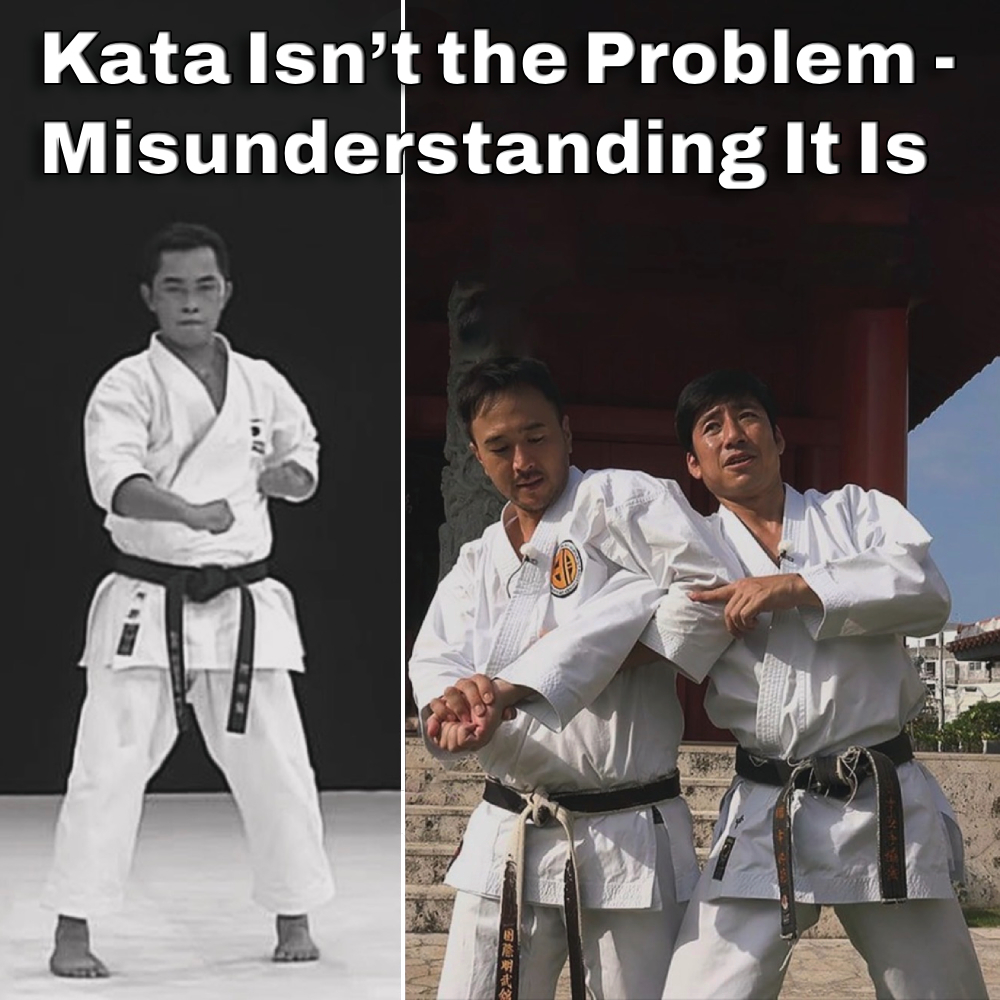
Here we go again.
Every time I write about the benefits of kata – really trying to help people understand what it is and how it works – someone shows up in the comments to tell me to go and do ‘real training’. This time it was someone proudly talking about his ‘street-real’ jiu-jitsu and MMA, as if that settled the matter before it had even begun.
“Stop with the crap”, he said. “Go do some real training”.
There’s always a tone to it. Not curiosity, not even disagreement, just certainty. And that usually tells you everything you need to know. People who speak like that aren’t trying to understand what they’re looking at, they’ve already decided what it is.
But that’s not really the issue.
The issue is how kata is being judged in the first place. People look at it as if you are supposed to use it exactly as it appears, movement by movement, sequence by sequence, as a literal method of fighting. They watch someone perform a kata and think, “That would never work in a real fight”. And if that is what they believe kata is, then they’re absolutely right.
The problem is, this is what many modern bunkai demonstrations lead people to believe – and that isn’t what kata is.
Kata is not something you use in that way. It was never meant to be copied on the surface and applied directly. What matters is what sits underneath it – the principles it carries. Balance, structure, control, the management of space, posture, the way power is generated and transferred through the body. These are the things that matter, and they are not unique to karate. They are human attributes, expressed through a particular method of training.
That’s where most of the misunderstanding begins. People look at the movement and see techniques – blocks, strikes, something literal – and assume that is the point. It isn’t. What they should be looking at is the shape of the movement as a whole, because that is where the meaning sits. The shape is the vehicle.
You don’t need kata to learn how to fight. There are plenty of ways to train, and systems like MMA, jiu-jitsu, and boxing have proven that repeatedly. But that doesn’t make kata redundant, it simply means it isn’t essential. It’s a choice, and like anything else, its value depends entirely on whether the person training understands what they are doing and why they are doing it.
There is also a difference between what kata was originally used for and what we often see today. In many places it has become performance, demonstration, sometimes even a kind of moving meditation. There is nothing wrong with that, as long as the context is clear. The problem comes when the context is lost, because then people either overestimate it or dismiss it completely, and neither position reflects what it actually offers.
Kata is closer to a reference than a solution. It preserves ideas, but it does not present them in a finished, ready-to-use form. You don’t copy it directly, but you can take from it, if you are willing to look a little deeper.
That is the part that often gets missed, not because it’s hidden, but because most people are not looking for it. They are looking for something immediate, something obvious, something that confirms what they already believe. When they don’t see that, they dismiss it:
“Do some real training.”
I have heard it before, and no doubt I will hear it again. It usually comes from people who assume that anything outside their own experience cannot possibly have value, and that way of thinking rarely leads anywhere useful.
I gave him the opportunity to have a conversation, but some people are not there for that. They ask, but they are not listening. They comment, but they are not engaging. At that point, there is nothing to be gained by continuing. Sometimes the best option is simply to press delete and move on.
Kata is not essential, but that has never really been the point. For those who take the time to understand it in the right context, it offers something that often goes unnoticed. Not a collection of answers, but a way of seeing what is already there.
And for the people who are actually looking, that is more than enough.
Photo Credit: (left) Abe Ryouki – (right) Akihito Yagi and Tatsuya Naka