
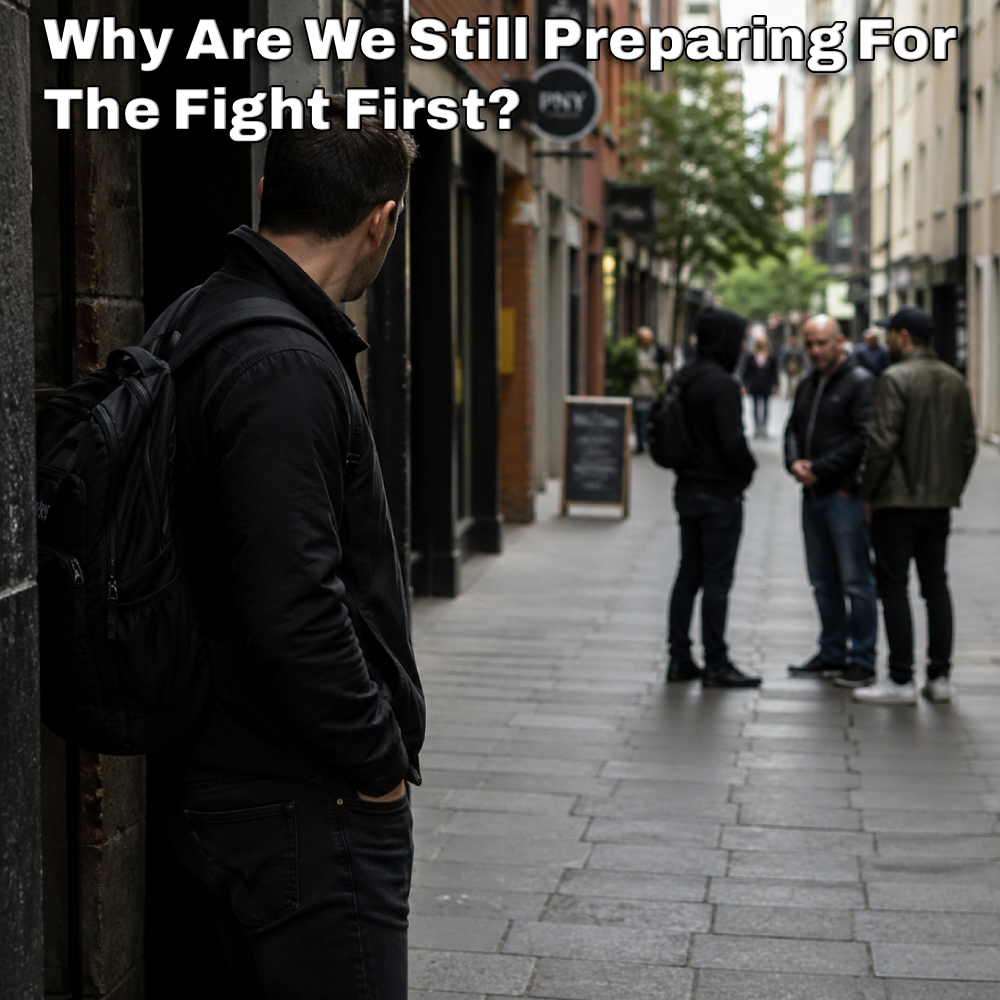
A few years ago, I wrote something about untrained people and how unpredictable they can be in a confrontation. The point at the time was simple enough – just because someone hasn’t trained doesn’t mean they’re not dangerous. In many ways, that unpredictability can make them more difficult to deal with.
I still agree with that.
But looking back on it now, I think I was focusing on the wrong part of the problem.
If untrained people are erratic, aggressive, and not going to behave in a way that fits what we practice, then choosing to engage with them physically at all starts to look like a poor decision. Once things become physical, you are no longer dealing with something controlled or predictable. You are dealing with size differences, emotional reactions, surprise, and the very real possibility that something goes wrong regardless of your level of experience.
At that point, skill matters, of course it does, but it doesn’t remove the risk. It just means you might manage it better than someone else.
And that raises a more important question. If self-defense has a purpose, is it really about handling that moment more effectively, or is it about not being there in the first place?
Because the more you think about it, the more it becomes obvious that once you are in a fight, you are already dealing with a breakdown of the situation. Something has been missed, ignored, or escalated to the point where your options have narrowed dramatically.
That doesn’t mean physical training isn’t important. It is. But perhaps its place is misunderstood. It should be what you fall back on when everything else has failed, not the starting point of the training.
Yet most of what we do begins there. We spend a huge amount of time working on exchanges, techniques, and responses within a fight, and far less time on the things that might prevent that situation from happening in the first place. Awareness, positioning, judgement, and the ability to recognize when something is shifting before it becomes physical are all part of self-defense, but they are harder to train, harder to measure, and often overlooked.
The irony is that we know how unreliable a fight can be, especially against someone untrained and unpredictable, and yet we still build much of our practice around that very moment.
It’s not that the training is wrong, but the priority might be.
If avoiding the fight matters most, why don’t we train for it?
And that leads to a question that’s difficult to avoid.
If avoiding the fight is more important than dealing with one, why do we spend so little time training the things that support that? Why is so much of our time spent on physical exchanges, and so little on awareness, positioning, and decision-making?
Part of it is practical. Physical techniques are easier to teach, easier to demonstrate, and easier to measure. You can see them working, or not working. You can repeat them, refine them, and test them in a controlled way.
The less physical side of self-defense is not as straightforward. Awareness is harder to define. Judgement is harder to pressure test. Decision-making is situational and often only becomes clear after the fact.
But difficulty doesn’t make it less important.
In fact, it may be the opposite.
Because if self-defense is about preventing the situation from becoming physical, then these are the very skills that sit at the front of it. They are what give you options before those options begin to disappear.
And yet, they are often treated as secondary. Talked about, but not deliberately trained.
Which brings it back to priority.
If most of our training time is spent on what happens during a fight, then we shouldn’t be surprised if that becomes the focus of how people think about self-defense. Not as something to avoid, but as something to prepare for.