
A friend told me last week he teaches karate on Tuesdays and self-defense on Thursdays. Like they’re two different things.
They are two different things. But they weren’t supposed to be.
Originally, martial arts were about self-defense. That was the whole point. Somewhere along the way, though, most of what gets taught became something else entirely – sport, art form, tradition, fitness. All valuable things, but not self-defense.
Most martial arts classes now teach you how to fight. More specifically, they teach you how to fight someone who fights the same way you do, under the same rules, in the same controlled space. It’s fun. It’s challenging. It builds skill. But it’s not what it was originally meant to be.
Think about sparring. If I demolished my training partner every single time – if they never landed anything, never had a chance – we’d both stop learning. I need them to push back. The whole point is the back-and-forth. We’re both trying to get better.
Now imagine someone jumps you in a parking garage. There’s no back-and-forth. There’s no “let’s both get better at this”. You need to get out. And if you can’t get out immediately, you need to overwhelm them so completely that you can get out.
Different game entirely.
Most martial arts classes give lip service to awareness – “stay alert, avoid bad areas” – but they don’t teach actual pattern recognition. What does pre-attack behavior look like? What’s the difference between someone who’s angry and someone who’s about to hit you? When should you already be moving? These aren’t abstract questions. They’re the difference between walking away and getting blindsided.
Same thing with de-escalation. How do you talk someone down? When should you even try? When does talking make it worse? I’ve never seen this addressed in a traditional dojo, but it’s often your best option when things start going sideways.
Then there’s legal reality. You can’t possibly know the self-defense laws for every state or country, but you can understand the basic framework. What’s a reasonable response? What crosses the line? This stuff matters, and it’s almost never covered in traditional training.
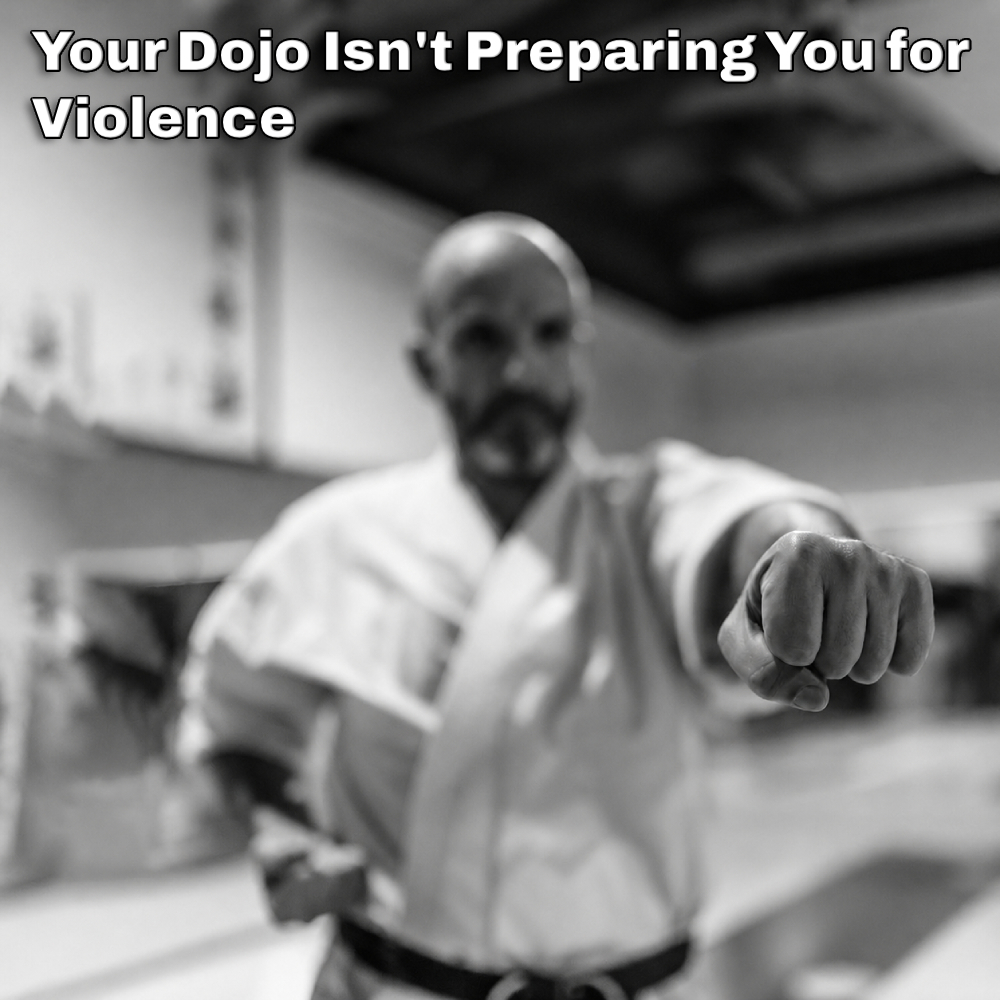
I’ve watched decades of students practice defense against attacks that don’t exist. That karate lunge punch from six feet away with the arm frozen in space? Nobody fights like that. Real violence is close, fast, and ugly. It starts before you realize it’s started. If your training partners are stepping back into perfect stances and leaving their arms extended, you’re training for a scenario that will never happen.
Punching air doesn’t tell you if your technique works. You need feedback – pads, bags, resistance, chaos. You need to know what it feels like when something actually connects, when someone’s actually trying to hurt you. Without that pressure, you’re just going through choreography.
And those “dirty” techniques everyone avoids? They’re only dirty because they’re banned in competition. Eye strikes, groin attacks, throat shots, spitting, biting – they’re banned because they work too well. If you’re not training them, you’re missing tools.
The attackers who matter aren’t looking for a fair fight. They don’t want to test their skills against yours. They want easy targets, surprise, overwhelming force. They want you frozen and confused while they do whatever they came to do.
And you will be surprised. Even with good awareness, even with training, violence in the real world doesn’t announce itself the way it does in the dojo.
The question is: how fast do you recover?
That’s the real skill. Not the technique. The recovery. Getting your brain back online when everything just went sideways.
Most martial artists I know – good people, serious practitioners – genuinely believe their training prepares them for “the street”. But what they’re actually prepared for is a fight. A consensual, rule-based exchange of techniques with someone who’s also trying to win within the same framework.
Self-defense is about not fighting at all if you can help it. And if you can’t help it, ending it as quickly as possible so you can leave.
Those are not the same thing. Make sure you know which one you’re training for.