
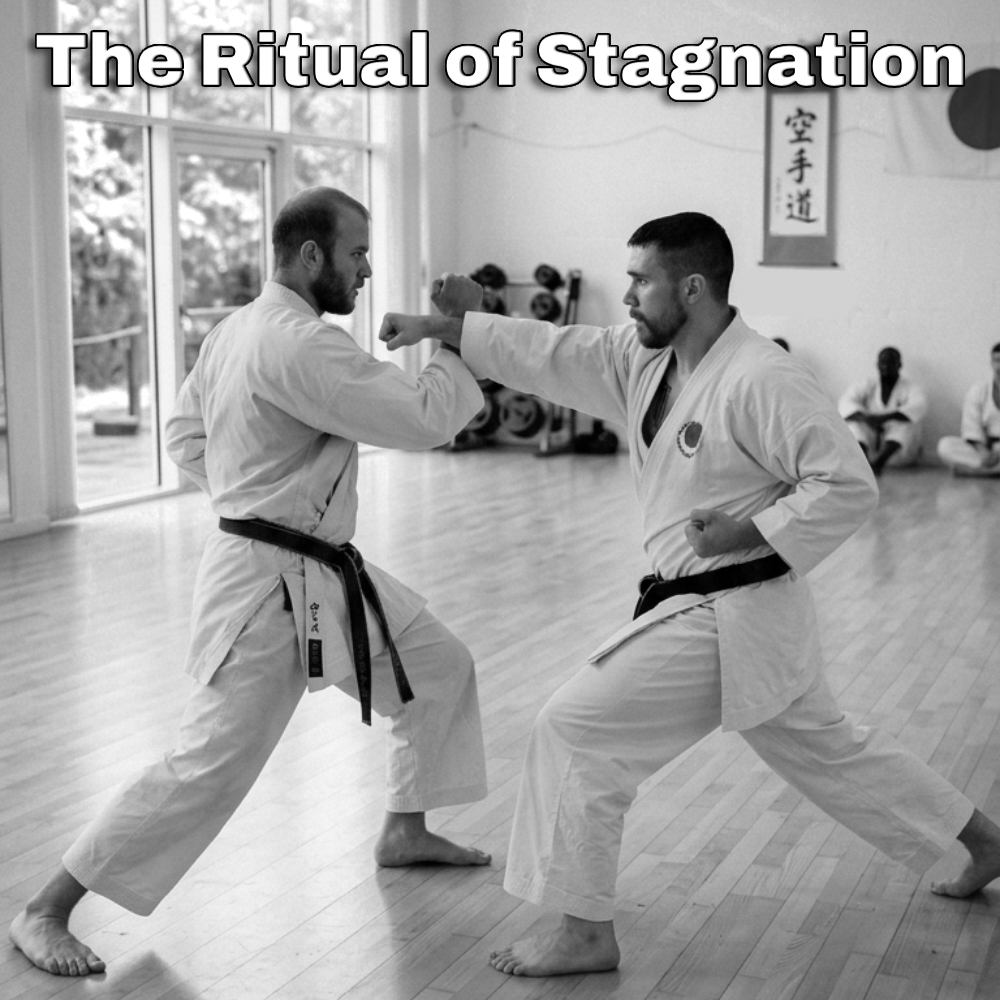
I saw a video recently that reinforced everything I’ve been saying about how stagnant karate has become.
It’s a recurring frustration.
You see the caption – Black Belt Training Course – and you expect to see the refinement of high-level skills. The people tasked with leading the next generation. Instead, you see grown men and women with decades of experience retreating in straight lines, responding to a choreographed attack that exists nowhere in any kind of reality.
It’s a bizarre stagnation.
If you spent twenty years learning to drive a car, but every weekend you still went back to the parking lot to practice “turning the key”, people would think you’d lost your mind. But in karate, we call it “refining the basics”.
Let’s be clear about what’s actually happening in that video.
It isn’t training. It’s a ritual.
When a black belt practices stepping-punch-versus-stepping-block from six feet away, they aren’t learning how to fight. They aren’t even learning how to move. They are performing a pantomime of what they think karate is supposed to look like.
The argument is always the same:
“We’re working on our form. We’re working on our structure.”
But structure without context is just a posture. If your structure only works when your partner is polite enough to stop their punch three inches from your chest and wait for your counter, your structure is a lie. It’s a house of cards that collapses the moment someone actually tries to hit you.
Too often, these courses aren’t about making better martial artists; they’re about ensuring the instructors can teach the next generation of beginners the same flawed patterns. It’s a closed loop. The goal is the preservation of the syllabus, not the preservation of the person.
If a black belt hasn’t evolved past the need for a compliant, single-step attack, then the “progression” so often talked about is a myth.
The belt changed color, but the logic stayed in the white belt class.
Someone told me recently they don’t want to practice for “real violence” in the dojo. Another said they were hired to teach “traditional karate, not self-defense”, so they don’t need reality.
That tells me they’ve confused stylization with function.
Whether you like it or not, karate is rooted in preparation for violence. If you remove the context that gave these movements meaning, what are you left with? You’re left with choreography.
Teaching young people “tradition” without reality isn’t a service – it’s a disservice. It’s giving them a false sense of security based on a compliant exchange that survives only in the dojo.
If karate is going to be anything more than a historical reenactment, we have to stop pretending that step-kumite is a foundational building block for real application. It isn’t. It’s a dead end.
It doesn’t lead to better timing. It leads to a false sense of security. It doesn’t lead to better distancing. It leads to a misunderstanding of how fast a real confrontation moves.
We have to stop confusing tradition with effectiveness.
Karate doesn’t fail people – unclear goals do.
If the most senior people in a style are still spending their time practicing how to fail in an overly controlled environment, we shouldn’t be surprised when the rest of the world stops taking karate seriously.
Because once the link to application is gone, the movements drift into theater. It might look impressive on social media, but it collapses under the slightest scrutiny.
It isn’t an evolution. It’s a circling of the drain.