
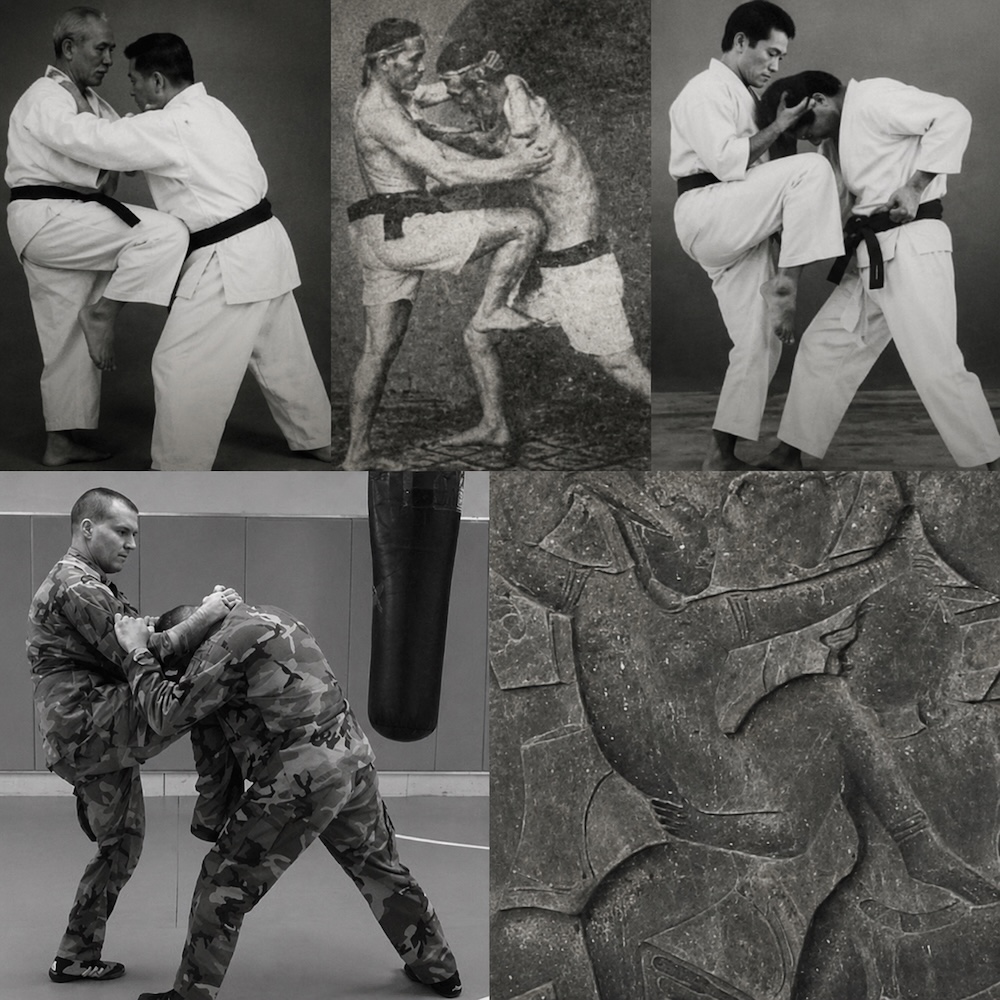
There is a strange habit in martial arts culture where people try to claim ownership over human movement.
A knee strike belongs to Muay Thai.
A joint lock belongs to Jujitsu.
A throw belongs to Judo.
As though human biomechanics were copyrighted. The reality is much simpler.
Human beings all have the same anatomy.
We bend the same way. Fall the same way. Break the same way.
Across different cultures and different centuries, people solving violent problems often arrived at similar answers independently.
This should not be surprising.
If two isolated groups of people discover that driving a knee into someone at close range is effective, it does not mean one “stole” it from the other.
It means both groups understood the mechanics of the human body.
Martial arts are full of these convergent developments.
The same is true of locks, throws, head control, limb destruction, low kicks, clinch work, and countless other methods.
The differences are usually not in the existence of the technique itself, but in the rules, priorities, training methods, and tactical context surrounding it.
Stylization often hides function.
People become so attached to the appearance of a movement that they stop recognizing its function. If a knee strike looks different from the version they are familiar with, they assume it must be unrelated.
But function matters more than aesthetics.
A technique does not suddenly belong to one system because that system popularized it, branded it well, or built a competitive format around it.
Violence is older than style.
The idea that martial arts developed as completely isolated inventions with exclusive ownership over specific movements collapses under even basic historical and practical scrutiny.
What martial arts systems really represent are different ways of organizing, emphasizing, and training shared human solutions.
That matters far more than arguing over who supposedly owns a knee strike.
The martial arts are not separate planets orbiting in isolation from one another. They are overlapping attempts by human beings to solve similar problems under different conditions.
Once you understand that, many of the endless style-versus-style arguments begin to look far less intelligent. And perhaps more importantly, you stop confusing stylization with function.
The human body has always moved the same way.
So has violence.
NOTE: The image includes a stone carving roughly 900 years old depicting a knee strike to the head.