
Being attacked with a knife is terrifying.
I have seen the results of many of these attacks in my past careers – some of them fatal.
And yet most knife defense demonstrations begin the same way.
A single, committed middle thrust from distance. Like a standard karate-type stepping punch.
No – that’s not how it happens.
Real knife assaults are not long-range duels. They are sudden. Close. Fast. Often concealed until the last possible moment.
The attacker doesn’t stand three steps away and announce their intention.
They close distance. They distract. They lead with the free hand. They shove, grab, crash in – and the weapon is already working before you have fully processed what is happening.
Knives are close-range tools. Most attacks begin at conversation distance – arm’s length or less. That leaves almost no reactionary gap.
If you’re not expecting it, stopping the first stab is unlikely.
And it won’t be a single thrust.
More often it resembles a sewing machine – short, rapid, repeated stabs delivered with forward pressure. The attacker will continue thrusting, stabbing, slashing until he has achieved his desired result.
Relentless.
And this is where many training assumptions fall apart. You’ve moved offline. Now what?
…nothing meaningful has changed.
You have altered your position, but you have not altered the threat.
In edged-weapon assaults, the issue is not the “line of attack”. It is the capacity to continue cutting.
If the attacker’s arm is free and mobile, and they remain within range, the assault continues.
That’s physics, not opinion.
The reason stepping offline became romanticized is simple: in compliant dojo formats, the attack ends when the defender completes the movement.
In reality, attackers do not stop because you performed one technique.
But there’s another uncomfortable question here.
If someone is far enough away to deliver a long, committed stepping thrust – why are you still standing there?
If you genuinely have distance, your first response is not to wait for the attack so you can get off the centre line and move to the side.
It is to get out of there.
Create space. Break contact. Use obstacles. Change direction. Run if you can.
That is judgement, not weakness.
Teaching self-defense – and yes, I am repeating myself – must show reality, not fantasy. If you have zero experience of this type of weapon attack, you should think very carefully before presenting choreography as functional survival.
I wrote recently about “karate ni sente nashi”. In practical terms it asks something simple – why wait? Why engage when you don’t have to?
If distance exists, use it.
Waiting for someone to launch a committed thrust so you can step off the centre line and believe the problem is solved is built on assumption.
Real knife assaults do not happen like that.
And it is irresponsible to teach it that way.
If there is room to move before the weapon is in play, that movement should be escape – not choreography.
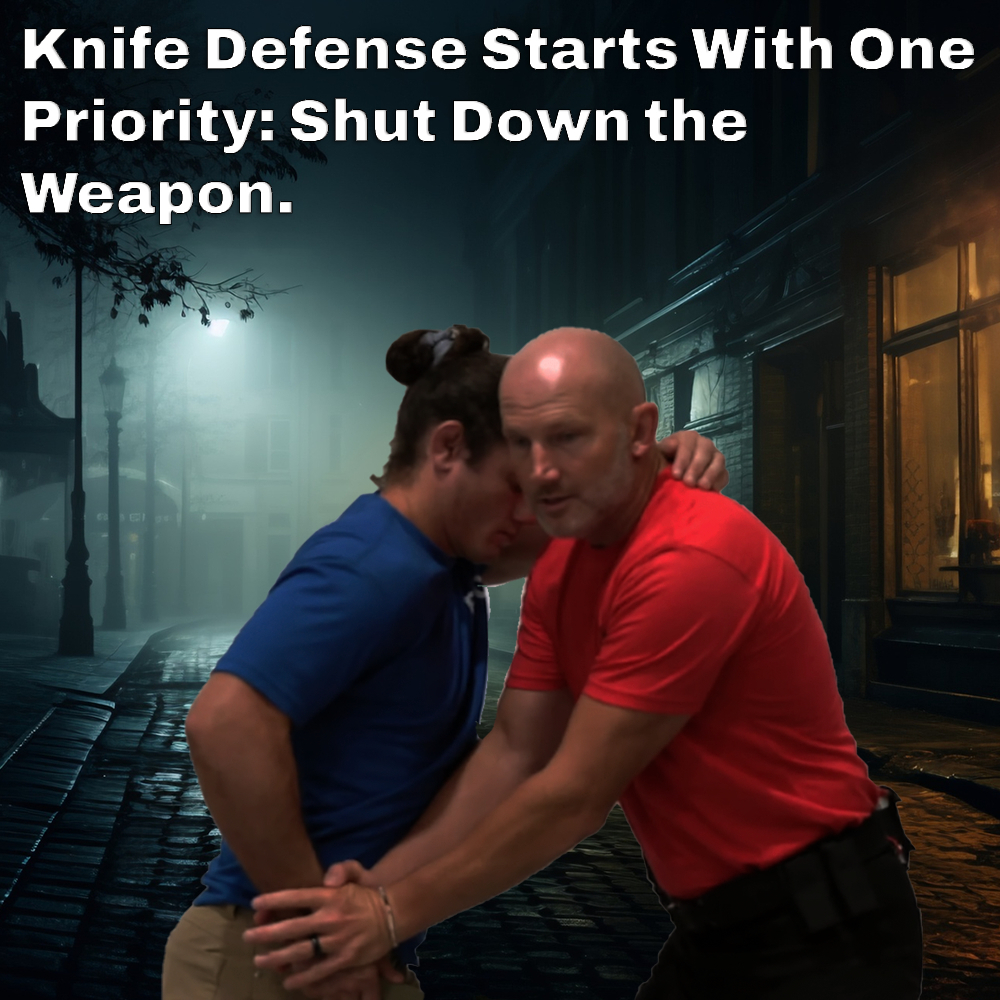
Once the blade is already working at close range, your options narrow dramatically. Distance and escape are always the first choice. But when distance has already collapsed and escape is no longer possible, the priority becomes brutally simple: shut down the weapon.
You may have to crash in. Smother the weapon arm. Trap it against your body. Jam it with your shoulder. Tie it up – and accept that you may get cut while trying to reduce the damage.
It is ugly. Close. Chaotic. Exhausting.
And even then, you may still bleed.
The goal is damage limitation.
I once demonstrated this with something as simple as a candle – firm enough to leave marks on a karate-gi, harmless enough not to injure. Within seconds there were multiple “wounds”. The students were surprised how simple it was for me to get through.
It was sobering.
Drills are useful. But drills are useless in the wrong context with the wrong assumptions.
If an attacker with a blade stops after one thrust and waits, you’re not rehearsing assault dynamics – you’re rehearsing cooperation.
That is not survivable.
And that is a lesson every martial arts instructor should think about very carefully.
If you value these insights, you can support my work here: buymeacoffee.com/shuridojo – Thank you – every contribution is appreciated.