
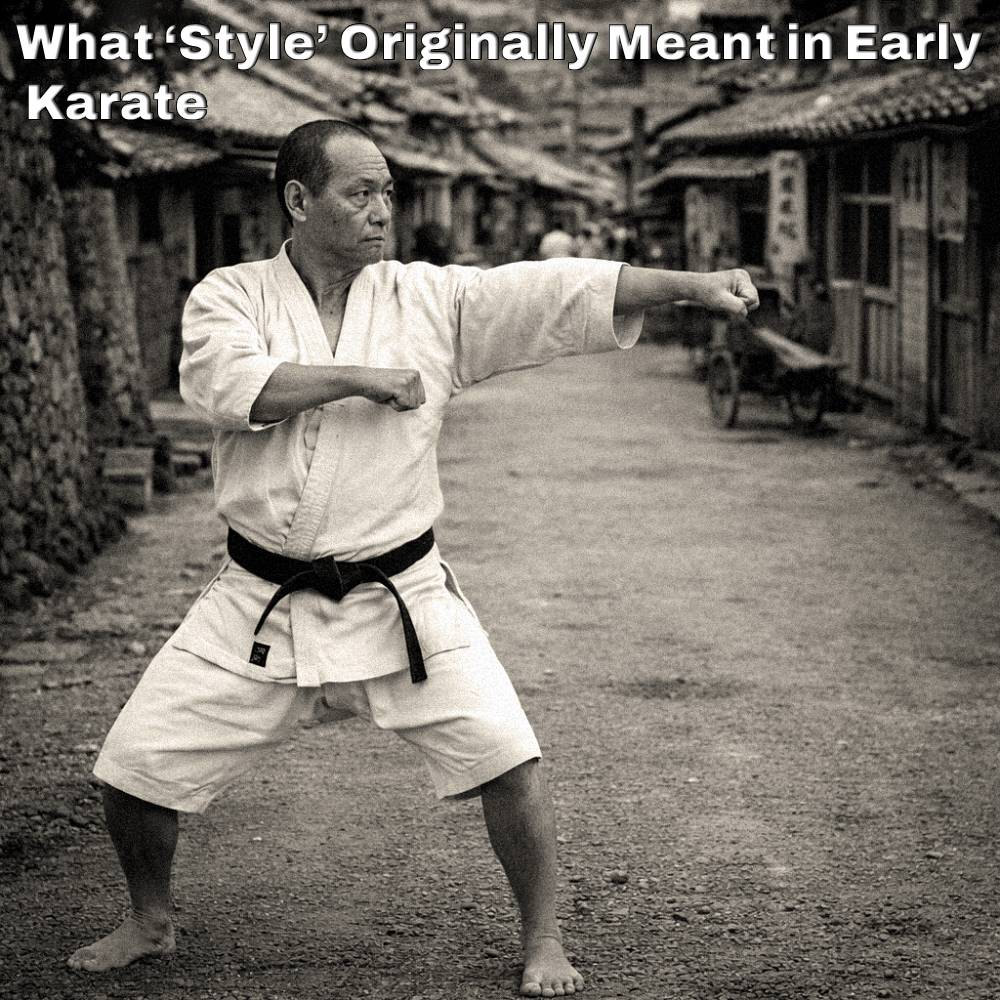
Choki Motobu once remarked that a single kata represented the style of the time. In my opinion, he wasn’t talking about stances and techniques, but something deeper.
Motobu was known for his very practical view of fighting. He famously emphasized the importance of Naihanchi, once stating that “Naihanchi is the foundation of karate.” His focus on that kata reflected something important about how the early pioneers thought about training.
Today we use the word “style” to describe a system or organization – Shotokan, Goju Ryu, Shito-Ryu and more. But when the early pioneers spoke of style, before these systems were formally named, they weren’t referring to stance depth or whether the hikite hand was chambered at the correct height.
They were talking about something broader.
They were referring to an overall strategy – their signature plan for controlling and finishing a fight.
That signature plan is the theme, if you like.
Think of it like this. If one teacher’s strategy focused on close-quarters control and joint manipulation, the resulting kata would naturally flow from strikes into grabs, teaching students how to stick to the opponent and control their joints. That kata codifies the plan. In many ways, it is the style.
Choki Motobu, for example, emphasized close-range grappling, control, and striking movement. Although Naihanchi was not his creation, his focus on it wasn’t just about technique – it reflected his strategic preference. The kata wasn’t simply a form – it was a blueprint.
Today we often define style by what we see. We might say, “style A uses low stances, style B uses high stances.” But aesthetics were unlikely to have been their concern.
Their definition of style was strategic. One teacher may use counters combined with grappling while managing distance, while another might overwhelm an opponent with rapid, direct striking.
Kata may sometimes have represented an entire family’s fighting method, but the real distinction lay in strategy – the theme – rather than appearance.
This focus on strategy also explains why techniques, to us at least, are often disguised within kata. A complex plan could not be spelled out literally – the kata would be far too long. Instead, the creator condensed the plan into simple movements, sometimes vague to modern eyes, trusting that students could decode them because they already understood the theme.
Today a style may contain many kata – we seem to be collectors. But in my opinion each kata carries its own theme. Every kata reflects a creator’s plan, a specific purpose. The style itself becomes the sum of those themes – a broader expression of strategy.
Of course things are very different today. Much of the focus has shifted to how techniques look, combined into what is essentially a performance form. But to truly understand kata we should be asking a different question – why is it there, and what did the creator intend?
When we study kata and try to understand its depth, we shouldn’t get lost in individual techniques. Look for the theme, the strategy, the reason behind every action.
Because once you understand the theme, the kata begins to make sense as a complete fighting method rather than a collection of movements.
That was the heart of the early pioneers’ teaching – their “style”.
Photo Credit: Artists rendition of Choki Motobu
If you value these insights, you can support my work here: buymeacoffee.com/shuridojo – Thank you – every contribution is appreciated.