
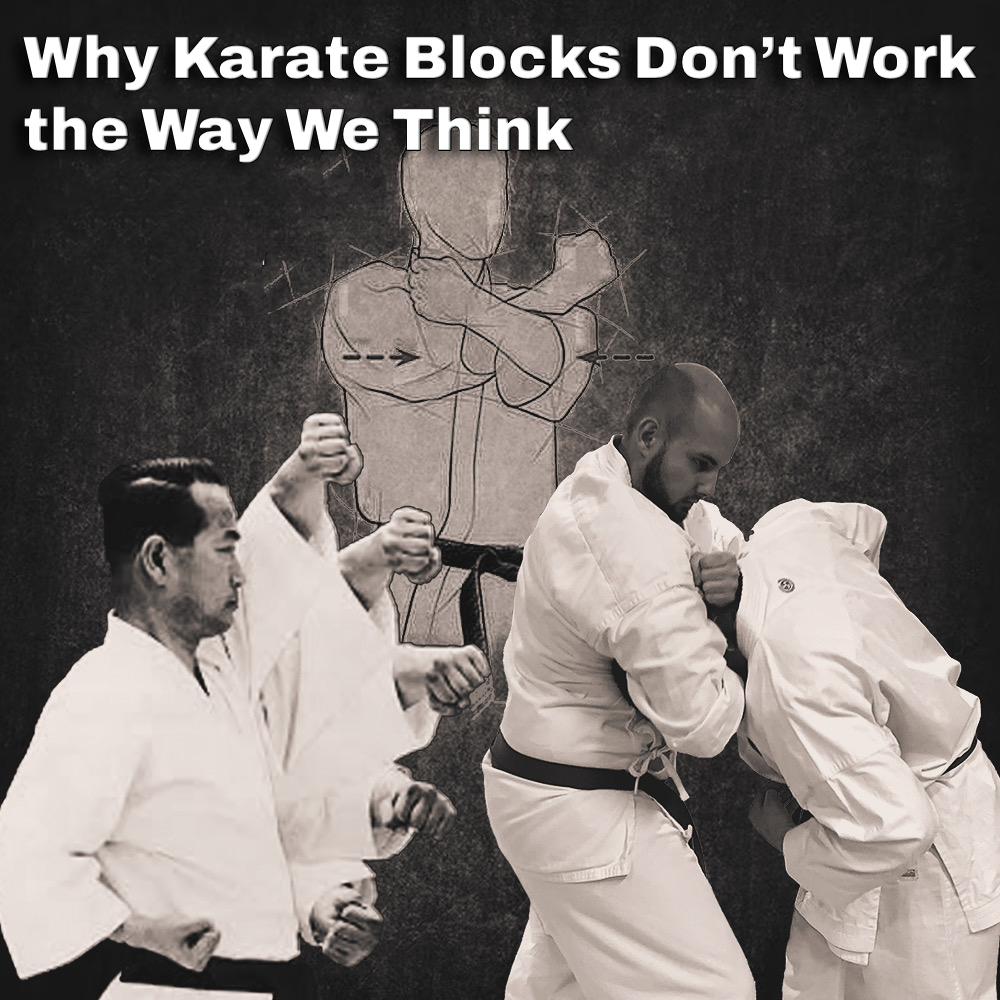
One of the first things you learn as a beginner is a ‘block’, right?
Typically, it’s one of these: upper, middle inner, middle outer, or a down block.
You spend a significant amount of time practicing these blocks, focusing on the small details, making sure your pulling hand (hikite) is positioned perfectly, all performed with excellent focus (kime).
After practicing them solo, you then face a partner and attempt to block their punch with your best technique.
However, with experience you soon realize that even when you anticipate it, blocking becomes challenging. Your partner is now getting experienced too and he is attacking faster and faster. Your instructor assures you that with even more practice, you’ll improve and become faster.
Yet, over time, you begin to realize that blocking an attack only works when you know it’s coming.
But hold on. That’s not reality.
Okay, but did they ever say it was?
For anything to work in any kind of reality you have to get close. There is no avoiding it.
If you have space then what is the best option? Escape. That should always be your first priority.
And if your goals are self-defense you had better learn how to get close, and how to get away from being close.
But when practicing in the dojo, you’re not close at all. You start at a distance, nowhere near being able to touch someone, let alone grab them. You will notice that the stances are usually too long. You’re trying to take a massive step just to reach your opponent. The distance is completely wrong for close combat. It’s unrealistic.
And then during the next phase you’re retreating directly backwards in the face of an attack. What would happen in reality if you keep stepping backwards?
You would be chased down.
You would lose balance, perhaps trip, stumble, fall over things.
You’re never in control.
It is much safer and more advantageous to move off the line of attack, isn’t it?
So if this stepping action doesn’t really work unless your partner stops his punch well short of you, in a locked front stance, in what reality is that?
It isn’t.
It’s a demonstration.
It is choreography so that no one gets hurt. I have seen so many attacks that either stop short of the person being attacked, with no penetration, or shift off to the side to avoid a collision. This kind of presentation may be useful for showing form, but it should never be mistaken for how violence actually unfolds.
Either way this is not helping the defender.
Training that is repeated becomes habit. Bad training becomes a bad habit, and you cannot simply drop bad habits whenever you like.
Someone once said to me that you wouldn’t teach children algebra before basic arithmetic.
True – but algebra is a natural progression, and it is useful.
Teaching something flawed just because someone is a beginner is wrong.
You can teach beginners practical, pragmatic karate from day one. There is no need for drills that do not work in the context of some kind of reality.
Watch a real fight – people cover, parry, duck, flinch.
All natural.
And that should tell us something important.
The body already has instinctive responses to sudden danger. Hands come up. The head drops. The shoulders turn. We try to protect ourselves while moving.
If karate is supposed to be a method of self-protection, then training should work with those instincts, not against them.
This is where many of the so-called ‘blocks’ start to make more sense.
Look again at movements like age-uke, soto-uke, or gedan-barai, but forget the idea that they are meant to meet a punch in mid-air from a long distance away.
At close range, those same movements become something very different.
They can clear an arm, control a limb, strike while covering the head, or move the opponent off balance while you reposition.
In other words, they are not simply blocks.
They are actions that happen once you are already close.
That is the part many training drills miss. They present the movement as a defensive response to a long-range attack, when in reality the movement only begins to make sense once distance has collapsed.
And distance always collapses.
Either you move in, or the other person does.
Once that happens the neat idea of standing in a long stance waiting to block a punch disappears very quickly.
What remains are small movements, tight actions, and the constant need to control the space between you and the other person.
That is where kata begins to make far more sense.
Instead of imagining distant punches and perfect blocks, you begin to see movements that deal with contact – clearing, covering, striking, controlling, and creating the moment needed to escape.
The movement did not change.
The context did.
And in karate, context changes everything.
If you value these insights, you can support my work here: buymeacoffee.com/shuridojo – Thank you – every contribution is appreciated.