
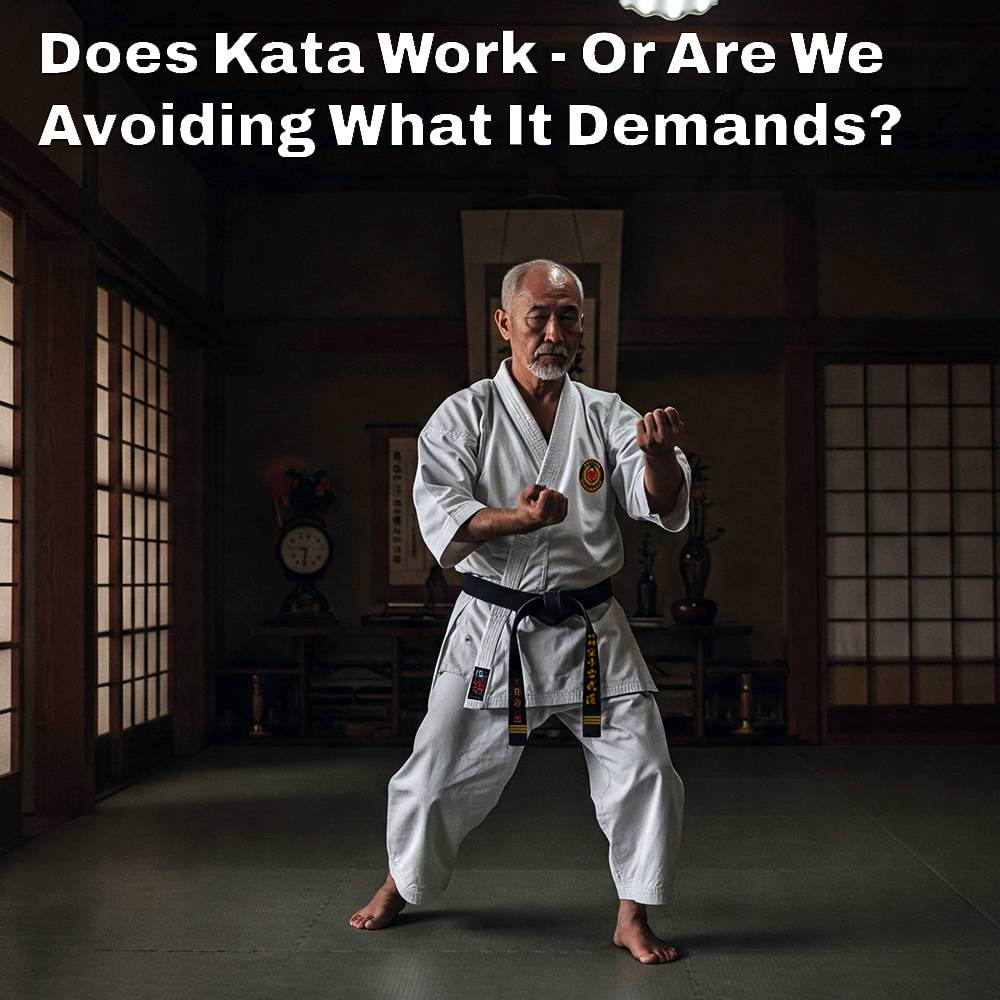
If we don’t understand the applications in kata – are we wasting our time?
Someone asked me that recently. It’s a fair question.
There is no single, perfect answer to what any movement in kata “is”. Even if the original creator had something specific in mind, that intent is long gone. What remains is the movement. What we extract from it depends on our level of understanding.
But here’s the part people don’t like hearing.
It isn’t kata’s fault if we don’t understand it.
Today we’re constantly reminded that we don’t “need” kata. Practitioners of MMA, jiu-jitsu, kickboxing, even some karateka – point out that you can train effectively without ever performing kata.
And they’re right.
But that misses the point.
Kata is what makes karate distinct. It’s a transmission method. Originally, it was a way of preserving fighting experience – a mnemonic catalogue of combative principles and two-person drills, condensed into solo practice. It allowed someone to train alone while retaining lessons learned in real violence.
That was its context.
Now the context has changed.
Today kata is used for fitness, art, competition, grading structures, cultural preservation. None of that is wrong – unless we start confusing one purpose for another.
And that’s where most of the confusion begins.
Your analysis – your bunkai – should not stop at:
“what does this movement do?”
It should move to:
“how does this actually work in different situations?”
That question changes everything.
Because the moment you test a movement against resistance – someone pushing or pulling you, not co-operating – unpredictability creeps in. When fear and adrenaline enter the party, it either holds up, or it doesn’t.
That’s where exploration begins.
Too often kata is taught at surface level – just enough to pass a test. Just enough to tick a box. And perhaps some students are perfectly content with that. Not everyone is searching for depth.
But historically, depth was the point.
The old Okinawan teachers did not accumulate endless kata. They studied a small number thoroughly. They went deep into principle – body positioning, weight transfer, limb control, striking angles, off-balancing.
They weren’t collecting patterns.
They were refining understanding.
In the West, we often equate having more with progress. If we’re not learning something new every few months, we feel stagnant.
But depth feels repetitive. It feels technical. It feels slow.
Understanding the “why” behind the “how” is rarely exciting.
It is, however, transformative.
When I teach application, I use Japanese terminology alongside English – but only as reference. The label is not the lesson. A term is not a rigid instruction to perform a single fixed technique.
The movement must be understood as a whole – from beginning to end – its full range, both hands, body position, angle, intent.
Otherwise, we are memorizing isolated techniques.
A beginner can demonstrate a basic interpretation of a sequence. An advanced practitioner should be able to move through it fluidly – showing variations, combinations, contingencies. Not fantasy additions, but developments grounded in pressure testing and experience.
People see kata in different ways: Exercise. Art. Performance. Self-expression. Self-defense. All valid – within their own context.
But context must be acknowledged.
If your goal is combative function, kata must be explored accordingly. If your goal is cultural study, that’s different. If your goal is sport performance, that is different again.
Problems arise when we blur those lines.
Kata is not inherently useless. Nor is it automatically profound.
It becomes valuable – or superficial – depending on how honestly we engage with it.
And for me, when approached with clarity of purpose and a willingness to test assumptions, karate is far richer for it.
Kata doesn’t fail people – using it in the wrong context does.
And sometimes the real question isn’t whether kata works.
It’s whether we’re willing to do what’s required to make it function.
If you value these insights, you can support my work here: buymeacoffee.com/shuridojo – Thank you – every contribution is appreciated.