
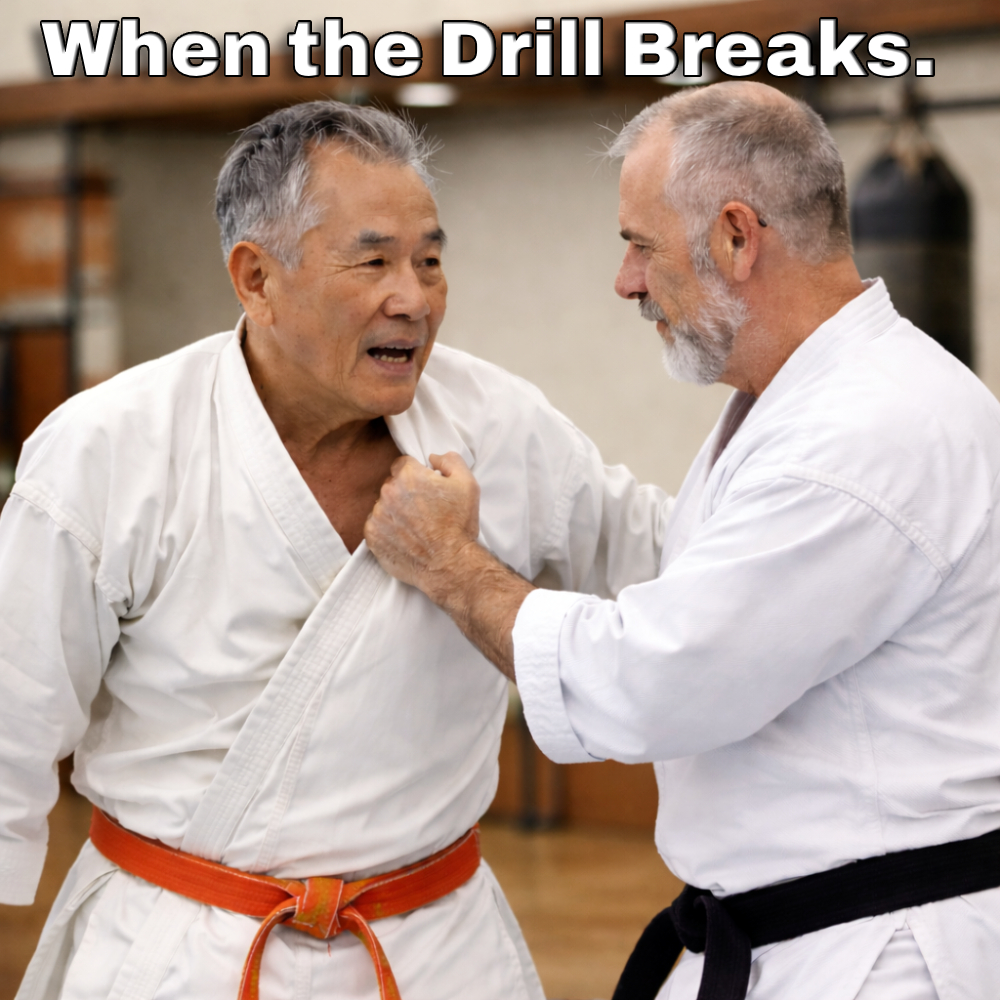
Sometimes a student freezes.
Not because they don’t know a technique – but because the expected sequence has disappeared.
That is the moment training becomes real.
In my last article, I wrote that cooperation is not the same as pressure – that structure without uncertainty becomes choreography.
The natural question follows.
How do we introduce uncertainty without creating chaos?
Beginners need structure. They need clarity. They need safety.
But safety and unpredictability are not opposites.
In my dojo, our training often begins with verbal pressure. Close range. Tone. Arguing. The student performs a learned response.
Then we break the drill.
The attacker adds something not rehearsed. A second movement. Sometimes a third. Something unexpected.
Sometimes the student freezes. That pause is not failure. It’s their first encounter with uncertainty.
When that happens, I tell them to try anything. Move. Adjust. Solve the problem in front of you.
At first, the response may be messy. Uncertain. Even awkward.
That’s fine.
The goal is not perfection.
The goal is decision-making.
Confidence does not come from repeating a flawless sequence. It comes from navigating something imperfect, something not expected, and finding a way through it.
At this stage, the intensity, the pressure, remains low, the environment is controlled. The structure is still there.
But the predictability is gone.
And that is where adaptability begins.
If kata preserved principles drawn from two people working together under pressure, then training must occasionally allow the pattern to break.
Not to overwhelm.
But to require a choice. To adapt. To find another way.
Because it’s confidence in problem solving – not performance, not choreography – that ultimately transfers beyond the dojo.