
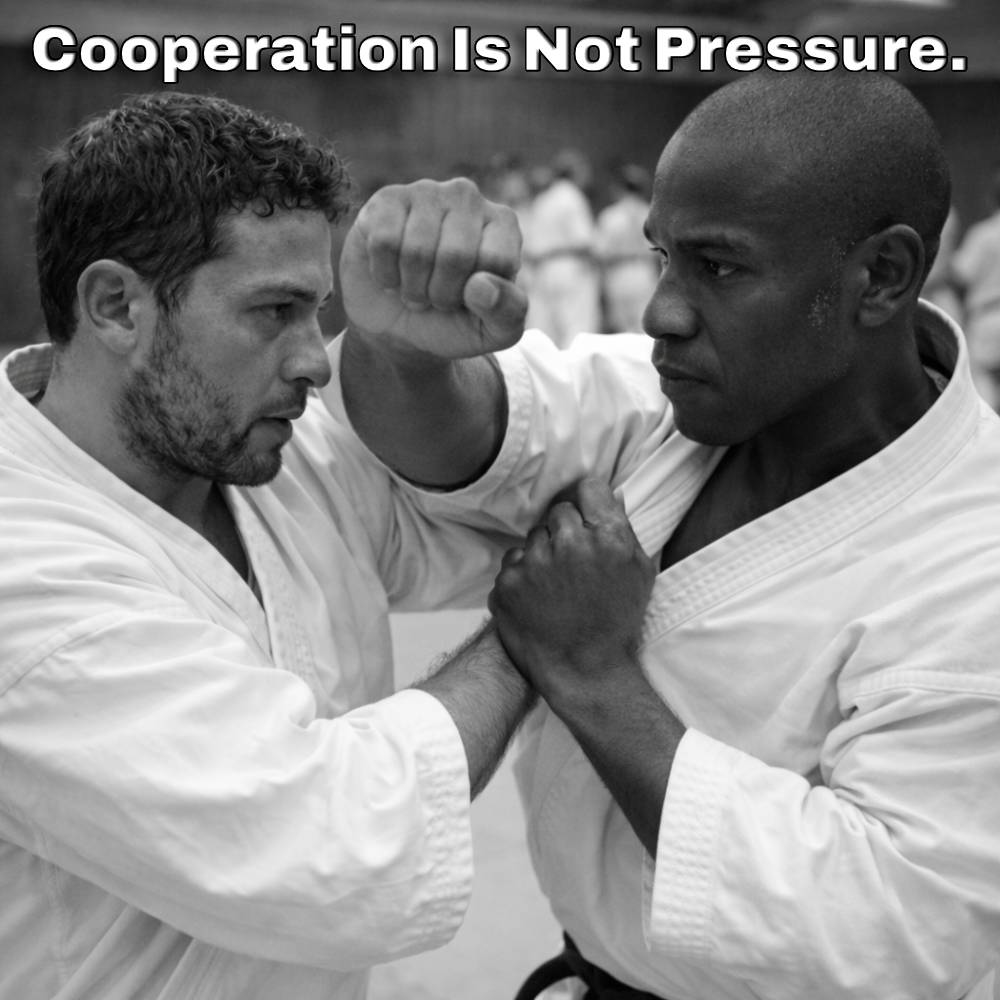
In my last article, I wrote that before there were kata, there were two people working together.
That order matters.
But working together is not the same as working under pressure.
There is a difference between training with a partner and training against uncertainty.
And that difference matters.
Many schools spend a great deal of time on pre-arranged drills. The attack is known. The response is fixed. Both people understand the script before it begins.
It looks precise. It feels organized.
But what is actually being trained?
If the response is fixed – if the sequence cannot break, change, or fail – then what is being developed is compliance with a script. You become good at completing the drill.
That is not the same as learning to deal with unpredictability.
I often hear that beginners need to “feel what it’s like to be attacked”. Fair enough. Everyone has to start somewhere.
But attacked how?
A real assault does not usually arrive as a measured lunge from an agreed distance. It comes from closer range. From a verbal exchange. From shifting tone. From pressure building before anyone says “go”.
Uncertainty is the defining feature.
Remove the uncertainty and you remove the very thing that needs to be learned.
This isn’t an argument against structure. Structure is essential. Beginners should not be thrown into chaos.
But structure does not have to mean choreography.
Even early drills can contain variation. Limited options. Variable starts. Broken rhythm. Pressure introduced carefully and progressively.
Structure can remain – without pretending that attacks arrive on cue.
If kata preserved principles drawn from two people working together under real pressure, then our responsibility is to reintroduce that pressure – not replace it with a script.
Cooperation teaches cooperation.
Function requires uncertainty.
Without it, partner work becomes performance.