
Kata Came Later
In my previous article, I wrote that training existed first and kata came later. That order matters.
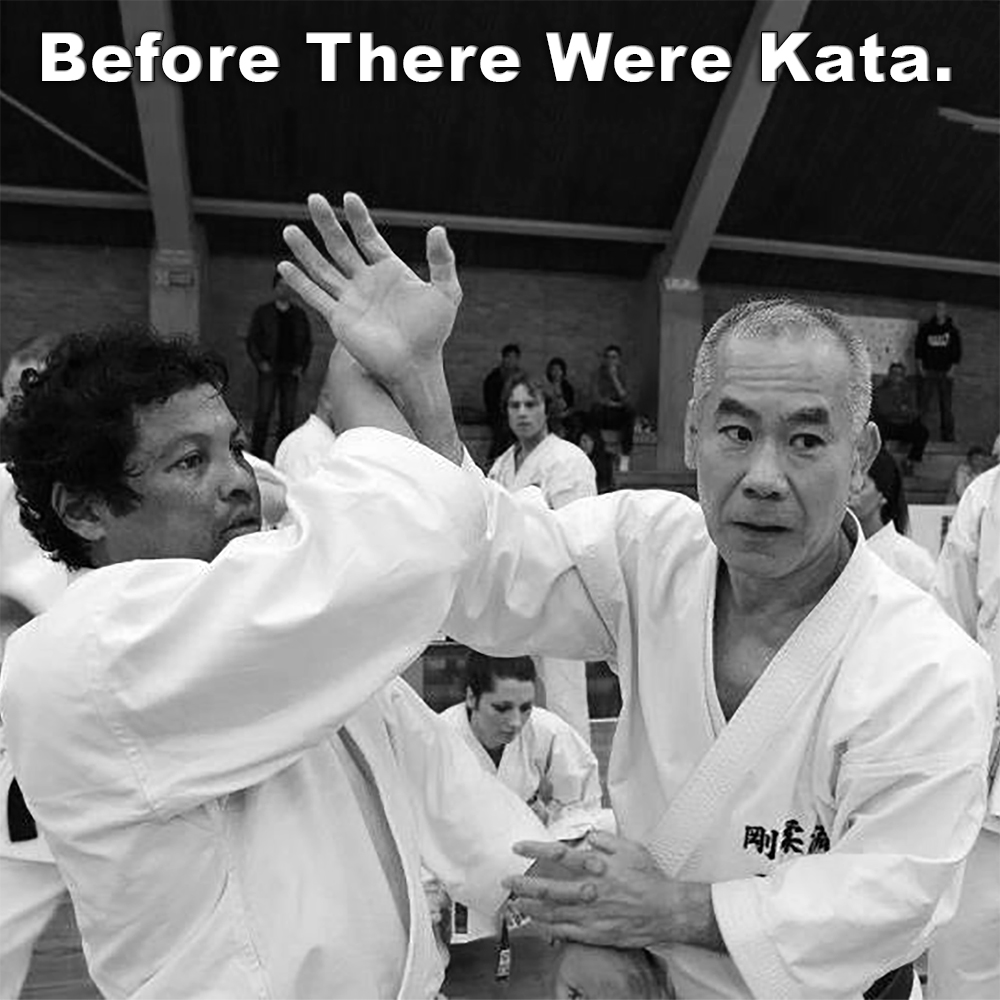
Before forms were formalized, people trained together. They worked through problems with a partner. They tested movement under pressure. They adjusted and refined what was useful.
Think about that for a moment. It had to be that way. Otherwise it’s just a dance.
Striking drills. Clinch work. Escapes from common holds. Methods for controlling space and balance. These were not theoretical ideas. They were explored directly with another person.
Those movements were not created by kata. They were preserved within it so they could be retained and revisited.
Kata does not show timing. It does not show resistance. It does not show unpredictability. Those elements come from partner training. Without them, the form becomes an outline without depth.
The key to the purpose of kata is intent in its practice.
Any application you extract – your analysis, your bunkai – must begin by asking what it’s for. Only then can a drill be considered functional or not. It is the context you place on your training that determines its value.
Without intent and context, kata becomes little more than a way to pass a test.
Over time, however, something subtle shifted.
In many schools today, kata is primarily associated with grading. It becomes something prepared, refined, and demonstrated in order to progress. The emphasis moves from what it preserves to how it appears.
When that shift happens, its meaning changes.
If kata becomes something to pass, then once the test is over, its purpose feels complete. It becomes a requirement fulfilled rather than a method explored.
But kata was never meant to stand alone.
If it’s a memory device, it must point back to real training – partner work, resistance, correction, exploration. Without that foundation, there is nothing meaningful for it to preserve.
When kata becomes detached from the training that gave it life, people naturally begin to question its value. That question is understandable.
The loss of meaning does not begin with the form itself. It begins when the surrounding training changes.
Kata reflects the priorities of the dojo that teaches it.
If the priority is rank, it reflects rank.
If the priority is performance, it reflects performance.
If the priority is functional training, it reflects function.
Kata can be thought of as textbooks. But a textbook only has value if we learn how to read it properly.
Before there were forms, there were two people working together.
Kata came later.