
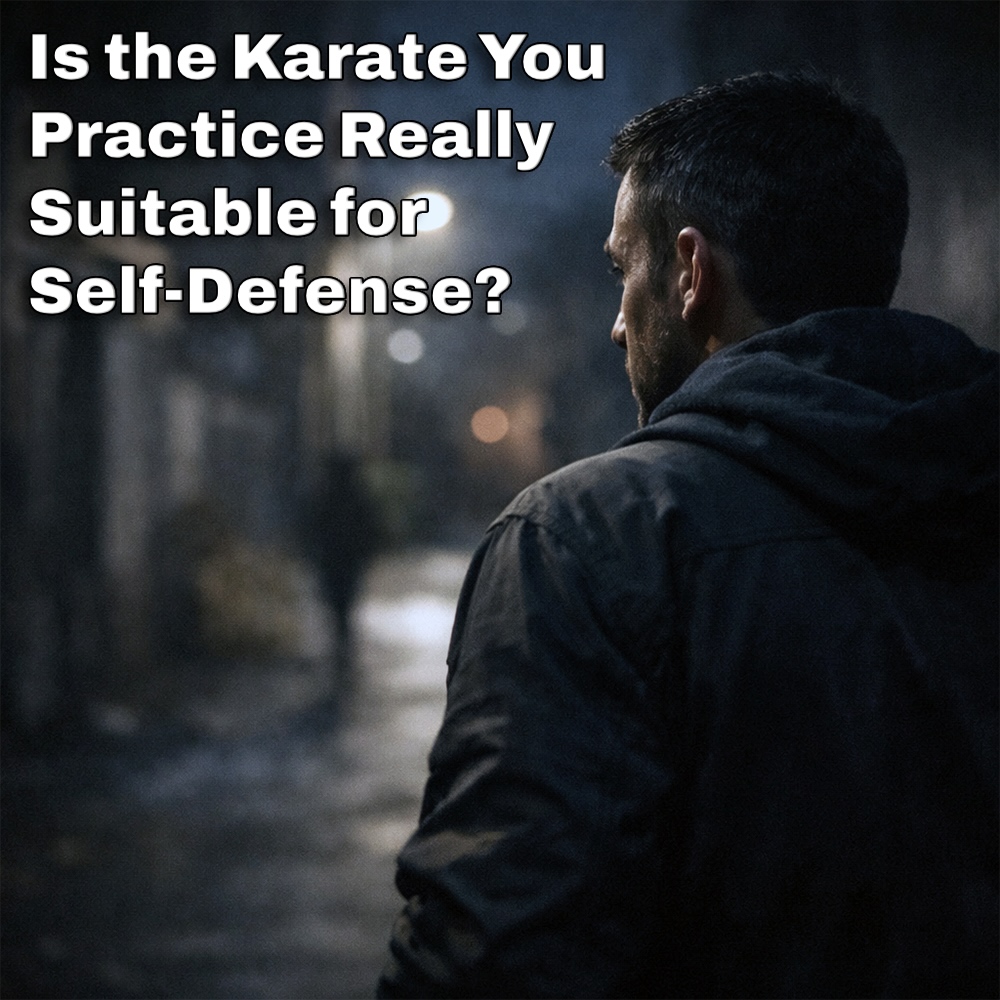
Almost every promotional video I am sent to watch, or website I am asked to view, mentions one thing – self-defense.
Very few say they teach competition. Fewer still say it is primarily for fitness or personal development.
Self-defense is the preferred label.
There is nothing inherently wrong with that. The problem begins when the content shown does not match the claim being made.
Karate can be many things. It can be athletic, traditional, competitive, cultural, or artistic. None of those are inferior pursuits. But if something is being presented as self-protection, it should withstand scrutiny in that context.
And this is where the uncomfortable question emerges.
Most demonstrations show the response. Very few show the beginning.
Where is the verbal boundary setting, the moment before contact, the physical positioning that prevents escalation? Where is the decision not to engage?
Violence does not begin with a clean, straight attack. It begins with ambiguity, emotion, people too close, and rapid decision-making.
Yet much of what is labelled self-defense focuses almost exclusively on stylized physical exchanges – often performed against compliant or paused attackers. These sequences may demonstrate coordination and technical skills, but it’s not self-defense.
This is not the same as preparing someone for confrontation.
This is not a criticism of any individual instructor, nor any particular style. It’s a question of context.
If we claim self-defense, we must ask: self-defense against what?
Against consensual sparring or prearranged attack drills? Or against unpredictable confrontation outside the dojo?
Walking away from a confrontation is not weakness. It’s judgment. De-escalation is not passivity. It’s control.
Physical skill has value. But it’s only part of the picture. I have said this more times than I can count. Self-protection includes awareness, restraint, timing, and the ability to disengage when possible. It includes protecting others. It includes knowing when involvement increases danger rather than reduces it. Getting out of there as quickly as possible is not weakness. It’s sound judgment.
New students often take instructors at their word. If something is advertised as self-defense, they reasonably assume it will help them stay safe outside controlled environments. That trust carries responsibility.
Karate does not need to be only one thing. But whatever we present it as – competition, tradition, fitness, or self-protection – it should hold up to examination in that context.
Perhaps I keep repeating myself because I keep being shown the same thing. I don’t care how respected the instructor is. The standard should be the same for everyone – if it’s presented as self-defense, it must hold up when examined honestly.
If we use the language of safety, we should be prepared to demonstrate it.
If you value these insights, you can support my work here: buymeacoffee.com/shuridojo – Thank you – every contribution is appreciated.