
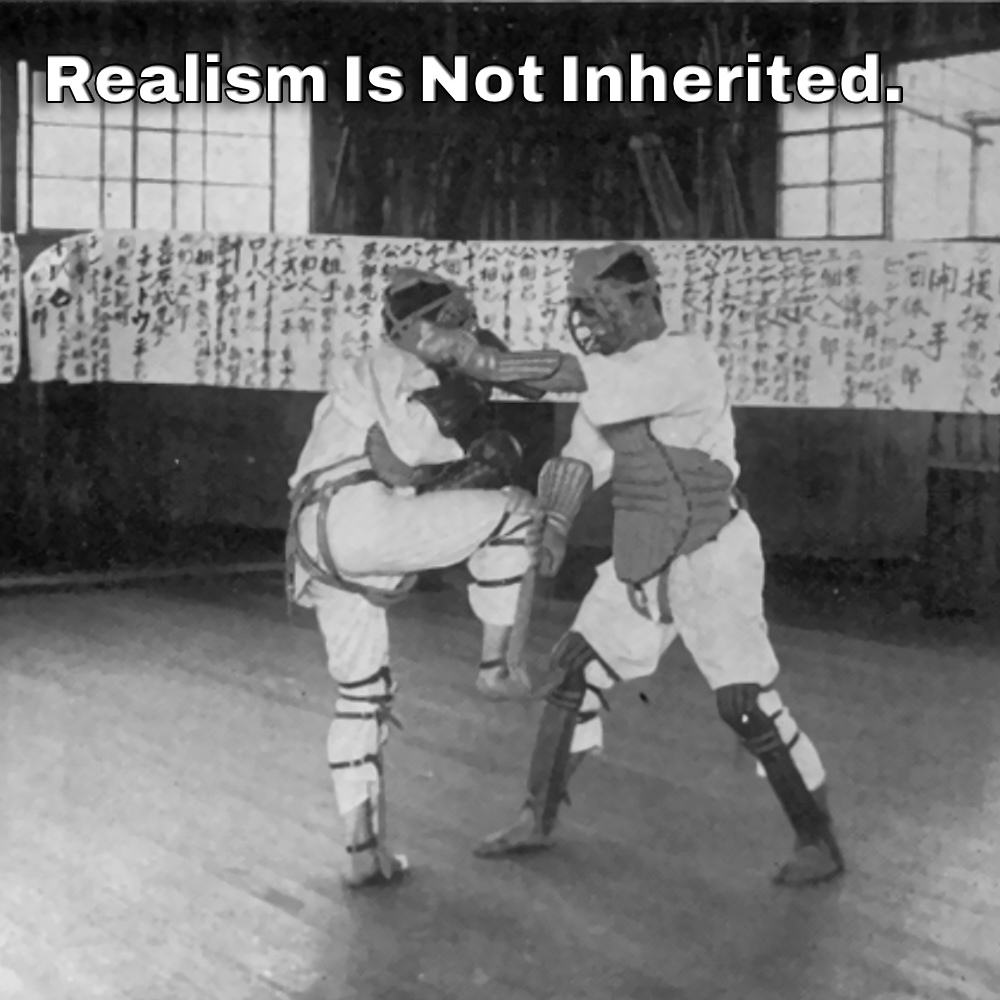
Are older systems, older styles, closer to realism?
There may be some truth in that. Older systems can preserve deeper material. They can carry forward ideas that were not designed for sport or performance.
But age on its own doesn’t guarantee anything.
I value lineage. I draw satisfaction from knowing who taught me, and who taught them. Continuity has meaning. It gives weight to what we do. That matters.
But preserving material and preserving intent are not the same thing.
You can inherit movements that are two hundred years old and still practice them in a way that has very little to do with how confrontation actually unfolds.
If the response is always known in advance, if the attack is always clean, if the timing is always cooperative, then the age of the movement doesn’t suddenly make it realistic.
Realism isn’t stored inside a system, waiting to be unlocked. It depends entirely on how training is approached.
An older curriculum might give you strong raw material. Look at the kata we’ve inherited. They do contain methods that lend themselves to close-range work or escalation awareness. That’s valuable. But those elements still have to be practiced deliberately.
Otherwise, they become something else.
When I say something has to be practiced deliberately, I mean this:
Are you allowing unpredictability into the drill, or is everything known in advance?
Is your partner resisting, interrupting, and disrupting you – or cooperating so the sequence completes cleanly?
Are you training the awkward beginning of confrontation – close, hesitant, verbal – or only the neat physical response?
Are mistakes allowed to happen so you learn to recover, or is everything reset the moment it goes wrong?
That is what deliberate practice looks like.
You deliberately allow things to go wrong. You look at how something begins, not just how it finishes.
You examine whether the drill reflects how people actually move, react, hesitate, escalate, or disengage.
Without that, even very old material can become choreography. And choreography can survive for generations if no one stops to examine it.
The dividing line is not old versus modern. It’s assumption versus examination.
Realism is not inherited.
It is maintained through how we train, not merely what we train.
If you value these insights, you can support my work here: buymeacoffee.com/shuridojo – Thank you – every contribution is appreciated.