
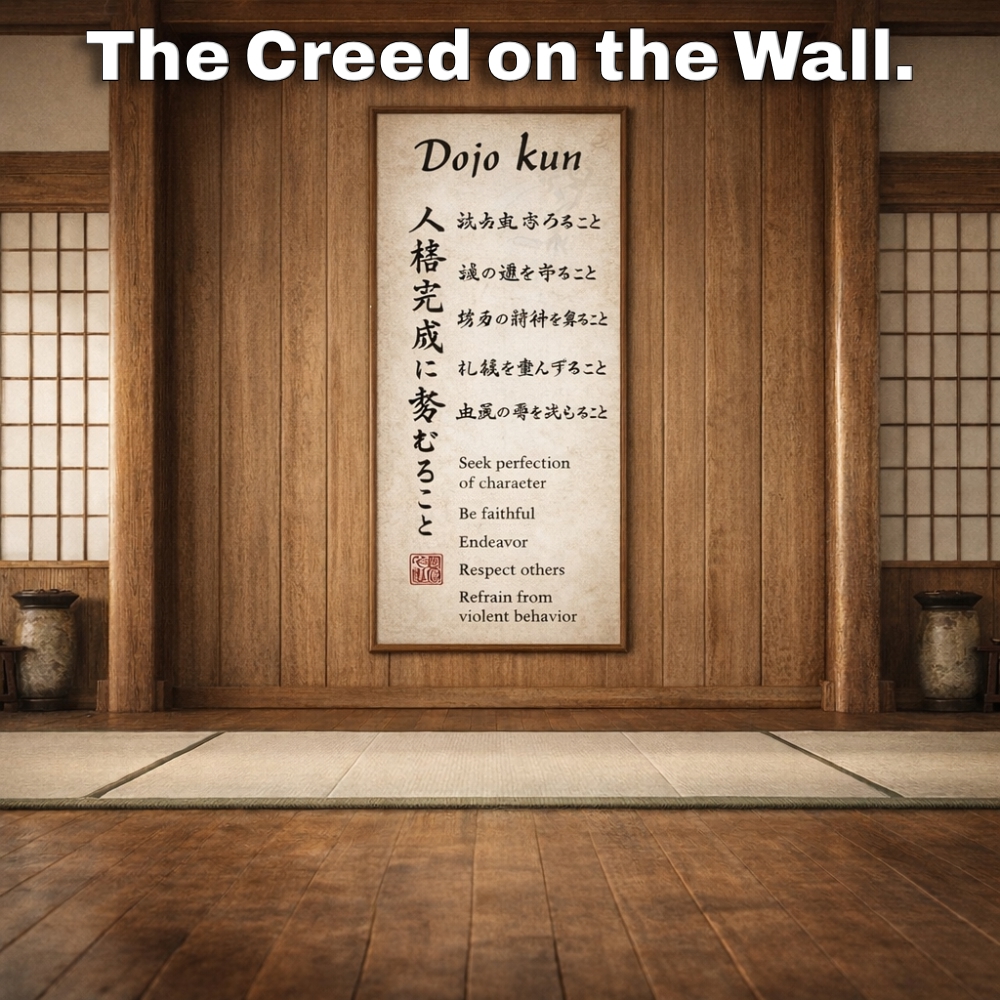
Most dojos have a creed – a Dojo-Kun (道場訓). A list of promises or ideals, framed neatly on the wall. Students recite it at the start or end of class, bow respectfully, then forget half of it before they reach the car park.
That isn’t criticism. It’s just observation.
A creed is only words until you choose to live by it.
Words on a wall won’t make you honest. They won’t make you humble. They won’t make you respectful. Behavior does that. Repetition does that. Decisions made when it would be easier not to bother do that.
Budo isn’t something you read. It’s something you prove.
Most dojo-kun speak about respect, effort, character, self-control. They are not complicated ideas. In fact, they are simple – almost obvious. Yet obvious things are often the least practiced.
If your dojo creed says “respect others” – do you? Not in the dojo. That’s easy. Do you respect the cashier who is slow? The colleague who disagrees with you? The person online who challenges your view?
If it says “be humble” – are you? Or only when it costs nothing?
If it says “seek perfection” – do you train like you mean it? Or do you cut corners when no one’s looking?
Reciting words creates the illusion of commitment. Living them removes the illusion.
The real test of a creed isn’t during bow-in. It’s in ordinary moments. The quiet ones. The ones no one applauds.
Practicing at home. Turning up to train when enthusiasm has faded. Doing the repetition again – properly – even though no one would notice if you didn’t.
A dojo-kun is not decoration. It isn’t heritage wallpaper. It isn’t there to make the dojo feel traditional.
It’s a standard. And a standard only matters if it applies when no one is watching.
Anyone can memorize a line. Fewer choose to embody it.
That is where training really begins.
If you value these insights, you can support my work here: buymeacoffee.com/shuridojo – Thank you – every contribution is appreciated.