
There is a specific “fact” in martial arts that has been repeated so often it has become gospel: “90% of all fights end up on the ground”. You’ve heard it, and I’ve heard it. It’s the primary justification for why so many people now spend 100% of their time rolling on mats. But if we peel back the marketing and look at where that number actually comes from, we find a reality that is far more dangerous than the myth itself.
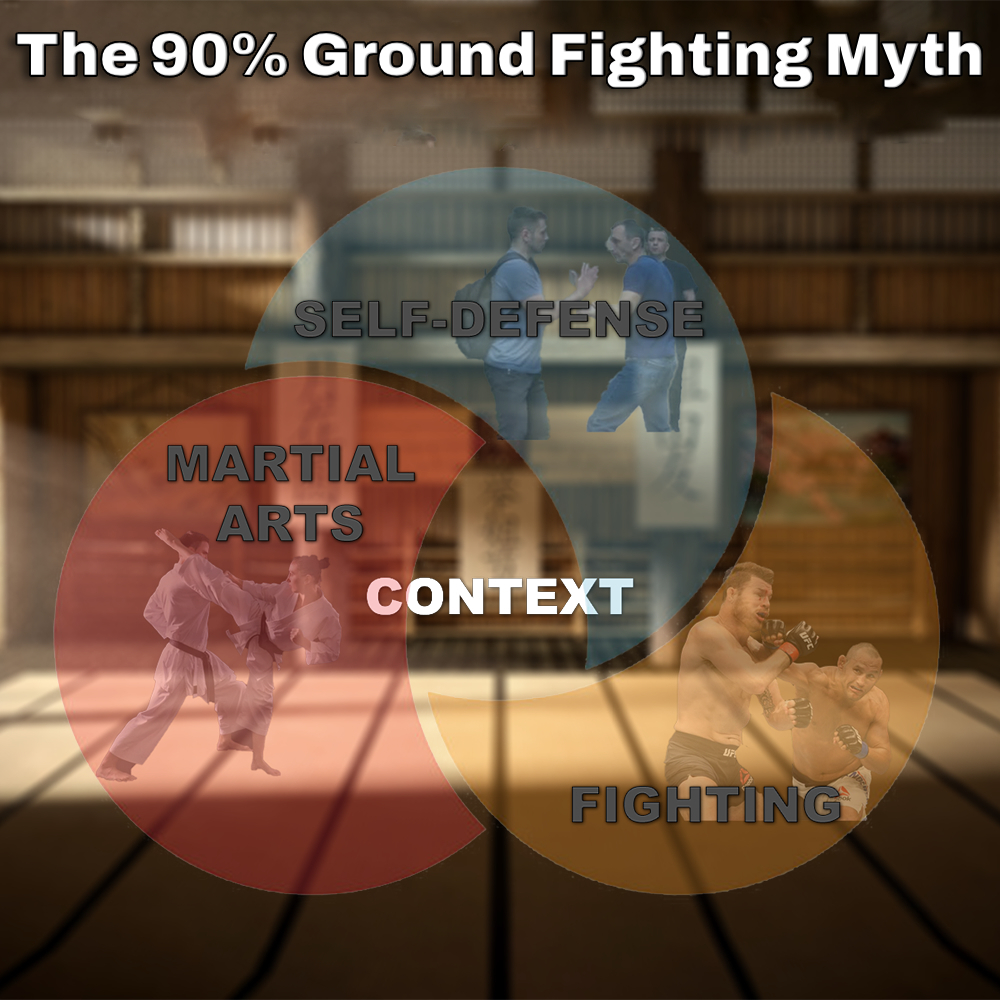
The problem isn’t the technique; it’s the lack of clarity regarding which circle you are currently standing in.
We have to start with the origin of the lie. This statistic didn’t come from a study of street violence or civilian survival; it came from an LAPD “Use of Force” study in the late 1980s. It found that when officers were arresting suspects, things ended on the ground 62% of the time.
Note the word: Restraint. In a policing context, sometimes a suspect has to be taken to the ground to finalize a restraint. The officer has a legal mandate to stay there until the cuffs are on. They have backup, they have body armor, and they have a radio.
For a civilian, hitting the ground isn’t a “phase” of the fight – it’s a failure of mobility.
When you look at what the data actually says – real HAPV (Habitual Acts of Physical Violence) statistics from the British Crime Survey or ER visit reports – the “90% myth” falls apart. These reports consistently show that while the ground is a possibility, most altercations are decided by standing strikes, shoves, and situational awareness before anyone ever loses their footing.
There is also the issue of the ego versus the family. Purposely going to the ground is a choice that ignores the reality of violence: accomplices, weapons, the environment, and your loved ones.
If you choose to enter a grappling match on the concrete to satisfy your ego, who is protecting your spouse or child standing three feet away?
You have functionally blinded yourself to the second attacker while you play a game of human chess on the asphalt. Staying on your feet gives you mobility. It gives you the chance to disengage.
Think of ground-fighting as an insurance policy. You must know how to fight there, but it is one part of a much larger, uglier whole. It should never be the destination. Sport-based methods choose the ground because the rules allow for it.
We need to stop training for “the move” and start training for the objective. Self-defense is about staying grounded in reality. Let’s leave the theatrics to the movies and the “90%” to the marketing departments.
References: LAPD stats from Journal of Non-lethal Combatives