
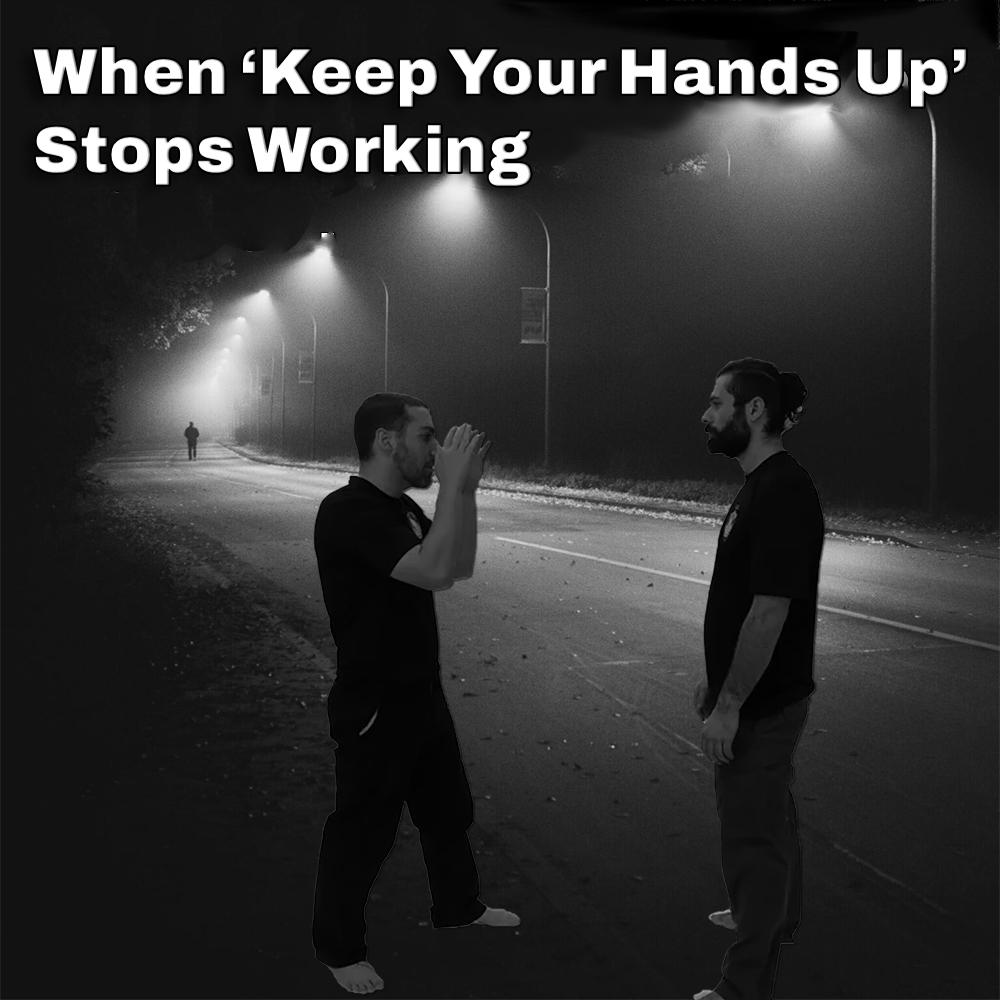
A while ago a student from a different style joined us. As we went through a few drills, one thing became obvious quite quickly – every time there was any kind of pressure, his hands went straight up to the sides of his head. Tight, high guard. He’d clearly spent a lot of time being told to ‘keep your hands up’.
Now, in a sporting context, that’s probably a good habit. There’s nothing wrong with it there.
But self-defense isn’t sport, and that’s where things start to change.
If you’re dealing with a genuine self-defense situation, the objective isn’t to win a fight. It’s to get out of it. Escape comes first. Always. And if you can’t immediately leave, then what you need isn’t a high guard – it’s control.
Grabbing, pulling, pushing, twisting, disrupting balance – doing something to stop the other person continuing.
I’ve seen people freeze behind a tight guard at close range – and get overwhelmed anyway, because their hands were protecting their head instead of controlling the person in front of them.
When you look at it like that, holding your hands fixed to your head starts to make less sense. They’re not doing anything there. They’re waiting. And waiting is a luxury you don’t usually have.
I’m not talking about the ‘fence’ here – that’s a different tool entirely.
So the question becomes – where should your hands actually be?
High like boxing? Lower like you often see in modern karate?
The honest answer is it depends, but more importantly, it depends on what you think you’re dealing with.
Most guards are shaped by rules, distance, and expectation. The guard you see in a lot of modern karate works well enough for long-to-mid-range sparring – karateka versus karateka, both people playing the same game. But that same position doesn’t carry over particularly well outside of that environment.
Because self-defense doesn’t usually start there, and it rarely stays there.
More often, you’re close. Very close. And once you’re there, a formal guard becomes less useful than what your hands are actually able to do.
This is where the older ideas make more sense. In Okinawan karate we use the term ‘meotode’ – husband and wife hands. Both hands working together. Not guarding, not waiting, but doing something. One hand controls, the other supports. They’re active.
That’s a very different mindset from holding a position and hoping it works.
Every time you default to a guard, you’re essentially giving the other person another attempt. Another chance to act. What we’re trying to do is take that away from them – interfere with their structure, their balance, their ability to continue.
That doesn’t mean a guard has no value. If everything goes wrong and it turns into a fight, then yes, covering up may be necessary. It can protect you, give you a moment to recover, and help you reset.
But that’s what it is – a fallback.
The problem is when it becomes the starting point.
Once that happens, everything becomes reactive. You’re waiting for something to happen so you can respond to it, and that’s not where you want to be in a self-defense situation.
This isn’t about exchanging techniques or trying to win something. It’s about dealing with a problem quickly and getting out of it.
So yes, learn a proper high guard. Understand when it’s useful.
But be clear about where it fits.
Because if you find yourself relying on it, it’s probably because something has already gone wrong in the first place.