
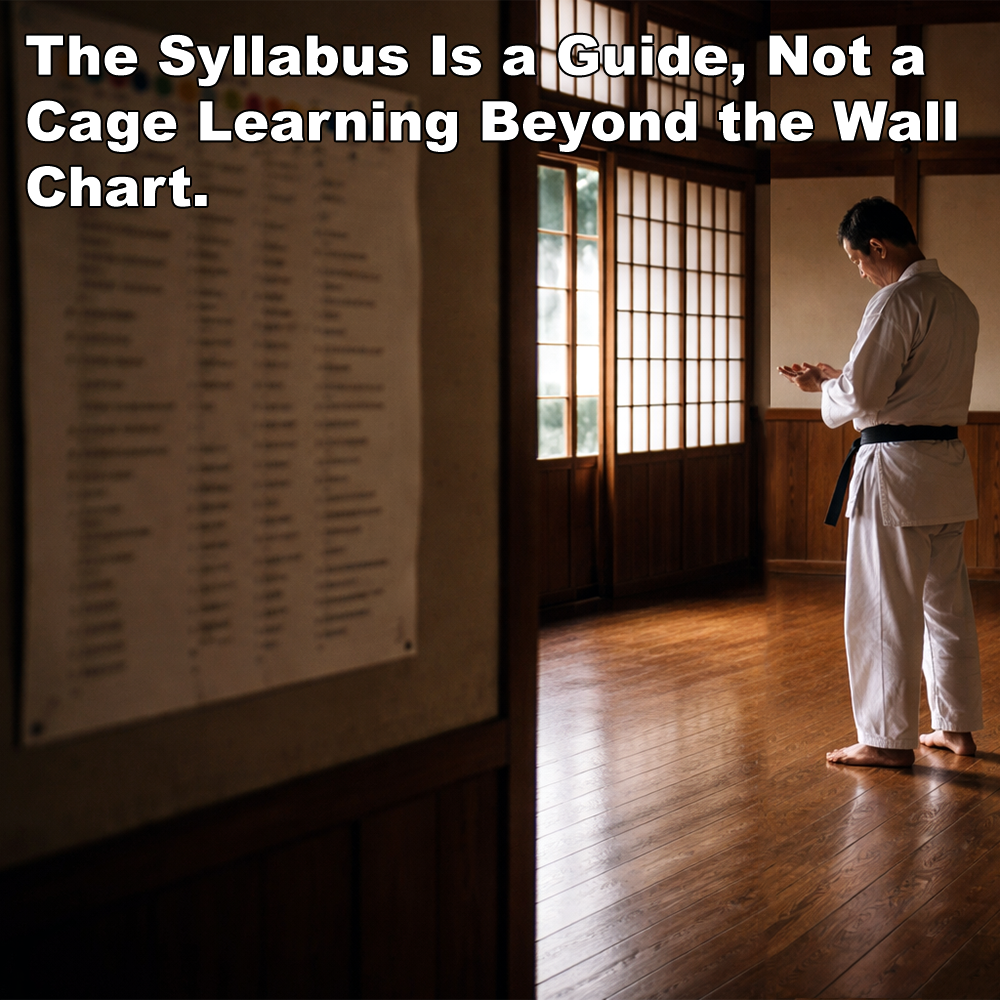
I remember some time ago visiting a dojo to teach. Hanging on the wall was the syllabus the students had to follow. One of the kata I had chosen to teach that day wasn’t listed, and they remarked that they didn’t need to learn it because it wasn’t on the syllabus.
.
We all want to progress in our chosen style, and to do that we need structure. A curriculum helps with that. But every now and then, it’s a good idea to step outside of it, to study something different, or simply go a bit deeper.
.
If all you ever do is follow a syllabus pinned to the wall, is anything really learned in depth? Moving from one technique to the next through repetition alone can easily become passive. Re-doing something without focus doesn’t build understanding. Active engagement does – recalling, explaining, experimenting, and solving new problems.
.
Without challenge, the brain isn’t learning anything new. It’s just reinforcing old patterns. If everything is always done the same comfortable way, adaptability never develops.
.
Asking questions, experimenting, and thinking for yourself slowly disappear. The adaptable karate we should all be studying becomes rigid, and when something outside the ordinary happens, it often fails.
.
When I first started training, I didn’t just repeat movements. I probably annoyed the heck out of some of my teachers. I was always asking questions. “What if this happens instead?” “Why this position?” “What else could this movement be?”
.
I questioned my teachers and tested the answers for myself. Not everyone liked it, but that’s how I learned.
.
Karate, like any genuine study, should never be reduced to ticking boxes. The syllabus is there to give structure, not to build walls around your thinking.
.
The real world won’t attack you in straight lines, at fixed distances, moving neatly backwards and forwards. Real threats don’t care what grade you hold or how sharp your gyaku-zuki looks.
.
A syllabus is a guide, not a cage. Grades, certificates, and titles are markers along the way, not the destination.
.
Real karate happens when you put the syllabus to one side for a moment and ask why. When you look at a movement and wonder what else it might do. When you’re grabbed, shoved, or caught off guard, and you respond by adapting rather than freezing.
.
So question more. Try things. Fail a little. Learn something different. That’s how you find real depth in what you do, and how you keep your karate alive when you need it most.
.
If you don’t, well… you might know how to pass a test, but you’ll never know if you can pass the real one.
.
.
Written by Adam Carter – Shuri Dojo