
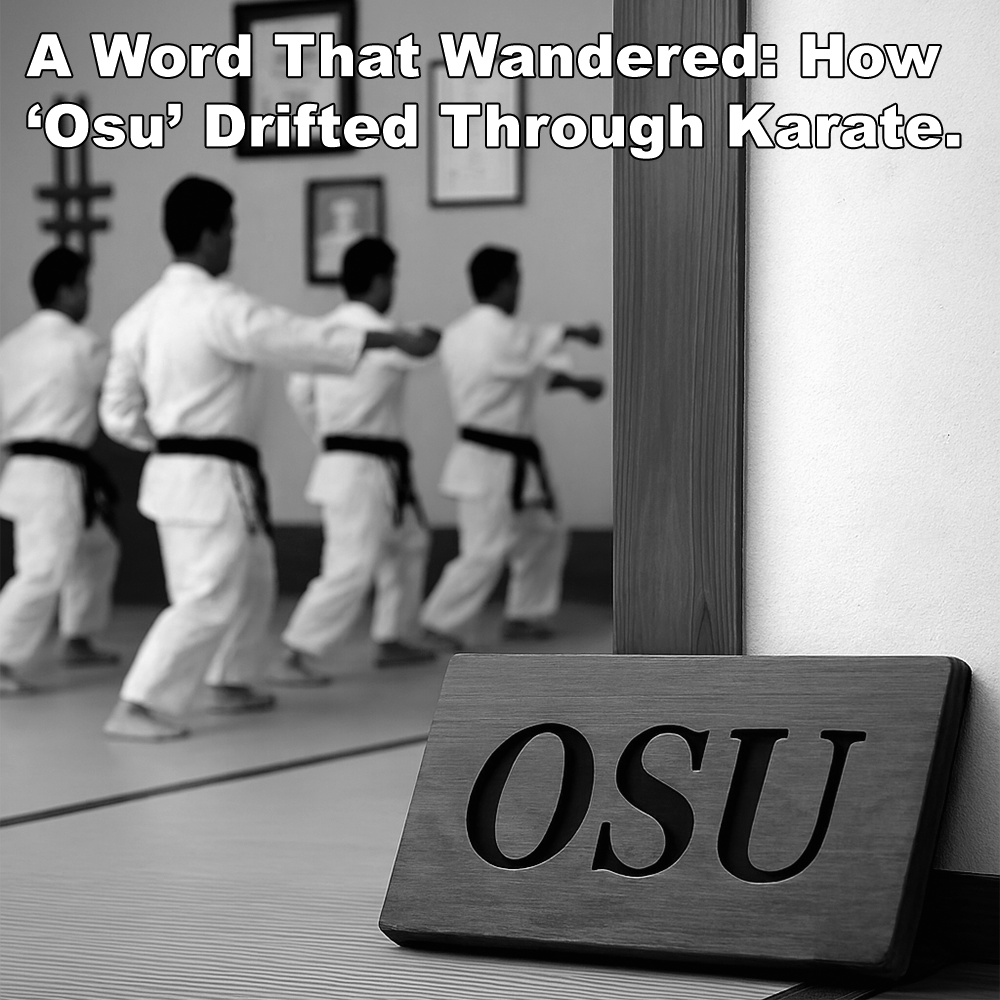
After I posted my thoughts about the word “osu”, I expected a few people to disagree. But what surprised me was how many long‑time practitioners, including instructors, admitted they weren’t actually sure where the word should be used, or even why they say it at all.
.
Some people told me they’d been using it for decades and still weren’t sure what it really meant. Others said they’d been taught it was an international greeting between karateka, something you could use with anyone, anywhere, as if it were a universal handshake.
.
One person even explained that in their dojo they use it for everything: stop, start, line up, greetings, acknowledgements – the entire vocabulary of the dojo compressed into one syllable.
.
That kind of comment is exactly why I wrote the original piece. It shows how deeply a habit can take root when no one ever explains where it came from or whether it belongs in the system you practice. People aren’t doing anything wrong; they’re simply repeating what they were taught, often without any cultural context.
.
The truth is that “osu” is a mainland Japanese budo slang term. It appeared in the early twentieth century, probably influenced by the military and school culture of that era. It was already being used in Japanese Shotokan university clubs.
.
Kyokushin later popularized the “push/endure” interpretation, but they didn’t create the word. And it certainly didn’t come from Okinawa. It was never part of Okinawan karate etiquette, and many Okinawan dojo find it crude, overly macho, or simply out of place.
.
When I taught at a Kyokushin dojo years ago, I heard it everywhere. Not just in class. Ordering pizza? “Osu”. Handing someone a tool from the back of a car? “Osu”. Greeting someone in the car park? “Osu”. At that point it isn’t etiquette anymore – it’s just a reflex. And that’s fine for those systems. It fits their culture, their training environment, and the atmosphere they want to create.
.
But Okinawan karate is different. The tone is different. The etiquette is different. The relationship between teacher and student is different.
.
Okinawan dojo culture is more conversational, more personal, less militarized. Teachers don’t bark clipped commands, and they don’t rely on a single word to replace half the language. So it simply doesn’t belong there.
.
What struck me most about the comments I received was how many instructors asked where they should use it. That question alone tells you how far the word has drifted from its origins.
.
If someone has been training for forty or fifty years and still isn’t sure what the word means or where it fits, is that their fault? It’s a sign that the term has been passed down without explanation for generations. It’s become a habit rather than a tradition.
.
My own view is simple. If you teach a Japanese system and “osu” fits the culture of your dojo, that’s entirely your choice. But if you teach an Okinawan system, it doesn’t belong there. And in my dojo, we don’t use it at all. Not because I’m trying to be difficult, but because it isn’t part of the culture or etiquette of the art I practice and teach.
.
This isn’t about policing language or telling anyone what they must or must not say. It’s about understanding what you do and why you do it. If it’s part of your lineage, fine. If it isn’t, that’s fine too. And if you’ve been saying it for decades without knowing where it came from… well, that’s simply how habits spread.
.
But habits aren’t the same as tradition, and repetition isn’t the same as understanding. Karate deserves more than automatic behavior.
.
It deserves awareness. It deserves context. And it deserves to be practiced with the same thoughtfulness that we expect from our students.
.
.
Written by Adam Carter – Shuri Dojo