
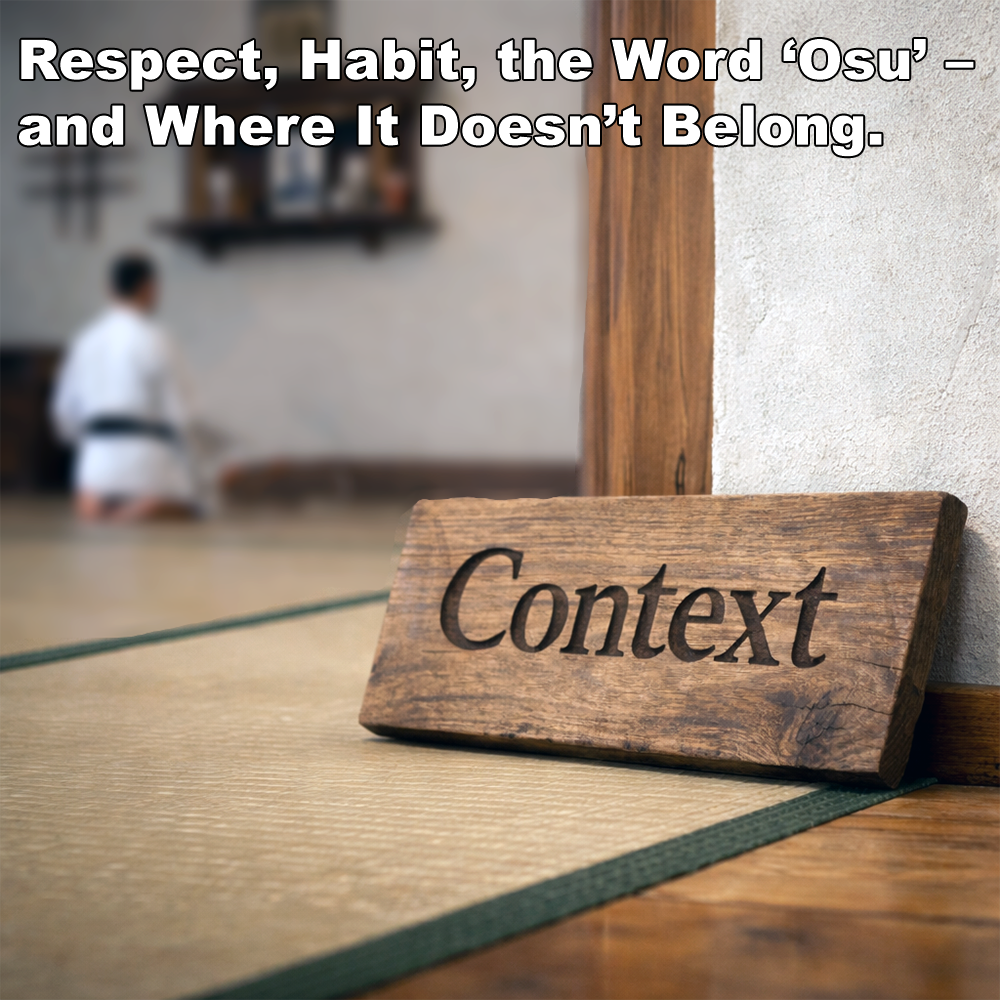
Respect for your teacher is paramount and following instructions is instilled from day one. But sometimes this culture of respect leads to habits that are repeated without thought – phrases, behaviors, and rituals that people copy simply because they’ve seen others do them.
.
I often receive comments on my articles and messages that consist of nothing more than “Osu”, they just begin or end with it, even though I don’t use the term, my dojo doesn’t use it, and Okinawan karate doesn’t use it.
.
I bring this up because, when I started training in 1974 under a Japanese sensei, I was guilty of it myself. Back then, I followed my sensei’s instructions without question. I respected him greatly, and respect is vital in any dojo. At the time, I didn’t think twice about it. Respect meant doing what you were told, and I did exactly that.
.
But when I later trained under an Okinawan teacher in the early 1980s, I discovered a very different culture. Okinawan dojo were more relaxed, more conversational, and far less rigid. From my experience, teachers encouraged questions once they knew you. The atmosphere was open, human, and grounded in personal connection rather than formality.
.
In many Okinawan dojo, the use of “Osu” is considered crude, overly macho, or simply out of place. Some teachers see it as a sign of ignorance about Okinawan etiquette.
.
Worse still, it has too many meanings.
.
Depending on who you ask, it can mean “yes”, “I understand”, “I’ll endure”, “push”, “patience”, “greetings”, “respect”, or simply act as a filler word. That ambiguity is exactly why it becomes messy – it’s a catch-all that ends up meaning nothing.
.
Online, people use it because they think it’s the “karate thing to say”, not because they understand its roots. In some circles it has become almost a meme.
.
I see this constantly in comments on my articles and in messages people send me. Sometimes people write nothing more than “Osu”, offering no context or thought beyond the word itself.
.
They’re not being disrespectful, they simply don’t know any better. They’re repeating something they’ve absorbed from a different culture of karate.
.
If you use it in your dojo, that’s entirely your choice. But in an Okinawan context, and certainly in mine, it simply doesn’t belong.
.
Practitioners need to understand the art they’re practicing. To know what belongs to their tradition and what doesn’t. To avoid becoming a collector of habits rather than a student of karate.
.
Respect doesn’t mean blind obedience. It means taking responsibility for your own learning, understanding the culture you train in, and honoring the lineage you represent.
.
In the West, we often adopt things believing we are showing respect, when in reality we are removing them from their cultural context. What feels harmless or traditional to us may feel inappropriate to those it comes from.
.
So if you train in an Okinawan system, or even if you don’t, ask yourself: does this belong here? Does it reflect the culture, the teachers, the history?
.
If not, it is perfectly acceptable, and sometimes necessary, to leave it behind.
.
Note: These are my personal observations based on my own training and experience. They are not instructions for others to follow, only thoughts offered for reflection.
.
.
Written by Adam Carter – Shuri Dojo