
I’ve been thinking lately about how much time we spend polishing the outside of the vessel without ever looking at what’s inside.
After over fifty years on the mat, I’ve performed thousands of repetitions of the same kata. In the beginning, it was about the physical – the crispness of the technique, the power in the kime, the “look” of the kata. But as the years pass, that purely athletic pursuit starts to feel hollow.
We often hear kata described as a “solo dance” or a “library of techniques”, but through the lens of what I now call Applied Methods, I see it differently.
It’s a mnemonic syllabus.
It was never meant for a stage – it was meant to be a survival manual for a time when you couldn’t just pull up a video to remember a lesson.
The old masters were pragmatic. They didn’t include ornamental moves. If a movement is in the kata, it’s there because it solves a problem.
The trouble is, we often try to solve the wrong problems with it.
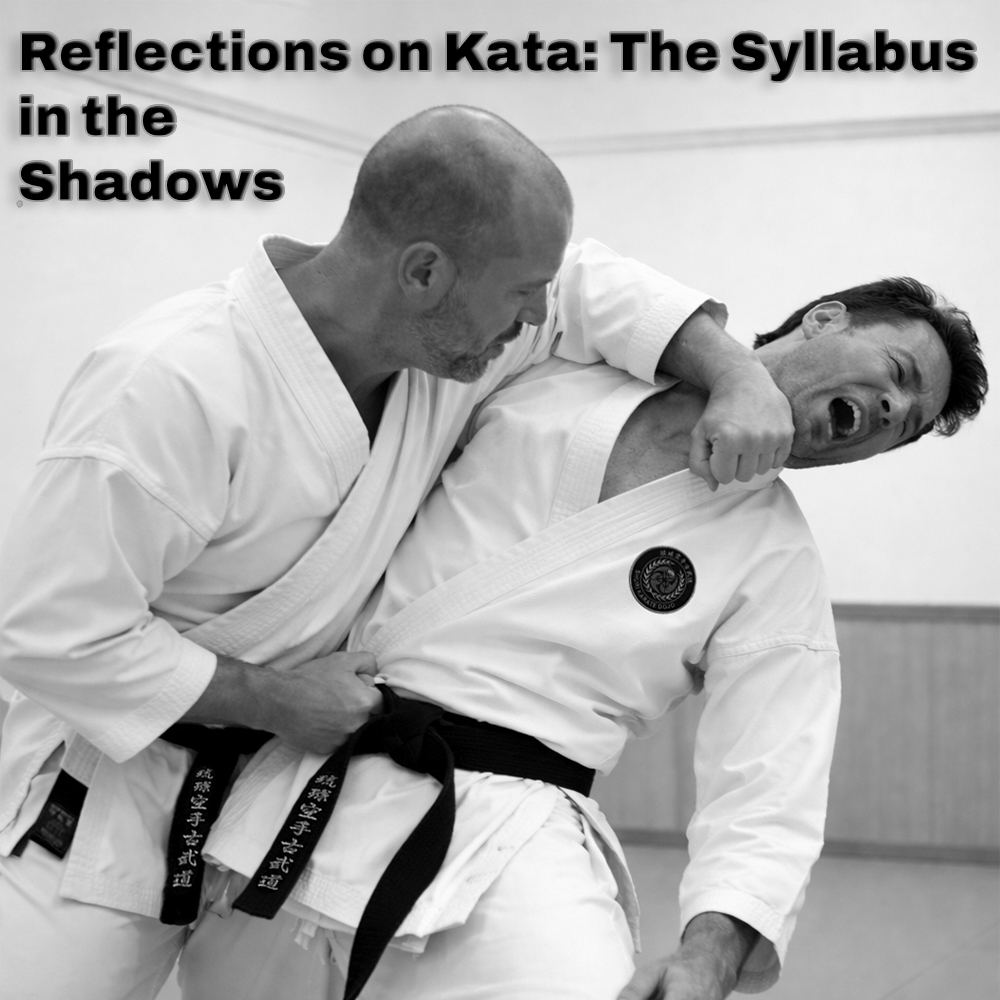
We try to “block” a lunging punch from six feet away, but these forms were born in the chaos of close-quarters violence – the grabs, the shoves, the frantic struggle where there is no room for a “perfect” stance.
When I’m working with a student and a piece of bunkai work feels a bit too “compliant” or “dojo-only”, I usually ask them to run it through a few simple filters.
It’s not about passing or failing – it’s about seeing if the application holds water when the “performance” stops.
First, check your distance.
If you’re standing at arm’s length or beyond, the kata’s logic usually breaks down. Most of this work was designed for the clinch – where you can feel the other person’s weight and breath. If you have to take a full step just to reach your partner, you’re likely practicing “sport” distance, not “protection” distance.
Real application happens in the space where you can’t see the attack coming – you can only feel it.
Next, look at the “block” again.
The word “uke” is a bit of a trap. If you’re waiting for a punch to arrive so you can intercept it with a pretty forearm block, you’ve already lost the initiative.
I tell my students to look at the “receiving” motion as a proactive response.
Is that high block actually a strike to the throat?
Is that low block actually a way to clear a limb or break a grip?
If the move doesn’t immediately change the momentum of the fight, keep looking – there’s usually a more aggressive intent hidden in the shape.
Finally, who are you fighting?
The kata wasn’t designed for a duel against another karateka in a clean karate-gi. It was designed for the person who grabs your collar, pulls your hair, or swings a wild hook in a crowded space.
If your application only works against a perfect “step-punch” (oi-zuki), it’s a drill – not a survival method.
The syllabus of the kata was built for messy, non-consensual violence.
It isn’t about proving anyone wrong. It’s about looking deeper.
I’ve spent a lot of time documenting these thoughts in my older Notebook entries, but even now, the work is still evolving. It’s a long road, and I’m still finding new shadows in the old forms.