
Yesterday, a seventy-eight-year-old man was gunned down in his own home near where I live. What does this have to do with martial arts?
.
Nothing.
.
And yet, it has everything to do with awareness.
.
Would awareness have saved this man? Probably not. And that matters. Not every act of violence is preventable, and pretending otherwise only feeds fantasy.
.
But what these incidents do highlight is how suddenly violence can appear, and how little most people, including martial artists, truly understand about what happens to them when it does.
.
Most practitioners spend the majority of their time focused on technique. On movements, combinations, drills, sequences. They become very good at performing routines under familiar conditions. Very few are trained to assess environments, to notice small changes, or to understand how their own internal state will collapse under real pressure.
.
Even fewer are trained to manage it.
.
Under stress, it’s not your favorite combination that decides what happens. It is not your best drill, your fastest punch, or your most polished kata. Under pressure, the nervous system takes over. It makes decisions before conscious thought has a chance to catch up.
.
I know this because I’ve experienced it.
.
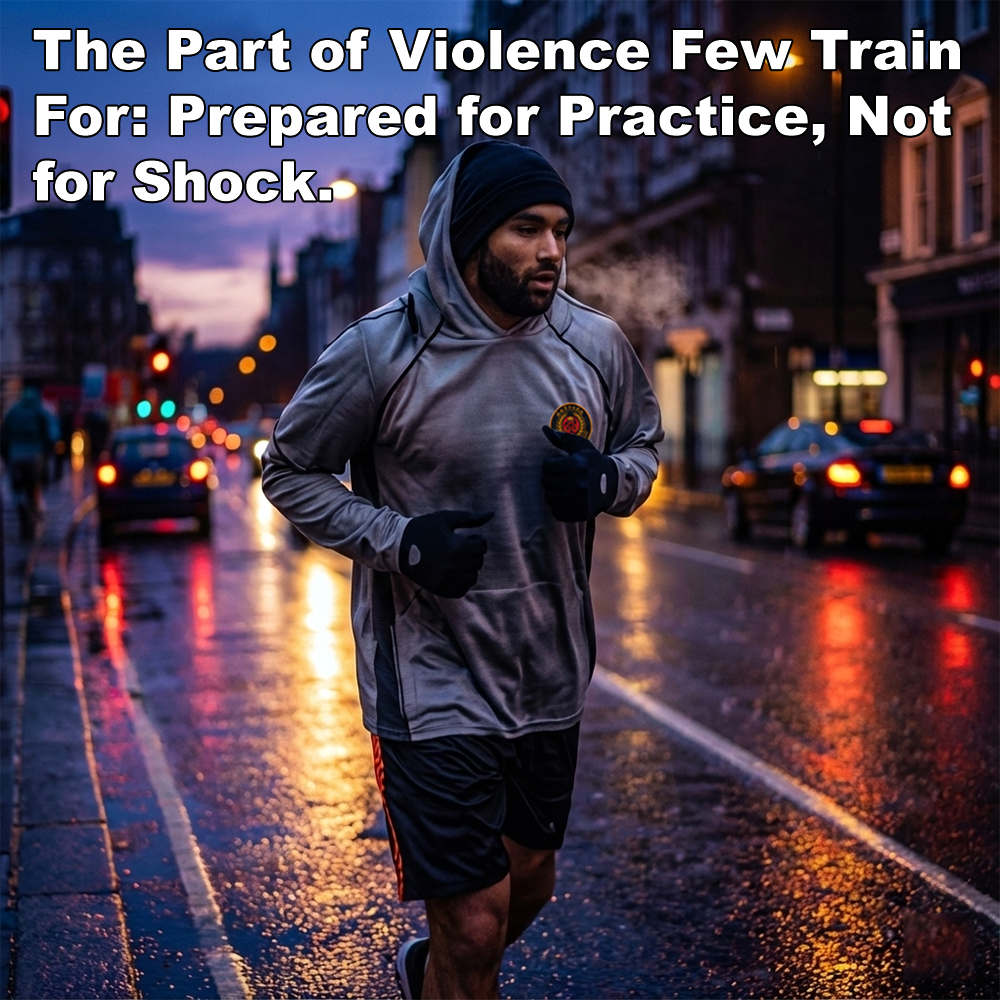
I was in my early twenties, fit, quietly out for a run in what was considered a relatively safe and affluent area. At the time, I was also competing nationally, so I was used to fighting in controlled, consensual environments. None of that mattered.
.
Being confronted without warning is not like training. There is no mental preparation. No controlled escalation. One moment everything is normal, the next your body is flooded with adrenaline to a degree that is difficult to explain unless you’ve lived it.
.
The adrenaline dump is absurd. Breathing becomes shallow or stops altogether. In my case, I initially held my breath without realizing it. Then came the opposite, rapid and uncontrolled breathing. After I managed to escape, I had to sit down away from the area because I was close to passing out. Not from injury, but from shock to the system.
.
This is the part no one talks about.
.
Everyone talks about technique.
.
They talk about what they would do. What strike they would use. What sequence would solve the problem. Very few talk about the body’s response to sudden threat, or how fragile fine motor skill becomes when the system is overwhelmed.
.
In any real confrontation, it isn’t about adding more techniques. It’s about whether you can remain functional long enough for any skill to survive the chaos. That means posture, breath, and attention. Without those, technique is largely irrelevant.
.
This is the difference between performance in the dojo and a real fight.
.
The body has limits. Strength, speed, endurance, all finite. But the brain, the processing of information, the ability to notice, to orient, and to regulate yourself under stress also need to be trained. In many dojo, they simply aren’t.
.
There is no point being technically excellent if you don’t notice the small things. No point having perfect form if you freeze, panic, or gas out in seconds. No point training for cooperative problems when violence does not cooperate.
.
This isn’t an argument against technique. It’s an argument against believing that technique alone is enough.
.
If martial arts are meant to prepare people for real self-protection, then awareness, mindset, and nervous system management cannot be optional extras. They must be central. Otherwise, we are teaching people how to look capable in safe environments, while leaving them unprepared for the reality they claim to train for.
.
.
Written by Adam Carter – Shuri Dojo