
Every martial art uses drills.
They are found in karate, boxing, jujitsu, military training, law enforcement, reality-based systems, and traditional systems. Everyone drills.
That alone should tell us something important – drills clearly have value.
The problem is not the existence of drills. The problem starts when people assume the drill is teaching more than it actually is.
A drill is not reality. It’s a learning environment. Problems begin when people forget that difference.
At their best, drills help develop attributes: timing, coordination, balance, mechanics, recognition, and repetition. They allow people to isolate parts of a skill and work on them without the chaos and unpredictability that comes with resistance and pressure.
That’s useful. In fact, it’s necessary.
No beginner can realistically learn under full resistance from day one. Structure matters. Repetition matters. Controlled environments matter.
But drills also create habits, and habits are not automatically good simply because they are repeated.
A person can become highly skilled at succeeding inside the conditions of a drill while becoming less adaptable outside of it.
That is where martial arts training can quietly drift away from reality without practitioners even noticing.
In this context, I’m talking about karate as a method of preparing for physical confrontation, not as recreation or performance.
If training repeatedly follows the same timing, the same rhythm, the same distance, the same attack, and the same response, eventually the student is no longer learning adaptability. They are learning familiarity.
The problem is that violence is rarely familiar.
Real confrontation is messy, emotional, unpredictable, and rarely clear. There may be deception, hesitation, aggression, panic, interruption, environmental obstacles, verbal escalation, or pre-attack cues that do not resemble the neat structure of a cooperative training drill.
Yet many practitioners spend years becoming efficient at responding to rehearsed movement patterns.
So the question is simple: are we developing functional attributes, or rehearsing choreography?
There is an important difference between the two.
A drill can improve movement without necessarily improving application. It can improve confidence without improving judgment. It can improve reaction to an expected attack while reducing adaptability to the unexpected.
None of this means drills are useless.
Far from it.
The issue is understanding their limitations.
A beginner drill may teach mechanics. A structured partner exercise may teach coordination. A compliant repetition may help introduce body positioning or movement patterns. There is nothing inherently wrong with any of that.
The problem comes when the drill becomes the destination rather than the introduction.
This happens more often than many people are willing to admit.
Sometimes practitioners become so conditioned by the training environment that they unconsciously require the agreement of their partner in order for their responses to function. The attack must look correct. The distance must feel familiar. The timing must match expectation. The sequence must unfold in a recognizable way.
But real conflict does not care about our preferred training structure.
This is why context matters so much in martial arts training.
Every method develops something. Training value depends on whether it matches the realities a person is actually likely to face.
“Karate doesn’t fail people – unclear goals do.”
If the goal is coordination, discipline, movement development, or introducing fundamentals, then many drills work perfectly well.
If the goal is preparing somebody for unpredictability, resistance, emotional stress, or violence, then training eventually has to evolve beyond cooperative repetition.
That evolution is where many people struggle – seeing the difference between what they are actually practicing and what they think they are training for.
Not because the drills are worthless, but because people become emotionally attached to them. Tradition becomes identity. Familiarity becomes comfort. Repetition becomes validation.
Over time, practitioners may become experts at performing the training method itself rather than understanding its limitations.
That is not a criticism of one style or one system. It’s present in all martial arts.
Even sparring has limitations.
Even pressure testing has limitations.
Even combat sports have limitations.
No training environment perfectly replicates reality.
The goal is awareness – a clear understanding of what it is you are actually training, and what the drill is actually for.
Because once that is understood, you stop confusing rehearsal with capability.
And that distinction may be one of the most important in martial arts training.
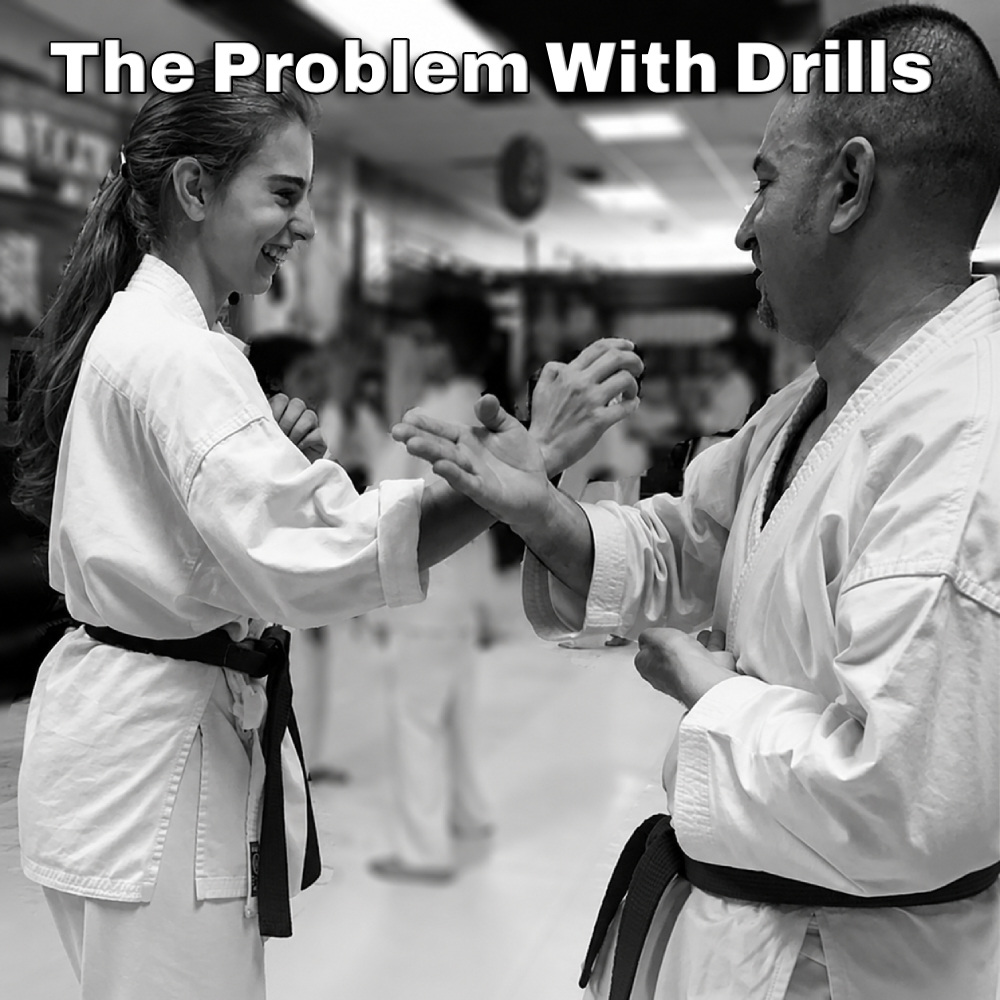
Photo: Two of my students having fun with a ‘kakie’ drill at the Shuri Dojo