
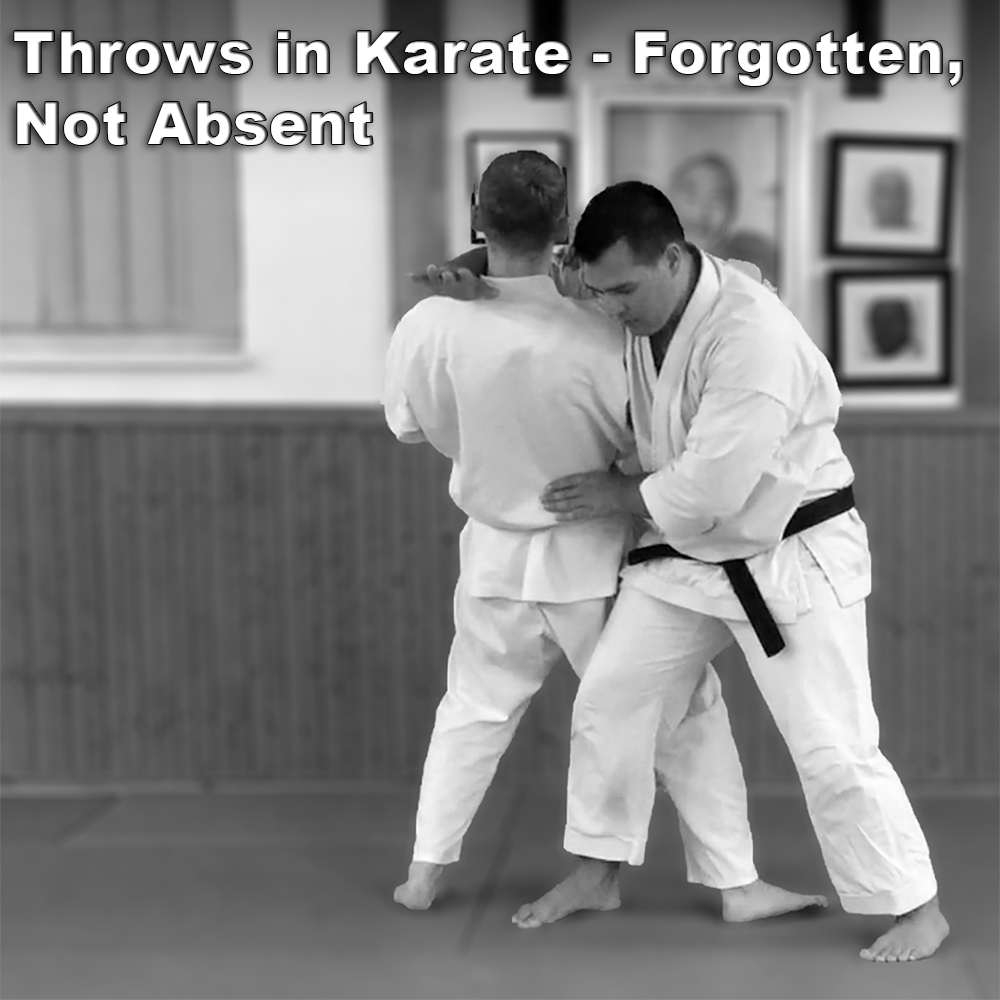
One of the strangest claims still repeated in karate is that throws do not belong in the art.
And yet the historical record says otherwise. Gichin Funakoshi himself documented throwing methods, and senior figures have long acknowledged their place. The issue is not whether throws existed in karate. The issue is why so many modern practitioners were never taught to see them.
When throws are neglected for generations, people start to assume they were never there at all. That is not history – it’s amnesia.
The same thing has happened with close-range striking, limb control, and much of what kata actually contains.
Funakoshi himself listed nine throwing methods in his early writings, yet they are still absent from much of modern training.
Many students, and instructors, who stand toe-to-toe and exchange techniques forget – or perhaps never consider – that at some point in a self-defense scenario, you will undoubtedly end up in a clinch. This is not unusual. It is often the natural outcome of close-range violence.
Therefore, training at different ranges – including getting in close, controlling, off-balancing, and throwing – should be part of your training.
Because that is where you may find yourself.
Close. Very close.
Nage-waza (投げ技), or throwing techniques, are not the primary focus of karate. They were never intended to be.
However, they remain an indispensable component of effective combative principles, and reflect an aspect of karate that has largely been forgotten.
This is also where confusion often arises.
Throws in karate are not the same as those in Judo.
Modern judo has its own objectives, rules, and methods. It is highly refined for competition. Karate, particularly when approached from a self-defense perspective, operates under very different conditions.
The goal is not to score.
It is to stay on your feet, manage distance, deal with strikes, and disengage safely.
Because of this, karate throws tend to be simpler, more direct, and closely tied to striking, disruption, and immediate follow-up.
They are not designed for extended grappling exchanges, but for moments of opportunity.
There is common ground between systems, of course. But there are also important differences – in objective, in context, in method of entry, and in what happens after the throw.
This is where responsibility lies with the instructor.
If techniques are being taught for self-defense, then those differences must be understood.
Not just demonstrated, but explained and trained with the correct context in mind.
There is also a deeper issue in how these movements are understood.
It is common to see a technique labelled as a single, fixed answer – this movement is this throw.
But real situations do not present themselves in such a predictable way.
Timing, distance, resistance, and intent all vary. What works in one moment may not work in the next.
Karate was never meant to be a catalogue of exact solutions. It is a method of developing adaptable responses.
Anyone who has experienced real conflict understands this quickly.
There is no single answer – only what works in that moment.
I believe no one could dispute the sense it makes as a karateka to be prepared and never need nage-waza, rather than find yourself in a clinch one day with your safety left to chance.
Photo Credit: With thanks to Daniel Pyatt.