
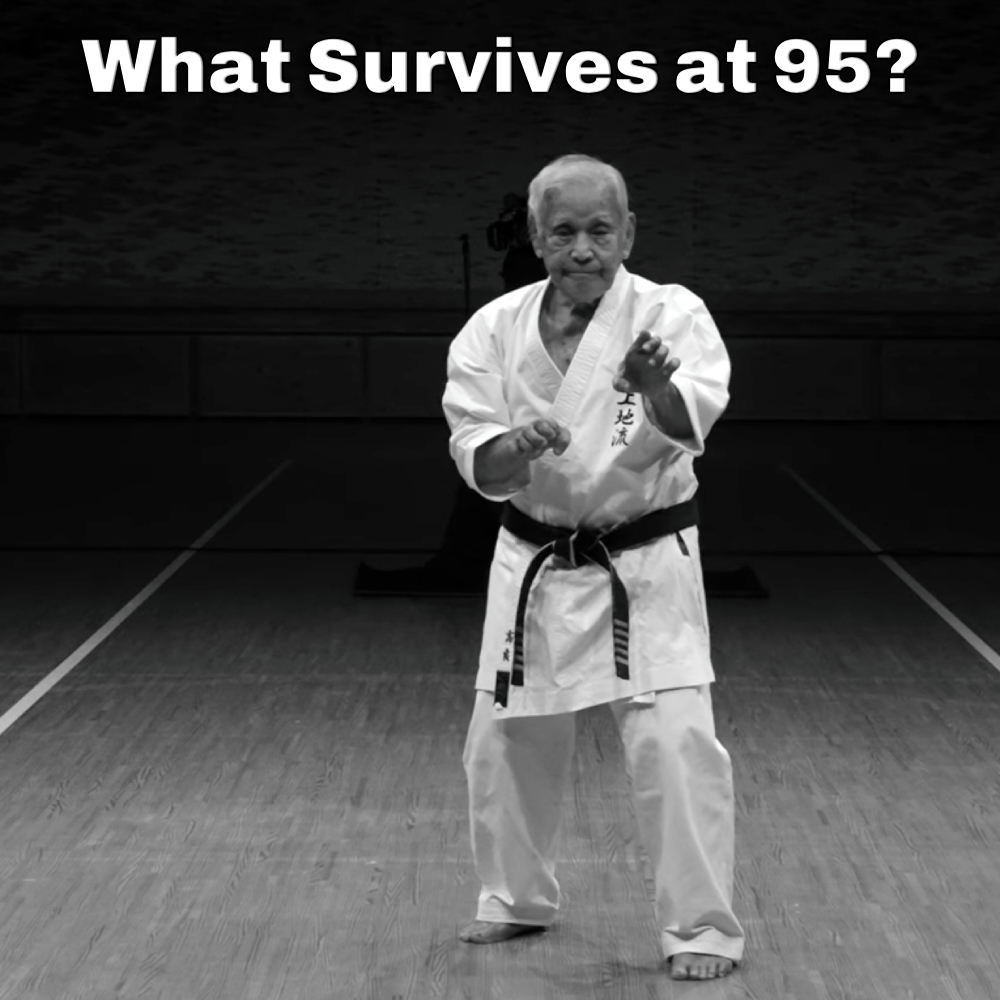
I watched a 95-year-old Okinawan Uechi-ryu master recently performing Sanseiryu, Shintoku Takara, and it stayed with me longer than I expected. Not because of anything dramatic, but because of how little seemed to be happening on the surface.
There was no urgency, no obvious effort, and none of the exaggerated movement that people often associate with power or effectiveness. And yet, it didn’t feel empty. Something was clearly still there, just expressed in a way that most people would probably overlook.
It made me think about Okinawa more broadly. It is the source of karate, and we tend to assume that what is happening there now must reflect what karate is supposed to be. But that assumption doesn’t really hold up when you look a little closer.
Bunkai is not always trained as we might expect, but it has not disappeared completely. It still exists, and it’s still present through paired work and structured drills. The difference is that it is often controlled, pre-arranged, and contained. It’s shown, but not always explored in the way many people today would expect, and it’s rarely pushed into the kind of pressure that exposes whether something truly holds up.
That is not necessarily a flaw. It reflects a different priority. There is a strong emphasis on preservation, on maintaining what has been passed down rather than constantly pulling it apart. Kata is kept intact, structure is respected, and the shape of the system is considered important in its own right. Application exists, but it tends to sit within boundaries rather than being used as a testing ground.
Alongside that, there is another factor that is difficult to ignore. Okinawa is often described as a ‘blue zone’, a place associated with longevity, and karate sits inside that culture whether we acknowledge it or not. The training supports movement, structure, breathing, and routine, and it creates a social framework that people can stay part of for decades. When you look at it from that perspective, the question is not only whether something works in a moment of conflict, but whether it can be sustained over a lifetime.
For much of my own training, I have looked at karate through a very direct lens. Does it hold up? Does it make sense under pressure? Can it be used when things are not controlled, not agreed, and not safe? That question still matters, and for many people it matters a great deal. As I have said before:
Training value depends on whether it matches the realities a person is actually likely to face.
For those who are concerned with self-protection, that cannot be ignored or softened.
At the same time, there is another question that sits alongside it, and it’s one that becomes harder to avoid with time. What is this training for now? I’m in my 60s now, I am not going to fight a fit 20-year-old in the street and expect it to play out on equal terms. That is not defeatist, it’s simply the truth.
What changes is not the principles. Distance, timing, decision-making, and awareness do not disappear with age. If anything, they become more important, because there is less room to rely on physical attributes. The difference is in how those principles are expressed. There is less speed, less force, and less tolerance for error, which naturally leads to less waste. Movement becomes smaller, decisions become earlier, and the emphasis shifts away from reacting late and trying to recover.
What I saw in that Okinawan master was something refined over decades until very little unnecessary movement remained. That kind of refinement does not come from chasing more techniques or adding more layers. It comes from removing what is not needed and becoming more precise in what is left.
This is where I think many people lose their way, because they feel they have to choose between extremes. Either everything must be judged by whether it would work in a fight tomorrow, or it becomes something entirely focused on health and longevity with no connection to application.
Both positions miss what is actually happening. The practical side doesn’t disappear, but the target of it changes. It’s not about proving anything in an exchange. It becomes about understanding whether you need to be in that exchange at all, and how early you can recognize and manage it.
That has always been part of karate, but it’s not always what is emphasized in training. It’s easier to focus on technique than it is to focus on decision-making.
Karate doesn’t fail people – unclear goals do.
If the goal is self-protection, then training has to reflect the realities of violence. If the goal includes sustaining practice over a lifetime, then the training also has to allow for that without becoming meaningless. Those two things are not mutually exclusive, but they do require a shift in how we think about what we are doing.
Watching someone at 95 does not show you how to fight. It shows you what remains after decades of training have stripped everything back to what is essential. That, in itself, is worth paying attention to, because it raises a question that applies to all of us.
What exactly are we building through our training? Something that peaks early and then fades, or something that continues to function, in whatever form is appropriate, as the years pass?
Because what survives at 95 is probably not what most people think they’re training.
Photo Credit: Shintoku Takara, demonstrating Uechi-ryu Sanseiryu in his 90s