
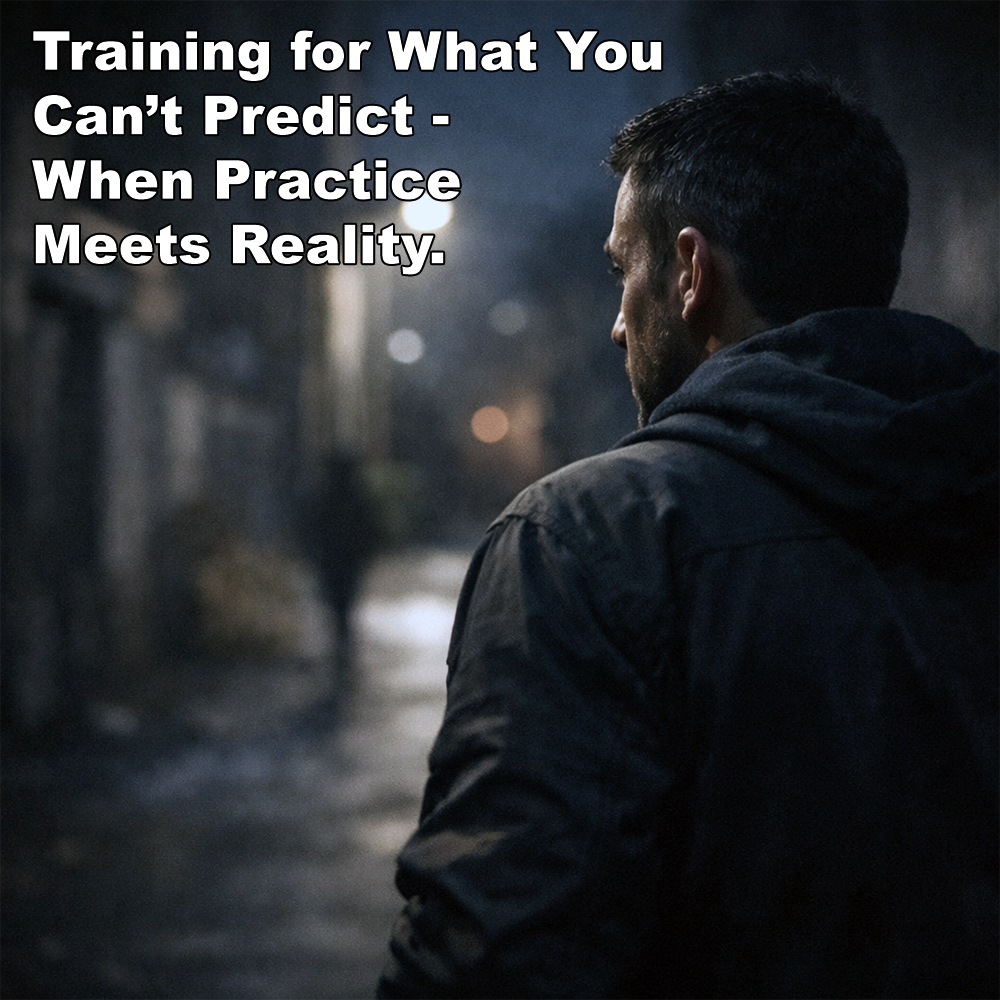
In a previous article, I wrote about how suddenly violence can appear, and how little control any of us may have over its arrival.
.
I also wrote about an incident from my early twenties, when I was attacked while out running. That experience stayed with me not because of technique, but because of what happened internally once the situation became real.
.
That article prompted a question: how do we actually prepare for this? What can a dojo do when violence doesn’t unfold the way we imagine it will?
.
The uncomfortable truth is that none of us truly know how we will react until the moment arrives. That isn’t a flaw in character or commitment. It’s simply how the human nervous system works.
.
Most people discover this the hard way. We rehearse scenarios in our head and feel confident about what we would do. Then something happens and the reality bears little resemblance to the plan. Breathing changes. Thoughts fragment. Time distorts. What shows up isn’t intention or skill, it’s physiology.
.
You can’t train to eliminate nervous system overload entirely. The shock of real violence, surprise, fear, threat, can only be safely recreated to a small degree.
.
What can be trained is more modest. You train to reduce the impact of overload, and to recover function more quickly when it happens.
.
In my first altercation, my breathing nearly vanished. I held it without realizing, which then swung into uncontrolled hyperventilation after I escaped. I had to sit down away from the area because I was close to passing out. Not from injury, but from the physiological response itself.
.
I faced this again, and while the situation was still chaotic, my internal response was different. Not calm – calm is the wrong word – but functional. I noticed my breathing much sooner. I recovered faster. I made better decisions under pressure. The difference wasn’t technique. It was how I managed my own system.
.
Under sudden stress, posture and breathing are usually the first things to collapse. When breathing collapses, so does technique. Learning to notice that loss and restore it matters more than adding another movement to a syllabus.
.
Attention follows a similar pattern. Under threat, attention narrows. People fixate. They miss exits, changes, or opportunities to disengage. Awareness is the deliberate practice of noticing what’s happening around you, and in you, when the mind wants to tunnel.
.
There is value in controlled exposure to unpredictability. Training where intensity and outcome aren’t agreed in advance. Enough pressure to unsettle the system, but not so much that learning collapses. The aim isn’t comfort. It’s familiarity with discomfort.
.
Occasionally, when I work with this aspect of training, I step away from karate techniques entirely. Why? Because it’s familiar, and familiarity can become a shield. I remove the expectations that make the situation recognizable as “karate training”. The aim isn’t to frighten or dominate, but to see what remains when comfort disappears.
.
What shows up in posture, breath, and attention is often far more genuine than anything rehearsed.
.
Dojo sparring stress isn’t real; it’s expected and consensual, the nervous system knows what’s coming. Real violence is neither expected nor consensual. That difference matters.
.
So when people ask how a dojo prepares someone for this, the answer isn’t more techniques. It’s training that acknowledges human limitation. Training that works with the nervous system, not against it. That cultivates awareness, breath, posture, and decision-making under pressure as foundational, not optional.
.
Most people expect a list of techniques here, but real preparation begins earlier than that. Before any movement can be used, the nervous system has to stay functional. Training breath, posture, and attention under manageable pressure is what makes technique possible in the first place.
.
None of this guarantees a perfect response. Nothing does. But it dramatically increases the chance you remain functional long enough to act, escape, or survive.
.
Reality can be unforgiving. Sometimes there won’t be a second chance.
.
That’s why the right preparation matters.
.
.
Written by Adam Carter – Shuri Dojo