
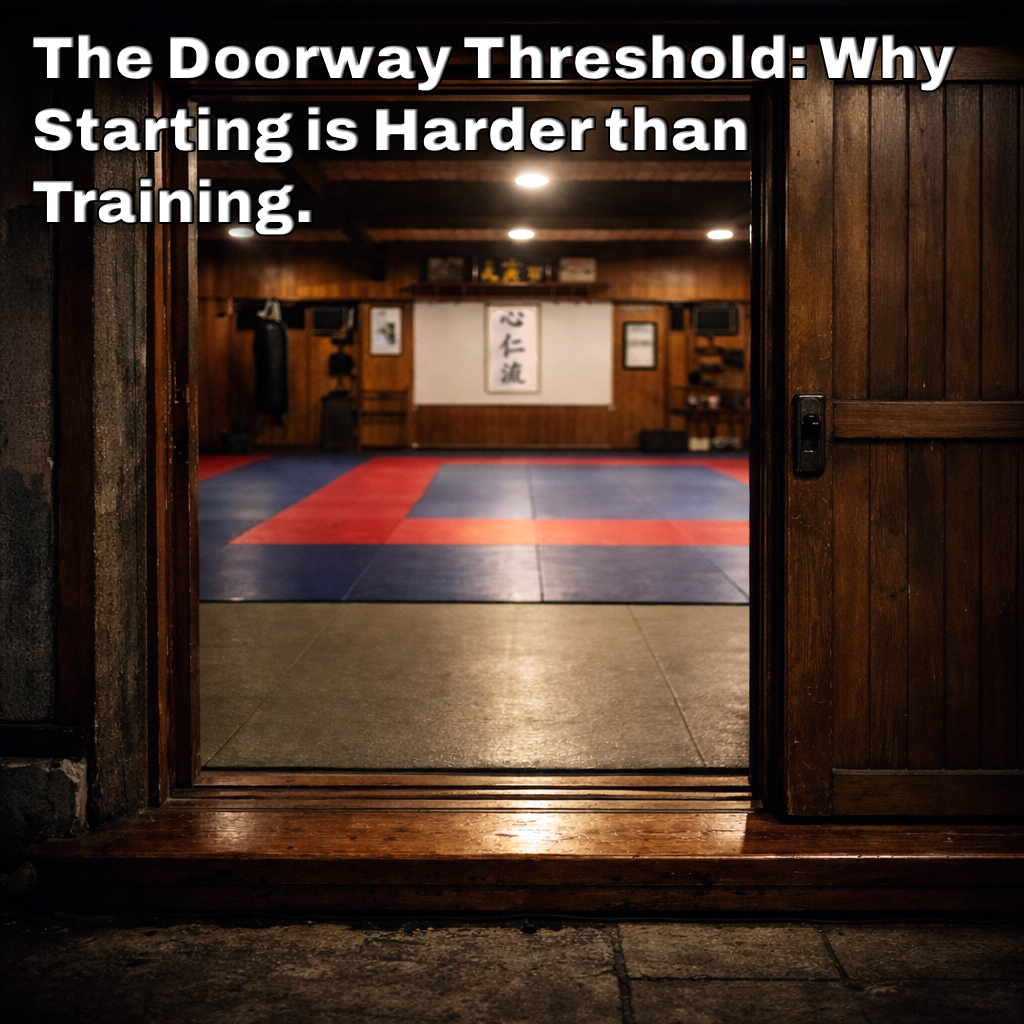
It is one of the great ironies of the martial arts – and life in general. We can spend two hours pushing our bodies to the limit, sweat‑drenched and exhausted, and feel absolutely fantastic. Yet the simple act of putting on our gear and stepping onto the mat can feel like trying to move a mountain.
The hardest part of the dojo isn’t the sparring, the conditioning, or the complex kata. It’s the front door.
The Psychology of Inertia
Why do we find it harder to start than to finish?
It comes down to a psychological coping mechanism I mentioned recently. When we are sitting on the couch, we are safe and comfortable. Our brain views the upcoming workout as a series of “threats”: physical discomfort, the potential to look “not‑good”, and the mental effort required to focus.
We start telling ourselves stories:
- “I’ll do a double session tomorrow.”
- “I’m a bit too stiff today; I might get injured.”
- “I’ve had a long day; I deserve a break.”
These aren’t truths; they are anchors. They are designed to keep us exactly where we are.
Momentum Is the Only Cure
Once you have finished the first ten minutes of a workout, the “stories” usually stop. Why? Because your physiology has changed. Your heart rate is up, your focus has narrowed, and the “discomfort” is now a reality you are managing rather than a monster you are fearing.
The “finish” is easy because momentum is doing the heavy lifting.
The “start” is hard because you are fighting static friction.
Three Ways to Break the Stall
If you find yourself “playing at training” in your head but failing to move your feet, try these three tactics:
1. The 5‑Minute Contract
Tell yourself: “I will train for five minutes. If I still want to stop after five minutes, I am allowed to walk away.”
Usually, once the blood is moving, you’ll find you want to keep going. The hardest part was just the transition.
2. Ritual Over Motivation
Motivation is a fair‑weather friend. It’s never there when it’s raining or when you’re tired. Instead of waiting to “feel like it”, rely on the ritual. Tie your belt. Bow to the room. These small, physical actions send a signal to your brain that the “couch version” of you is now offline, and the “training version” is in charge.
3. The “Dress‑Up” Tactic
If the idea of a full workout feels overwhelming, don’t commit to the workout. Just commit to putting on your karate‑gi or your gym clothes. That’s it. It’s very psychologically difficult to sit on the couch in full training gear. Once the clothes are on, the workout almost always follows.
The Bottom Line
Stop waiting for the “perfect” time to train. Stop waiting to feel “ready”. You don’t need to want to do it; you just need to do it.
I’m curious – now that you’ve read the full piece – which of those three tactics speaks to you most? Or do you have a ritual of your own that gets you through the door?