
(Approx 2 minute 15 second read)
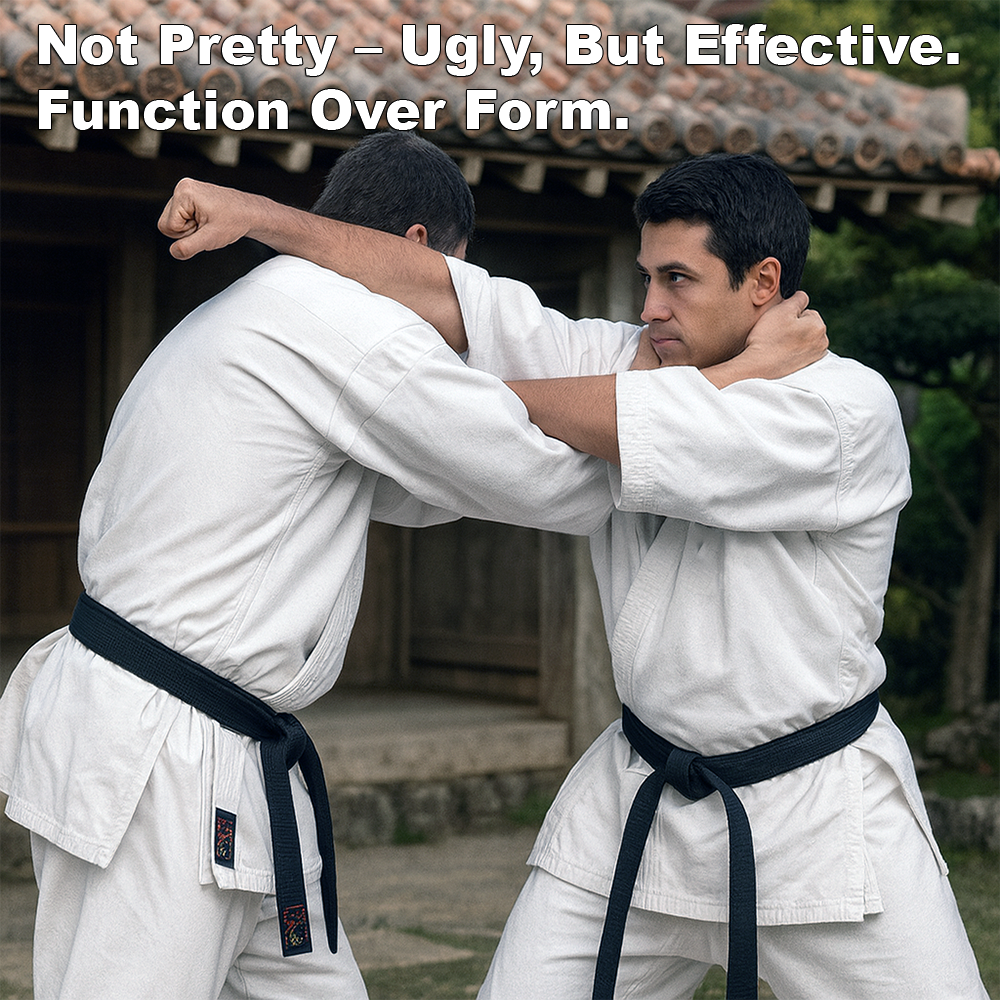
Recently I was criticized on someone’s page for saying the pioneers of karate, the masters of the past, preferred “function over form”. He asked, “What proof does he have?”
.
If I’m wrong, I have no problem admitting it. But in this case, I really don’t think I am. And why he can’t approach me directly before criticizing me, I honestly don’t know.
.
Perhaps he’s confusing my use of the word “form”. I made it clear, aesthetics, how it looks, not form in the sense of kata. Just in case there is any further ambiguity.
.
Surely it’s common sense that if someone needed a method of self-defense, they would be far more concerned with whether their system worked in a real-life situation than how it looked. Therefore, they would inevitably be more concerned with function over form.
.
Real-life attacks are rarely pretty. If he wants proof, it’s all around us.
.
But wait one moment while I tidy my karategi, move my foot an inch to the right, and make sure my stance is long enough.
.
To continue, sarcasm aside.
.
The pioneers showed this in their words, their actions, and the very structure of the art they passed down. Anko Itosu, in his 1908 ‘Ten Precepts of Karate’, made it clear that karate was intended not for performance but for protecting oneself against real threats: “Not against a single assailant but instead as a way of avoiding a fight should one be confronted by a villain or ruffian.”
.
Gichin Funakoshi warned that kata are meaningless unless they can be applied in an emergency. Choki Motobu, stated that karate is “of no use whatsoever” if its techniques cannot be executed under pressure.
.
Kenwa Mabuni wrote: (paraphrased) “…… kata is not some kind of beautiful competitive dance, but a grand martial art of self-defense, which determines life and death.” – From ‘Karate Kenkyu’ (1934), English translation by Mark Tankosich.
.
Common sense tells us the rest: if your goal is survival and practical self-defense, aesthetics must be secondary. Movements are designed for efficiency and effectiveness, not to look impressive.
.
Modern historians and practical karate specialists studying Okinawan and early Japanese karate confirm this interpretation. Kata and training methods were developed for application, not display.
.
So while the masters may not have written the words “function over form” as I phrased it in my original article, everything they taught and demonstrated points directly to that principle. Understanding this is not a matter of opinion, it’s understanding the art as it was meant to be used.
.
It’s frustrating that such a fundamental point still needs to be explained. Yet the evidence is clear: the pioneers of karate emphasized practical self-defense above aesthetics.
.
And the person criticizing me – his titles, certificates, and years of experience mean little if they obscure that principle.
.
Function over form. If that principle offends someone, the problem isn’t my explanation, it’s their understanding of karate. Denying it doesn’t make them knowledgeable; it proves they’ve abandoned what karate was meant to be.
.
.
Written by Adam Carter – Shuri Dojo