
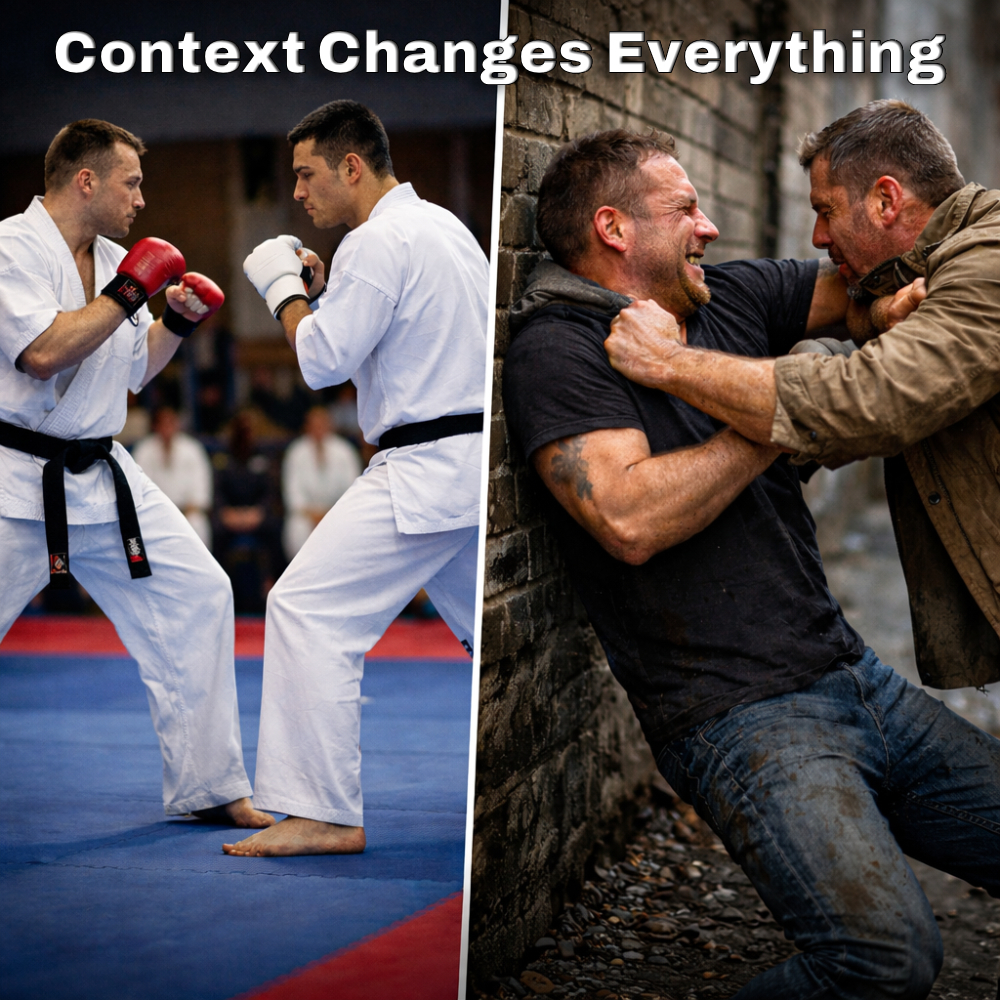
Whenever I write about real-world self-defense, the comments seem to explode into “my style is the best”.
I’m not convinced a lot of these people actually train themselves – maybe keyboard warriors, maybe just inexperienced – these comments often seem to revolve around one style in particular: Kyokushin.
Now, before anyone accuses me of bashing the style, let me make one thing clear. I’ve trained in Kyokushin. Back in the 1980s, when I was competing, I spent time in a Kyokushin dojo training with a world champion fighter. The training was outstanding for my competitive goals at the time. When I later moved to the US, I was invited to train and teach at a Kyokushin dojo. So I’m not knocking the style in any way – this is simply an observation.
If you’ve read my articles, you know I prefer my karate to be practical and pragmatic. Yet I constantly hear people claiming that Kyokushin is the best for self-defense. But no single martial art holds the distinction of being “the best”, and more importantly, it never can.
The problem isn’t the style – it’s what you think you’re training for.
Unless you specifically train for self-protection, no style will be the “ultimate” for that context. That’s the real issue – context is everything.
There’s no point learning football if you want to play rugby. Yes, they both have a ball, but that’s where the similarity ends. Obvious, isn’t it? So why isn’t it so obvious in the martial arts?
Every martial art has its benefits, and every martial art has its limitations.
I had a friend back in the UK – a multiple-time world champion. His dojo was one of the most successful around, and his students dominated for years. In his prime, he took on everyone, regardless of style, and he reigned supreme. Was he a Kyokushin fighter, the “ultimate” martial artist? No. His foundation was Kung-Fu.
The point is simple. It’s not the style that makes the fighter. It’s the person, the training, the preparation, and the application that count.
If your goal is to compete, then find a dojo that excels in that. There are plenty of great schools that will help you succeed. But if your interest is self-protection, then you need to find a school that actually specializes in it, not assume it comes as a by-product.
Training value depends on whether it matches the realities a person is actually likely to face.
In a self-defense situation, people don’t square off. You’re not going to face a criminal the way you would an opponent in the dojo or in competition. It’s often sudden, close, and over before you have time to think.
The levels of fitness and competition preparedness in Kyokushin are well-known and commendable. It builds toughness, endurance (in some), and fighting spirit. If your goal is to compete, it will serve you well. But does that make it the “toughest”, the “best”, the “ultimate”? No, because those labels ignore context.
I remember a Kyokushin 2nd dan in his 30s once saying about me, “He hits really hard – doesn’t he know how to hit with less force?” Even though Kyokushin is known for hard training, plenty of other styles are too. They just don’t feel the need to shout about it.
Self-protection requires a different mindset and a different set of skills. No one style is the best. Instead of arguing, focus on improving. The right training for the right purpose, in the right context – that’s what truly matters.
For most practitioners, self-defense is rare, messy, and often hypothetical.