
Someone said to me the other day, ‘Why don’t you give up practical karate, as you call it, and just do karate-do?’
.
It’s an interesting comment, but one built on a misunderstanding.
.
What sat beneath the comment was the assumption that karate itself cannot be pragmatic. That once effectiveness and real-world purpose are introduced, karate no longer holds up, and must therefore be reframed as something else – more refined, more symbolic, more acceptable as a ‘way’, rather than a method expected to work outside the dojo.
.
The word ‘do’ simply means way or path. It does not prescribe how karate should look. It only requires that practice follows a coherent direction, shaped by intent, discipline, and responsibility over time. In that sense, practical karate is not separate from karate-do at all. It’s just one way of walking that path.
.
I understand what is being implied. For many practitioners today, karate-do has come to mean something largely symbolic – something practiced for personal development, aesthetics, or competition, with little expectation of relevance beyond the dojo. In many cases, that interpretation accurately reflects what is actually being trained.
.
But that does not mean karate-do itself is incapable of being pragmatic. It means the intent placed into its practice has changed.
.
Practical karate does not reject the ‘do’. It asks a different question of it. What is this practice for? What behavior does it reinforce? And what responsibility comes with claiming skill in something that historically dealt with violence and personal harm?
.
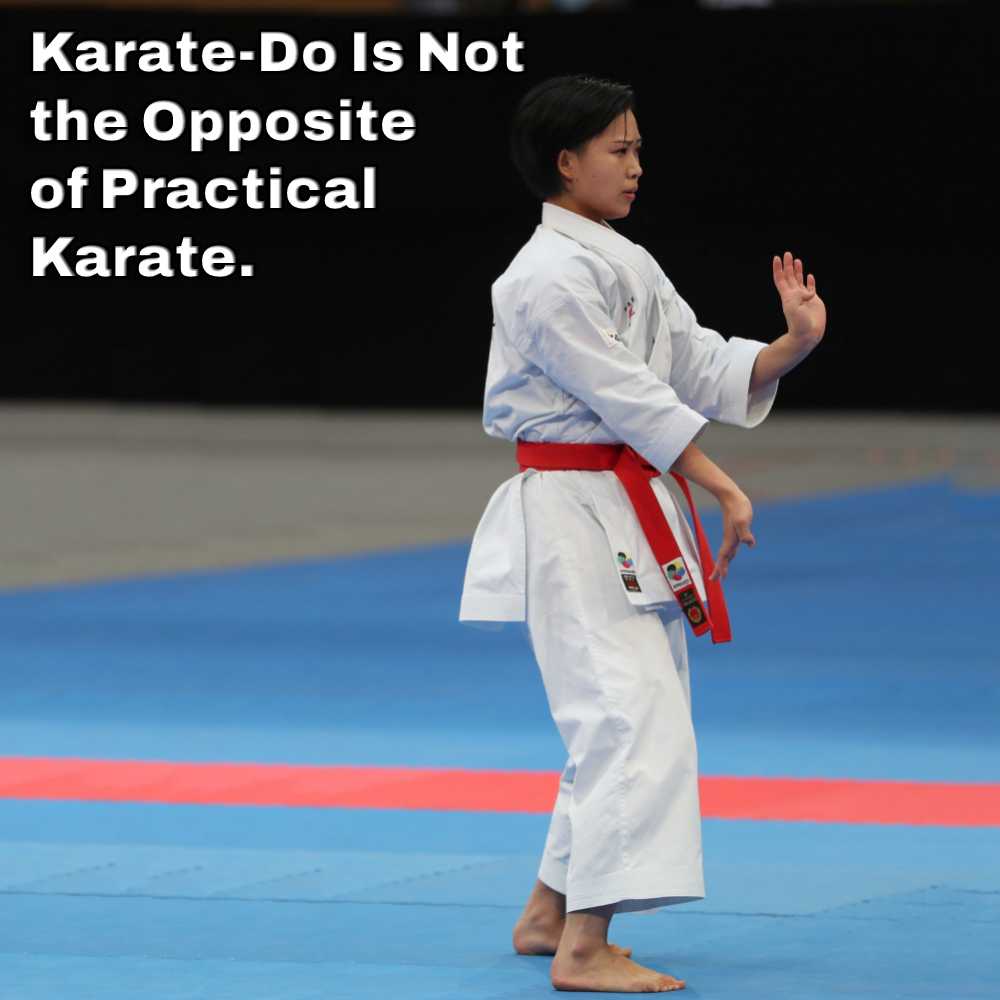
This is where kata often enters the discussion, and it tends to be misunderstood. Kata matters here not as tradition to be preserved, or choreography to be admired, but as one method of study within a broader practical framework.
.
For those interested only in fighting or sport, kata will understandably feel outdated and unnecessary. There are other training methods better suited to those goals. There is nothing wrong with that.
.
But when karate is approached as a civilian method of self-protection, kata becomes a way to examine problems and responses without having to recreate those situations directly.
.
The issue, as I have written about repeatedly, is that people focus on how kata looks rather than whether the movements serve a function. Aesthetic replaces effectiveness. Performance replaces purpose.
.
When kata is treated as something to endure in order to pass a grade, disconnected from application or intent, it will always appear pointless. That is not a failure of kata, but of how it is being used.
.
Saying that practical karate and its use of kata is useless is like looking at a book and calling it a stack of paper. For someone who cannot read, that judgment makes perfect sense. The value lies not in the object itself, but in the ability to understand and apply what it contains.
.
Finding relevance in karate today has less to do with preserving labels or arguing definitions, and more to do with understanding context. Karate has been taught in many ways, for many purposes, across different cultures and time periods. The ‘do’ was never about uniformity. It was about commitment to a path.
.
In that sense, the purpose karate serves is determined entirely by the intent placed into its practice. If you believe it’s outdated and symbolic, that is exactly what it will become for you. If you practice it as a method of personal responsibility, realism, and restraint, then that too is a valid expression of the ‘do’.
.
Karate-do is not opposed to practicality. It’s revealed by it.
.
.
– Adam Carter
.
.
Photo Credit: Natsuki Shimizu.