
Following my last article, one of the comments said that karate’s Chinese influences were based on systems that used clearly defined sequences, and therefore Okinawan kata must have been designed the same way.
.
In that article I also mentioned that many people assume kata itself is made up of clearly defined sections – that one part ends, another begins, and that obvious joins hold everything together.
.
In reality kata rarely works that neatly. The assumption that it does pushes us toward a very specific way of thinking about violence and training.
.
To be clear, I’m not saying that kata contains no sequences or structure. I’m saying that those sequences are not guarantees, and they don’t survive contact without adaptation.
.
Now, this isn’t a criticism of instructors, students, or even particular styles or methods. It’s simply an observation about how context shapes emphasis.
.
We’ve seen this before. At the turn of the 20th century, when karate was introduced into school and university systems, it changed. Teaching methods adapted to fit new settings, new goals, and new constraints.
.
The same thing happens whenever training is shaped by its teaching context. Methods naturally adapt to what can be taught safely and repeatedly, and over time order and clarity can begin to replace adaptability and judgement.
.
When certainty becomes the goal, training tends to drift toward scripted sequences and choreography, and the idea that one action reliably produces a specific response every time it’s applied. It looks organized. It feels controllable.
.
The problem is that violence doesn’t behave that way.
.
Violence does not follow a script. Anyone who has genuinely been involved in enough of it knows this. Yes, there are cues. Yes, experience sharpens awareness. But cues are not guarantees, and awareness is not control.
.
The moment two people interact, the situation becomes dynamic. That isn’t philosophy, it’s observable fact.
.
The idea that you can simply “follow a sequence” assumes cooperation, predictability, and compliance. When those are absent, which they usually are, adaptation becomes necessary.
.
If adaptation wasn’t required, it would just be choreography. This is where kata often becomes misunderstood.
.
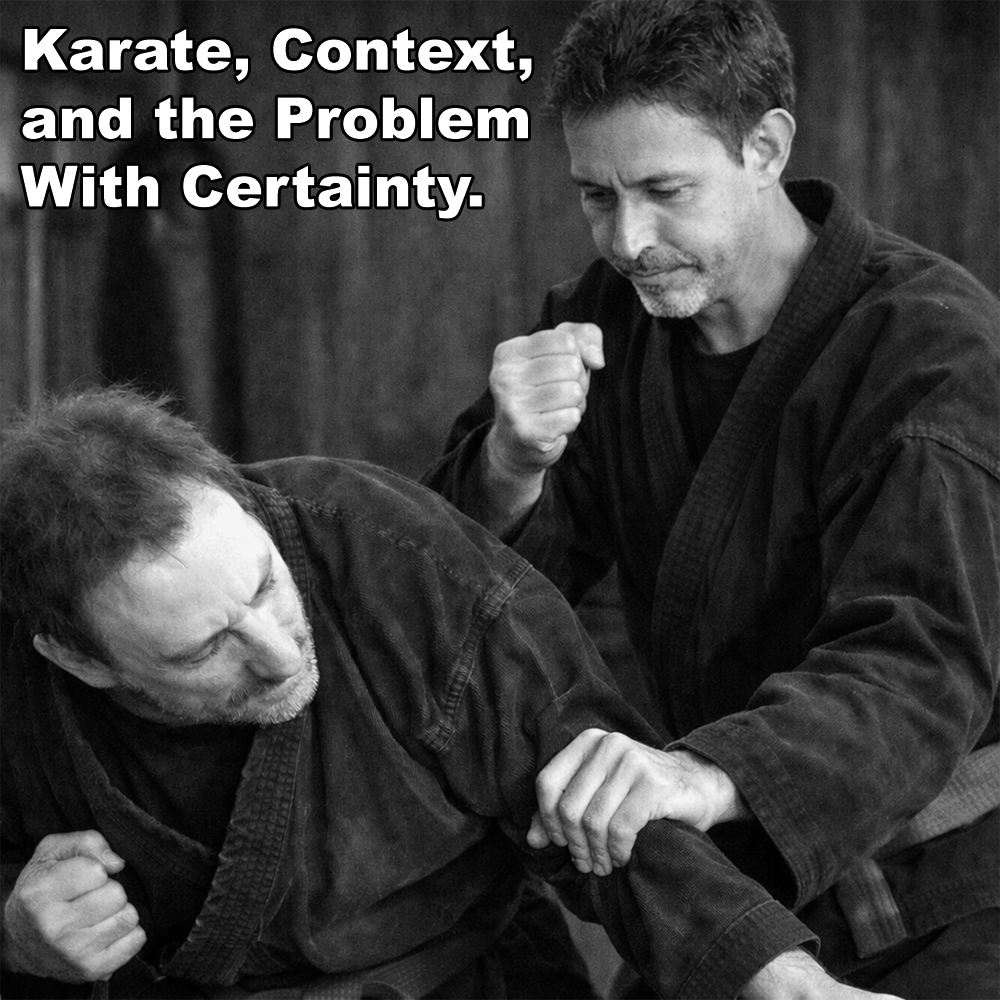
Kata isn’t a script for violence. It’s not a set of guaranteed responses. It’s a record of principles, preferences, and workable ideas that must be explored under pressure with another person. Its value lies in guidance, not certainty.
.
Some movements may be preferred actions. But if something didn’t work against a resisting human being, it wouldn’t have survived long enough to be passed down at all.
.
What we teach must be grounded in common sense. You cannot follow a script. You must adapt to changing circumstances. This is where much of the misunderstanding continues.
.
Kata must be thought of like this. It is not a way to fight; it is a record of principles and movements that allow you to choose what you need, when you need it. This is why I dislike having 100s of named techniques one for each scenario. It doesn’t reflect how violence actually behaves.
.
Violence is dynamic, and your responses have to be adaptive, resistant, and ever-changing. No single answer makes sense. What will you do if it doesn’t work and the attacker doesn’t follow the script?
.
The original comment suggested that Chinese systems were organized around known sequences. I don’t claim experience there. But the same question inevitably arises.
.
What happens when the script isn’t followed?
.
Violence has never respected our explanations.
.
.
Written by Adam Carter – Shuri Dojo