
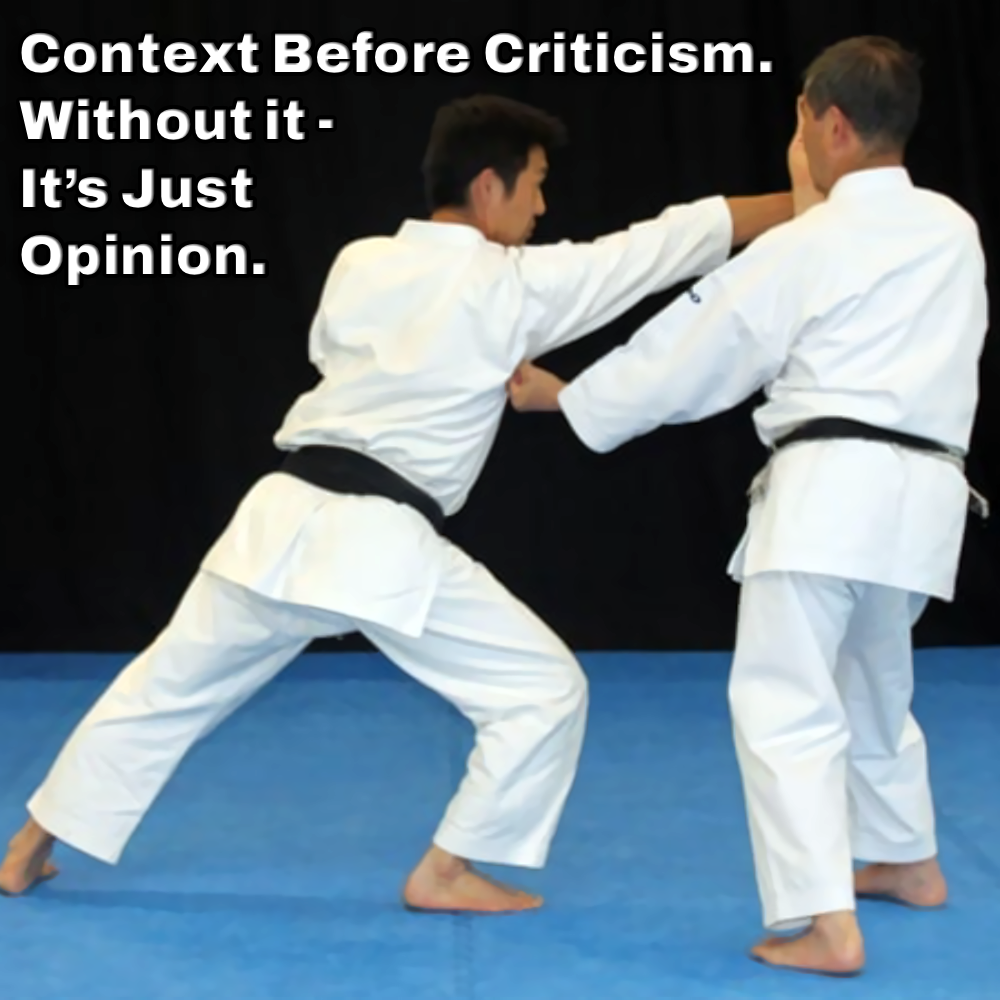
Recently there was a video clip doing the usual rounds on social media of a highly skilled and knowledgeable karate instructor being ridiculed for his defense against an ‘oi zuki’ attack.
Now I am usually the first to criticize any kind of step-kumite drill as practically useless for anything but the drill itself. However, in this case, you have to give the benefit of the doubt. Why? Because context has not been offered within the video clip.
Without the context of the whole seminar, its hard to say what the “point” of this exercise is from such a small clip. A practical lens would suggest this is pointless due to the nature of the type of attack used.
Those of us who study karate primarily as more pragmatic and practical in nature, of course can criticize this type of demonstration for its lack of reality. And we may be right. But we must accept that karate has moved on and practitioners practice for various other reasons.
My objection to this type of drill is when it is described as being for self-defense, then we can criticize and offer our opinions. But until that happens we have to hold back and understand context.
This is where everything should start when we view these things. As without it, without an explanation of the ‘why’ then the ‘how’ cannot be distinguished.
But if something is claimed to be self-defense, then it must stand up to scrutiny. However – criticism without context is just noise, not analysis.
The modern problem is that we are often judging a 10 second video clip as if it represents an entire methodology, or an entire instructor’s understanding of violence. It doesn’t. It represents 10 seconds. Nothing more.
This does not mean everything should be protected from criticism. Far from it. If an exercise is being presented as preparation for real world violence, then it must be examined through that lens. But if we don’t even know the intended purpose, then we are not critiquing training – we are reacting to our own assumptions.
Over time, karate has become many things to many people. That is not necessarily a problem. The problem begins when we stop naming those differences honestly. Karate for children is not the same as karate for competition. Competition karate is not the same as karate for self-protection. None of these are inherently wrong. But historically, karate existed because violence existed. When we lose sight of that origin completely, and begin treating everything under the same label as interchangeable, we risk turning something that was once life-preserving into something closer to a game.
Not everything in karate has to be about self-defense. Some people train for tradition. Some for competition. Some for structure, discipline, or personal challenge. That is their choice. The issue only begins when lines are blurred and training designed for one purpose is presented as preparation for something else.
Karate doesn’t become ineffective because someone practices a drill. It becomes ineffective when people stop being honest about what that drill is for.
There is also a growing habit of public ridicule within martial arts that should concern all of us. It’s easy to mock a short clip. It’s much harder to understand the full context of what was being taught, who it was being taught to, and why it was being taught that way. Without that understanding, we are not engaging in professional or constructive discussion. We are just reacting.
Karate has not simply changed. It has divided into different purposes. Some of those purposes are far removed from its original function. That is reality. But if karate is to retain any connection to its life-preserving roots, then at the very least we should be honest about what we are practicing, what it is for, and what it is not for.
Context is not an excuse. It is the starting point for any serious discussion. Without it, we are not analyzing training. We are just performing opinion.