
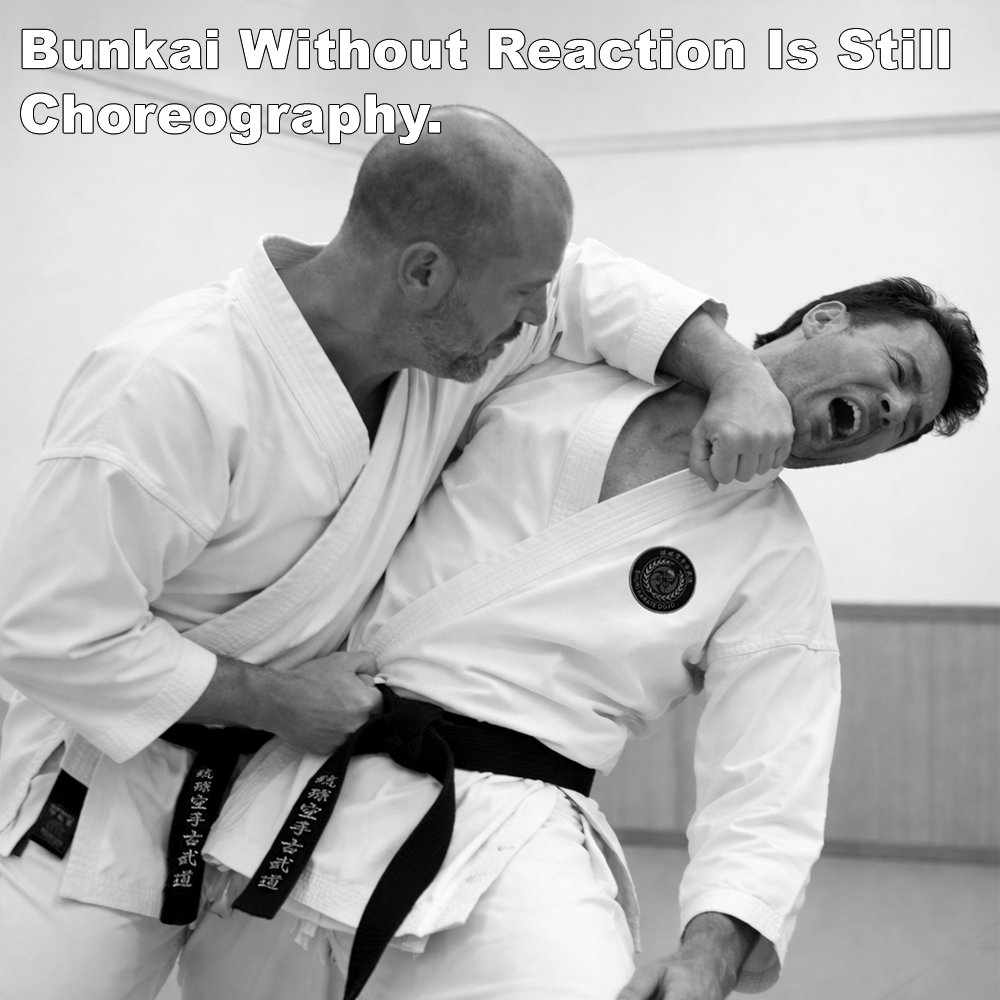
Bunkai – in some circles it is getting better. Practitioners and instructors are beginning to understand the reality of violence rather than relying on the familiar, stylized karate-type attacks. Intent, distance, and targets are improving. In others, however, there is still a long way to go.
.
But something fundamental is still missing in many of the demonstrations I see… the reaction of the attacker.
.
Even if the bunkai shown is only one or two techniques, the attacker has to react. If they don’t, then the initial technique was ineffective. That isn’t a matter of opinion; it’s a matter of cause and effect.
.
If you strike a body, there is a reaction. If you pull a limb, there is a reaction. If you twist an elbow, there is a reaction. Bodies do not stay where they were put, and people do not freeze simply because a movement was performed. So show it.
.
This is not a demand for pressure testing or full resistance. Everyone understands that demonstrations have to start somewhere. What is being discussed here is far simpler than that – the acknowledgement that human bodies respond to input. Reaction is not resistance. It’s basic physiology and behavior.
.
The attacker may no longer be in the place they started because of your input. Their posture, balance, direction, or structure will change. If that movement is not acknowledged or expressed, then regardless of how real the technique is believed to be, the demonstration has already drifted away from reality.
.
This applies long before physical contact as well. A verbal exchange creates responses, posture shifts, emotional changes, flinching, hesitation, escalation. That is where encounters begin, and where reactions first appear. Ignoring that stage removes context before technique is even introduced.
.
A physical response can also induce the flinch response, and that is not a mistake… it’s often by design. But if the disruption it causes is ignored, the bunkai again becomes tidy and predictable instead of real.
.
Choreography is not just unrealistic movement. It’s the absence of consequence. When reactions are removed, even plausible techniques become staged.
.
If reaction is not factored in, then choreography has simply been reintroduced under a different name.
.
For instructors in particular, this is worth sitting with. No matter how practical you believe your karate to be, if your bunkai does not show the reaction created by your action, it still isn’t real.
.
Technique without visible consequence is performance, not function. If the attacker does not move, change, or have their posture broken because of what you did, then what is being shown is belief rather than evidence.
.
This is not about pressure, speed, or resistance, those things come later. It is about acknowledging reaction to input, even when movement is slow, cautious, or deliberately controlled for demonstration.
.
If a demonstration cannot even show consequence at low intensity, increasing speed or resistance later will not fix it.
.
.
– Adam Carter