
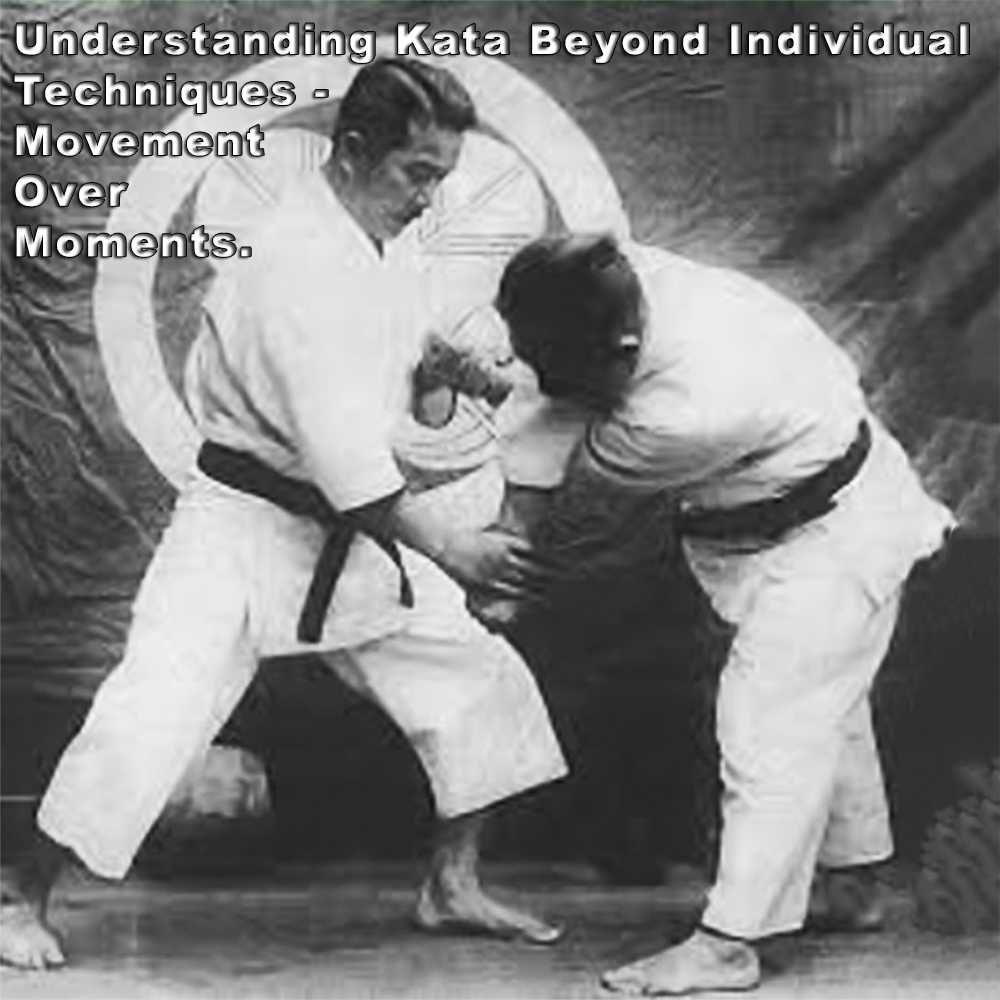
(Approx 2 minute read)
One of the most common mistakes people make when analyzing kata is treating each posture as a separate technique.
.
They stop the movement, freeze it, and ask, “What is this?” Then they move on to the next position and do the same thing. The result is a sequence that becomes a list of disconnected answers to imagined questions.
.
That approach often removes the meaning.
.
This isn’t about performing a whole kata in a fight. It’s about not breaking short sequences into isolated movements.
.
Many sequences make very little sense when viewed as individual actions. But when you stop isolating each movement and look at what the sequence is doing overall, it becomes far clearer.
.
What you often see is not a collection of techniques, but one problem being dealt with over time.
.
Repeated steps and repeated movements are rarely there to show different techniques. More often, they suggest persistence. The situation hasn’t been resolved. The person is still moving forward and still dealing with the same threat.
.
This changes how the movements are understood.
.
Actions that look unnecessary or decorative when frozen in place begin to make sense when seen as part of forward movement under pressure. Advancing, lifting the body, and protecting vulnerable targets all point toward close-range danger rather than a clean, long-range exchange.
.
When the hands come high to protect the head, that alone tells you something important. It suggests the threat is already close. It’s not about standing back and responding neatly. It’s about moving into danger while protecting yourself.
.
Movements that follow are often misunderstood because they are taken out of context. When seen as part of the same action, they don’t look like separate techniques. They look like what happens once contact has been made – clearing, controlling, or creating space to continue.
.
Viewed this way, the sequence is not teaching named techniques. It’s showing conditions.
.
A threat that is already happening. The need to protect yourself while moving forward. The reality that one action may not be enough.
.
Repetition in kata is rarely accidental. When something appears again and again, it’s usually reinforcing a situation, not a specific move. Often, the message is simple – this doesn’t end immediately.
.
Could parts of any of these sequences involve striking? Yes. Could they involve grappling or limb control? Yes. And more. That flexibility is intentional.
.
The body mechanics support different actions depending on what is happening in front of you. Kata is not giving a single answer. It’s describing a problem.
.
This is why asking, “What technique is this?” often leads people in the wrong direction.
.
Many parts of kata are not techniques at all. They are set-ups, unbalancing, creating angles, moving in or out – moments in a fight that hasn’t resolved yet.
.
And that is where, in my experience, much of kata lives.
.
.
Written by Adam Carter – Shuri Dojo
.
.
Photo Credit: Yasuhiro Konishi and Kenwa Mabuni