
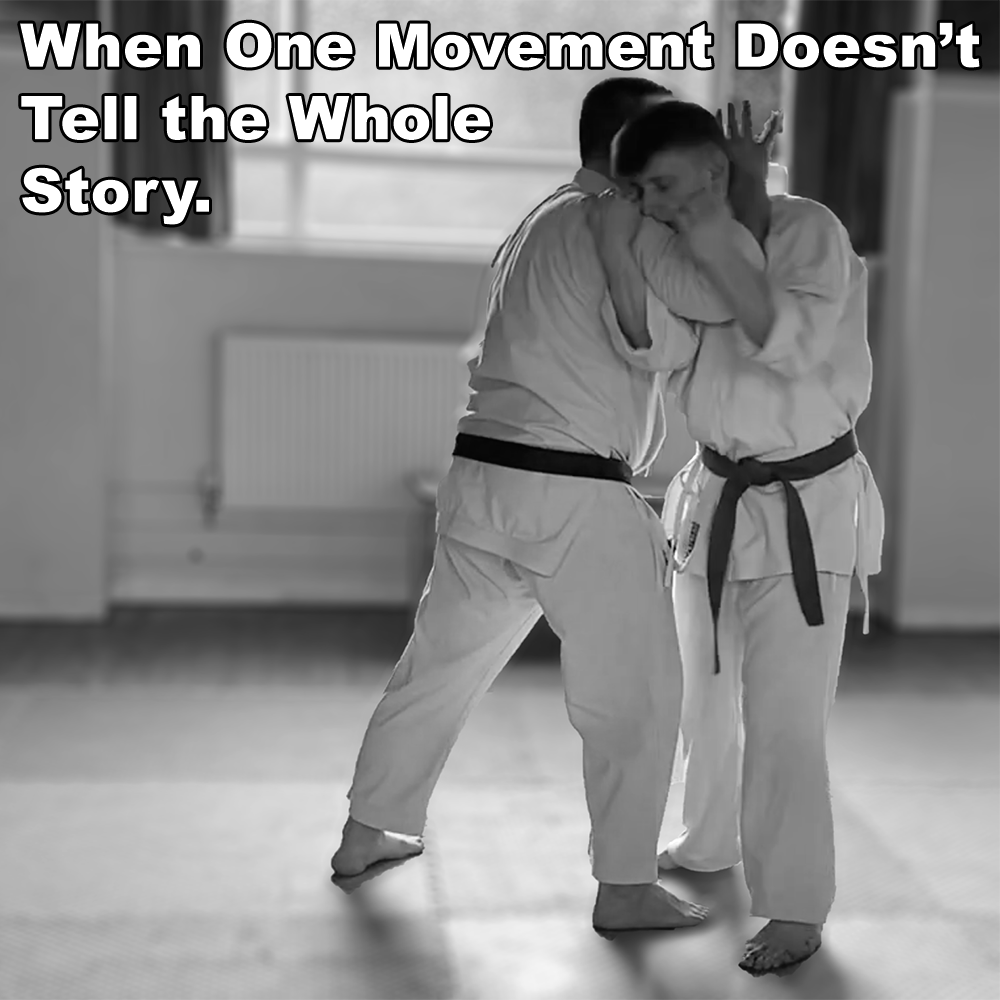
(Approx 1 minute 55 second read)
Some time ago, while teaching at a Kyokushin dojo, a nidan asked me about the meaning of a particular movement in Kanku.
.
It wasn’t a version of the kata I had practiced before, but that didn’t really matter. What interested me was the question itself, because it highlighted a common problem when people try to interpret kata by isolating individual movements.
.
When you pull a single motion out of a kata and examine it on its own, it can easily become misleading. Very often, the movements before and after it tell you far more than the technique itself.
.
Transitions, posture, balance, direction, and how the body enters and exits a position all offer clues about intent. Those details disappear when the focus narrows too much.
.
Kata like Kanku, and any other for that matter, make more sense when viewed as a series of flowing movements rather than a collection of separate techniques.
.
While individual movements can be trained and applied independently, the way they connect often reveals how they actually function.
.
That doesn’t mean applications must follow the kata from start to finish in strict order. The solo form isn’t a script for a fight. However, observing how movements relate to one another can help clarify what a technique is doing and why it exists.
.
What appears to be a punch could just as easily function as a grab, a strike, or a control, depending on how you enter or leave the position.
.
This is one of kata’s strengths. It isn’t a set of rigid instructions. It’s a toolbox. The movements are there to be adapted as understanding develops.
.
When you approach kata this way, possibilities open up. A movement later in the kata can shed light on something earlier, and vice versa. Kata isn’t always tied to a fixed sequence of applications, even though the solo performance itself never changes.
.
The important step is getting past the idea that movements must always look the same in application.
.
Real conflict is full of variables. The aggression of the attacker, height differences, angles, timing, what happened just before, how the opponent reacts, it all matters. Application must adapt to circumstances.
.
Instead of concentrating on the label of a technique, examine the path of the movement and pay attention to what the function may be beyond that label.
.
Kata is more than a historical record. It’s a living method of learning. When you stop fixating on individual techniques and start looking at the whole movement from beginning to end, not the kata as a sequence, but the movement itself, the connections become clearer.
.
That understanding leads to flexibility, depth, and a far more realistic preparation for real-world application.
.
.
Written by Adam Carter – Shuri Dojo
.
.
Photo Credit: With thanks to Daniel Pyatt sensei